



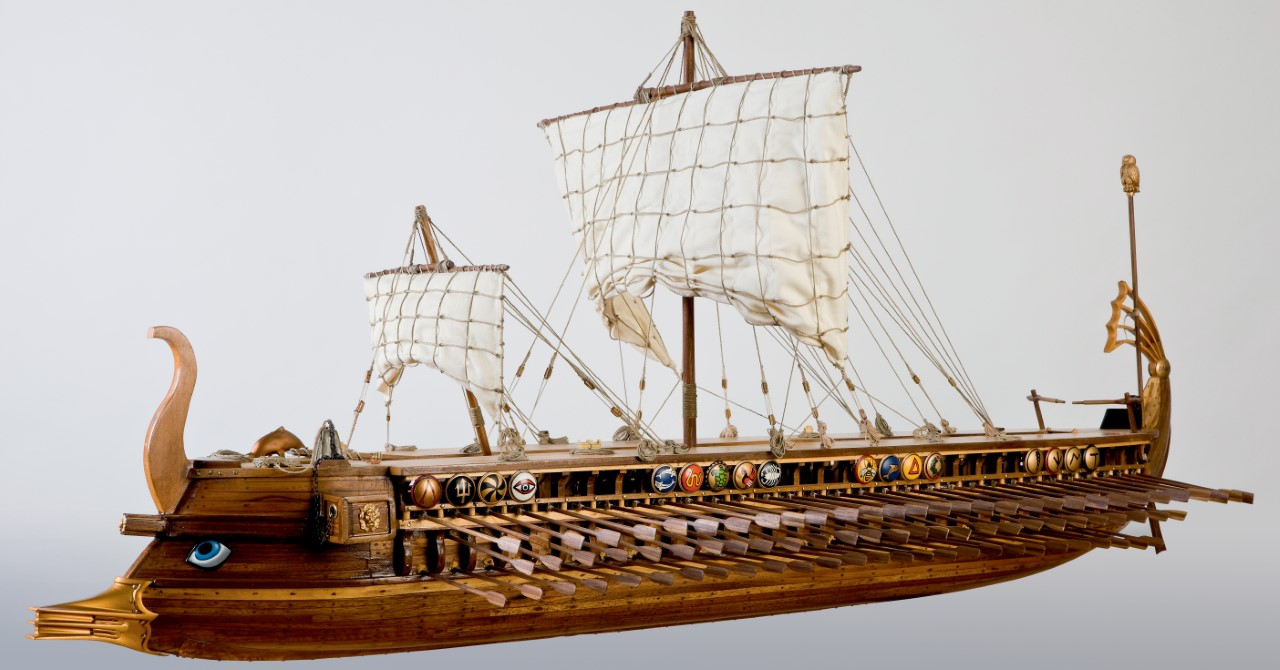
The first type, the twenty-oared icosakontor, was a broad barge, which was manned by 20 eretes.
The second type was the pentakontor, a ship with 50 oars, and it was used for a variety of purposes, among which was the fight against piracy but also military operations.
The pentakontor, which originally had one row of oars, was later shaped into a ship with two rows of oars. Thus, increasing the levels from which the eretes rowed had the effect of reducing the length of the ship from 35 meters to about 25 meters.
The smaller dimensions result from the excavations carried out in Heraio, Samos, which brought to light two stone structures, each of which consists of 9 parallel bearings, with length decreasing towards the two ends, forming the plan of a ship. The dating of the construction is before 650 BC, and it is believed that a pentagon with two rows of eretes was placed on these seats.
Another innovation was the invention of the outrigger, which made it possible to place the oarsmen outside the peritoneum of the boat, on a bearing known as the ‘thranos’. From the thranos, the rowers of this level were called “thranitai”.
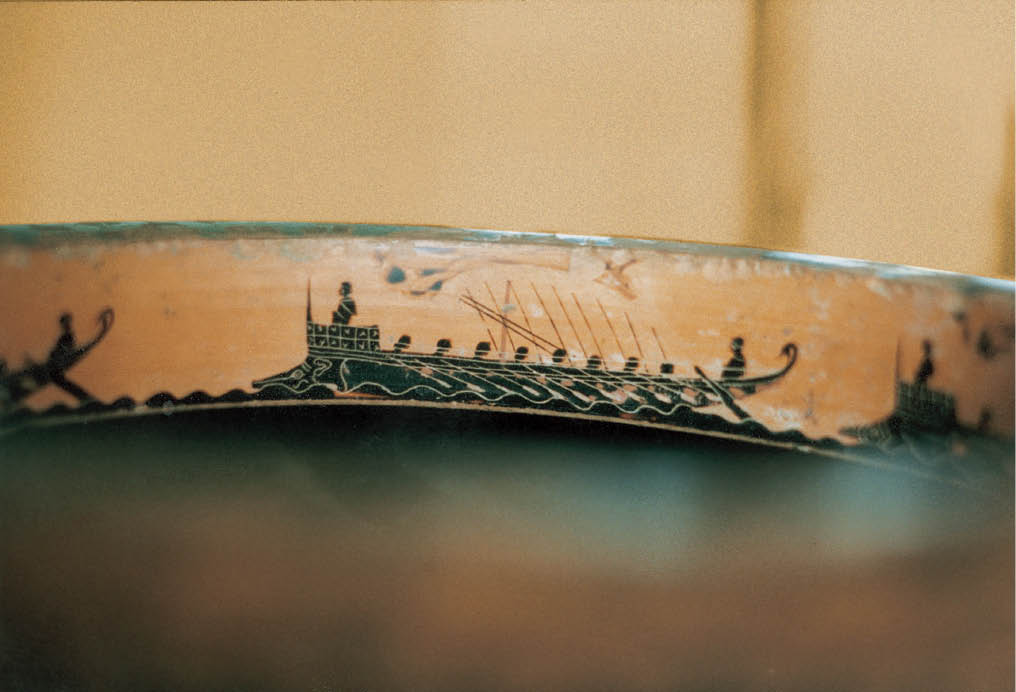
It is estimated that the abuse is attributed to design in the form of a wide band in representations of ships, depicted on vases of the 8th century BC. The kylix of the Louvre Museum, no. F123, attributed to the painter Nikosthenes, and dated around 530 BC, shows four identical ships, in which the abuse is attributed with two horizontal bands, below which are drawn the skylights, through which the oars of the scales.
A third innovation in shipbuilding was the development of the piston in the bow of warships, which enabled them to sail faster, due to less resistance while sailing, but also more effective defense and attack. In the Mycenaean ships, a small projection can already be seen at the end of the keel, which in the representations of ships of the geometric period acquires a different shape, while increasing in length.
Useful information on the use of the piston as an offensive weapon, as early as the 6th BC. century, the ancient writers provide us.
The – piston according to Herodotus – was used for the first time as a weapon in the naval battle of Alalia between the Phocaeans and the united fleet of the Carthaginians and Tyrrhenians. The Phocaeans of Ionia, when they were besieged in 564 BC. from the Persians, they abandoned their city and fled with their ships to Alalia in Corsica.
There they soon broke with the Tyrrhenians, who, having allied themselves with the Carthaginians, declared war against them. The two allies were equipped for this purpose with 60 ships each.
But the Phocaeans, equipping 60 ships, hastened to face the enemy in the Sardonian Sea. During the naval battle that took place in 540 BC, the Phocaeans won a decisive victory, since 40 of their ships were destroyed, and the rest were rendered useless because their pistons were twisted. From this description of the ancient historian we can conclude that the naval battle was conducted using the piston mainly. However, the ships that participated in this naval battle were not triremes, since Herodotus in his account does not mention it.
The first written testimony about the trieri and the piston is given to us by the poet Hipponax of Ephesus, who was exiled to Clazomenes in 542 BC. But Herodotus also mentions that Polycrates, tyrant of Samos, sent the citizens suspected of rebellion to Cambyses with 40 triremes. This episode dates back to 525 BC. Thus, the existence of the trinity already in 525 BC. it is certain. Bearing in mind that in the naval battle of Alalia, in 540 BC, triremes were not used, it is concluded that the trireme began to be used by the Greek forces between the years 540 and 525 BC. At the end of the 6th century BC, the Greek warship builder did not look to building ships to carry more warriors, but to the power of the ship, its speed, the durability and the equipment of the ship to meet the tactical of embolization.
The Ionian revolution and the use of triremes
When the Ionians revolted against the Persians in 499 BC, they already had fleets of many triremes, the construction of which had probably been financed by the Persians in the past, as part of their expansionist policy. Among the first successes of the Ionians, during the revolution, was their victory over the Phoenician fleet, off the coast of Cyprus.
It seems that the Phoenicians, after building new triremes, appeared with 600 ships in 494 BC. before Miletus. Characteristic is the passage of Herodotus, which mentions that the Athenians, in order to help the Ionians, sailed to Miletus with 20 ships, bringing with them 5 Eretrian triremes. From the above it follows that the 20 ships of the Athenians were not triremes, also that before 480 BC. Athens was not a naval power to be reckoned with.
In 494 BC, in the naval battle of Ladis, the Ionians lined up 353 triremes under the leadership of Dionysius, who every day led the ships into the open sea lined up in a line (on a horn), i.e. in a production line, as we say today , and he trained the oarsmen in the tactics of the crossbow and trained the hoplites. The Ionians participated in gymnasiums for seven days, but on the eighth day they decided not to exercise. Immediately after the start of the naval battle near the island of Ladis, the Samians left with their ships.
However, 11 triarchs decided to participate in the fight, fulfilling their patriotic duty. The Samians were followed by the Lesbians with their own ships, which numbered 70. Thus, the burden of the naval battle was borne by Chios, which participated with 100 triremes.
In each ship of Chios, in addition to the oarsmen, there were 40 “passengers” on board, that is, elite armed citizens in order to fight. The Chios, applying the tactic of intercepting and reversing, destroyed many Phoenician ships, but lost almost all of their own, since the Phoenicians had the upper hand.
The use of the piston – The aggressive maneuver of the manifold
The aggressive maneuver of the triremes with the aim of ramming the enemy ship, was the cross and reversal. The term diekplou is found for the first time in Herodotus, in the description of the naval battle of Ladis. Although this passage does not give a precise description of the gap, we are able to conclude that this maneuver consisted in the mass penetration of the attacking triremes in a line of production through the gaps in the enemy line, which had formed a front.
The next maneuver of the attackers was the reversal, i.e. direct turning of the triremes, which had penetrated the enemy line and were between the enemy, for the embolization of the opposing ships, on the sides. The main countermeasure against the schooner maneuver was obviously the exact observance of close formation by the enemy, but this was difficult in unpracticed fleets.
As for turning, the only antidote lay in the immediate and cumulative turning of the opposing ships, so that they could present their bows as quickly as possible to the triremes that had penetrated their ranks. In addition to the tactic of interception and reversal, there were cases when the attackers applied the tactic of circumnavigation, that is, the circular formation around the enemy fleet.
The march formation was then, as now, the combination of the production line and the front line, which allowed for easy and rapid deployment in battle.

Embolization-Pistonation naval battles
Naval battle of Artemisium
Herodotus, in the narration of the skirmishes that preceded the naval battle of Salamis, in 480 BC, mentions that the Greeks who were with their ships in Artemisium, when they found that the enemy ships were not sailing against them, moved against the barbarians wishing to test the combat and tactics of the intercom. But the Persians, observing that the Greeks sailed against them with few ships, sailed against them, believing that they would easily defeat them, since they had twice as many ships and faster.
With this conviction, the Persians circled them to put them in the middle, but by this maneuver they exposed the sides of their ships. When the first point of battle was given to the Greeks, they turned the prows of their ships against the barbarians and formed a circle with the sterns towards the centre. When the second signal was given they began the battle, attacking the enemy ships and ramming them. 30 enemy ships were sunk and afterwards, the Greeks sailed for Artemisium, and the Persians for Afetes.
During the night following the first collision, heavy rain fell and thunder was heard throughout the night. The Persians, who had been ordered to sail around Euboia at night, were found by bad weather in the sea, with the result that many ships fell on the rocks. The next day, 53 ships arrived from Piraeus, thus strengthening the Greek fleet. While the Persians remained at Aphetes, the Greeks attacked them and fell upon the ships of the Cilicians, which they destroyed, and then returned to Artemisium.
On the third day of the conflict, the Persians decided to take the initiative and sailed from the Aphetes at noon, with their entire fleet. The Greeks kept their ships at Artemisium so that they would have the advantage of the narrow space. The Persians lined up their ships in a line, but so did the Greeks, resting on the land’s ledges. When the conflict began, the Persian ships, which were large, hampered in their movements, nevertheless persisted in the fight. During the naval battle, losses were heavy for both sides, but heavier for the Persians.
Battle of Salamis
The naval battle of Salamis is narrated mainly by Herodotus, from whom we derive the information about the tactics used. After the naval battles at Artemisium, the Greek fleet moved towards Salamis and was reinforced by ships that arrived from the port of Troizena, Pogona.
According to Herodotus, the Greeks had 378 triremes, which were gathered in the Gulf of Salamis, which today is called Palukia, west of the small island of Agios Georgios. And the Persians, who had occupied Attica, according to Aeschylus, had about 1,000 ships, which had anchored in the bays of Western Attica, while the Greeks – according to the same tragic poet – had 300 triremes at their disposal. The Persians, believing that the Greeks would try to escape, as soon as night fell sent one of the four squadrons of their fleet south of Salamis, to prevent the escape of the Greek fleet. Two other Squadrons, of 250 ships each, sailed in the channel between Salamis and Attica, sailing left and right of the island of Psyttaleia.
In the morning, the two Persian squadrons, with tired crews, after rowing all night, proceeded towards the island of Agios Georgios, without noticing the Greek fleet that was in Salamis. The Greek ships, with rested crews, set off at dawn towards the narrow point of the channel, 1,200 meters wide. At this width, only 80 triremes could be placed side by side, forming a single front line. The rest of the ships followed further behind. As the two Persian Squadrons sailed northward, they were surprised to hear the Greeks, who were sailing towards them, singing together the war hymn:
«Ω παίδες Ελλήνων, ίτε ελευθερούτε πατρίδ’, ελευθερούτε δε παίδας, γυναίκας, θεών τε πατρώων έδη, θήκας τε προγόνων. Νυν υπέρ πάντων αγών». (“O children of the Greeks, if you liberate your country, liberate the child, the woman, the gods and the fathers, the thea and the ancestors. Now in favor of all games”).
While the center and left horn of the Greeks were opposite them, blocking the enemy’s march, the right horn of the Greek fleet, from the front line, began to move forward, to form a line of production and surround the Persian fleet.
The Persians were taken by surprise and remained inactive at first, because they had not imagined that the Greeks would decide to fight. Soon the Greek triremes, following the starboard ships, hastened to complete the circling maneuver against the enemy ships.
This maneuver was intended to implement the diversionary tactic. Although the Greeks’ ships were slower than the enemy’s, they had managed to maneuver admirably, while the enemy’s had fallen into confusion, since they were unable to advance, but also to move freely due to the narrowness of the space.
Then the ancient historian states that the Greek ships, attacking with their copper-mouthed pistons, began to break the oars of the Persian ships and ram them into the sides, causing them to be flooded with water. Enemy ships were soon disabled or sunk, taking rowers and warriors with them. The total destruction of the enemy fleet resulted in the sea being filled with corpses and broken ships, while the shores and dry lands were covered with drowned Persians.

Naval battle of Nafpaktos (Lepado)
Thucydides, when describing the war events of the Peloponnesian war, mentions that in the winter of 430 BC. Phormion was sent by the Athenians with 20 ships to the Corinthian gulf, and he used Nafpaktos as a base to blockade the gulf. In 429 BC, the Corinthians and their allies had decided to send a Squadron of ships to Acarnania to prevent the Acarnanians from joining the Athenians.
Indeed, while the Corinthians and their allies were sailing along the southern shore of the gulf, they were perceived by Phormion, who did not move against them while they were in the gulf, but waited for them to come out in order to attack them on the open sea.
The Corinthians and their allies were not prepared for a naval battle, but for land military operations in Acarnania. Because they had 47 ships, they believed that Phormion would not dare to attack them. But as soon as they came out of the bay, they found that the Athenian ships were sailing parallel to them and opposite them, when they did not begin to pass from the side of Patras to the opposite land, they realized that the Athenians were sailing against them. Then they decided to fight in the middle of the sea, which separates the Peloponnese from the mainland.
And the Peloponnesians arrayed their triremes in a circle, with the prows outwards and the sterns inward, so as not to allow the adversaries to sail, while they placed the small ships together with the 5 that were the best, in center of the circle. And the Athenians, having lined up their ships in a production line “one sail at a time”, swarmed their opponents, forcing them to shrink and be constantly confined to a smaller space. This was because the Athenians were sailing around them, giving the impression that they would attack at any moment.
However, Phormion had given orders that they should not attack, because he believed that the enemy’s warships would be forced too close to each other, and that those in the center would cause a disturbance, also that the wind, which usually blew in the morning from the bay out, would split their line. But when the wind began to blow, as was expected, and the ships of the Peloponnesians, which had been stranded, began to collide with each other, the men on board used poles to keep them apart.
Then the noise caused covered the orders and orders of the sailors, and the oarsmen, being inexperienced, were unable to raise the oars and bring them back, so that the ships remained unruly. According to the expression of Thucydides: “Infinite men are governed by the unfathomable and providential.”
While this was going on, Phormion gave the signal for the attack, and the Athenians first sank (dive) a strategida, and then began to destroy (spoil) every other enemy ship, against which they attacked in order to ram it. The Peloponnesians, unable to offer resistance, began to flee, pursued by the Athenians, who captured 12 ships and most of the men on board. For this victory they set up a trophy near Antirrio.
After the defeat, the Peloponnesian fleet gathered at Kyllini. There, after receiving reinforcements, he again sailed to the Corinthian. The purpose, which now numbered 77 triremes, was the destruction of Phormion’s fleet which had only 20. While the Peloponnesians had advanced near Rio of Achaia, Phormion approached Rio the Molykricus. After 6-7 days the generals of the Peloponnesians decided to have a naval battle. The Peloponnesians set sail at daybreak, having drawn up their 77 ships in four lines in the direction of the gulf, preceding the right horn, on which they placed 20 of their fastest ships. Then Phormion also sailed parallel to the land in the direction of Nafpaktos, which was not guarded.
When the Peloponnesians found that Phormion’s 20 ships were sailing into the bay, one behind the other, they attacked the 20 Athenian ships and captured 9 of them, while the remaining 11 managed to escape. The Peloponnesians tied ropes to some of the empty ships whose sailors had gone ashore and tried to tow them away. But the Messenian hoplites, who were on land, after entering the shallow waters, climbed aboard the ships, fighting on the decks, cut the ropes and freed them.
In the meantime, the 20 fast ships of the right horn began to pursue the 11 ships of Phormion, which rushed towards Nafpaktos. All the Athenian ships except one managed to escape to Nafpaktos, and turned their prows towards the enemy to defend themselves.
When a Lefkada ship, which was ahead, pursued Phormion’s ship, which had fallen behind, it hid behind a barge and at the right moment rammed the pursuing ship. After this success, the oarsmen of some ships stopped rowing to await reinforcements, while others threw their ships into shallow water. Phormion’s ships then counterattacked, capturing 6 enemy ships and removing their own ships that were trying to tow.

Naval battle of Cyzicus
The naval battle of Cyzicus is described by two ancient authors mainly. In 410 BC, the reinforced fleet of the Athenians, which numbered 86 ships, moved from Sisto in the Hellespont to Prokonnisos. There the Athenians were informed that the Lacedaemonian admiral Mindaros and the Persian Pharnavazos had captured Cyzikos.
Then the Athenians landed a military force in the region of Cyzicus, and then divided the fleet into three Squadrons, under Thrasybulus, Theramenes, and Alcibiades.
Alcibiades, with a Squadron consisting of 20 triremes, sailed to Cyzicus in order to challenge Mindarus off the coast to a naval battle, while the other two Athenian generals, Theramenes and Thrasybulus, abbots of the other two Squadrons, were placed on the left and right of Alcibiades, taking cover from rain, thunder, and darkness, they waited hidden on the neighboring promontories, to prevent the retreat of Mindarus. When Mindarus was informed that an Athenian fleet of 20 triremes had appeared off Cyzicus, he set sail with 80 ships against it, considering it easy prey.
At first, Alcibiades, pretending to retreat, fled, while the Peloponnesians pursued him. When the Peloponnesians moved away from the shores of the city, the triremes of Alcibiades, performing a 180-degree reversal, moved against Mindaros, while the other two Squadrons of the Athenians, performing a double circumnavigation, blocked his retreat towards Cyzikos. Then Mindaros moved towards the coast of Clera, hoping for the help of Pharnavazos. After the Athenians disembarked on land, a battle was fought, in which Mindaros was killed. The Athenians, after setting up two trophies, left Cyzicus, taking with them the ships they had captured, except the ships of the Syracusans, who preferred to burn them rather than hand them over.
The naval battle at Arginousse
We get the information about the naval battle at Argineuse from Xenophon. In the spring of 406 BC, Lysander handed over command of the fleet to Callicratides, who besieged Conon in Mytilene.
As soon as the Athenians were informed of the events, they sent 110 ships to help. These, together with the allied ships, gathered at Samos. When Kallikratidas was informed that help was there, after leaving 50 ships under Eteonikos to guard Cononas, he sailed with the remaining 120 to Cape Malea in Lesvos, where he dined.
On the same day, the Athenians also dined at the Arginouses, which are located between Lesvos and the coasts of Asia Minor. Kallikratidas, as soon as he learned that the Athenians were in front of him, sailed by night to attack them, but heavy rain and thunder prevented him, so that he approached the Argineuses at dawn. The Athenians sailed first with their left horn as follows: Aristocrates, holding the left horn, led with 15 ships, followed by Diomedes with 15 more, and behind Aristocrates was Pericles and behind Diomedon was Erasinides. The last two seem to have had under their command 15 ships each.
Near Diomedon the Samians were lined up with 10 ships in a line, immediately after the 10 ships of the Admirals were lined up in the same way, and behind them were the 3 ships of the admirals and some allies. On the right horn was Protomachus with 15 ships and near him Thrasyllos with 15 more.
Behind Protomachus was Lysias with 15 ships and behind Thrasyllus Aristogenes with as many. They had lined up in this way to prevent the enemy from crossing because their ships were slower. The Lacedaemonian ships were all arranged in a line.
It seems that this fleet consisted of eight squadrons of 15 ships, for if 120 ships were placed one behind the other, then a distance of 5 km was required. They were apparently arranged in this way, because the Lacedaemonians looked to the tactic of the ship and periplu, since their ships were faster. Kallikratidas was in charge of the right horn. The Peloponnesian admiral was advised by Hermon Megareus to withdraw, because the Athenian triremes were more numerous.
The two fleets battled for a long time, until Callikratidas fell into the sea and perished, while Protomachus with the right horn defeated the left of the Lacedaemonians. Then many Peloponnesians fled to Chios and others to Phocaea, while the Athenians returned to Arginous.
The Athenians lost 25 ships and their crews, while the Peloponnesians lost 9 out of 10 Laconians and their allies more than sixty.


