



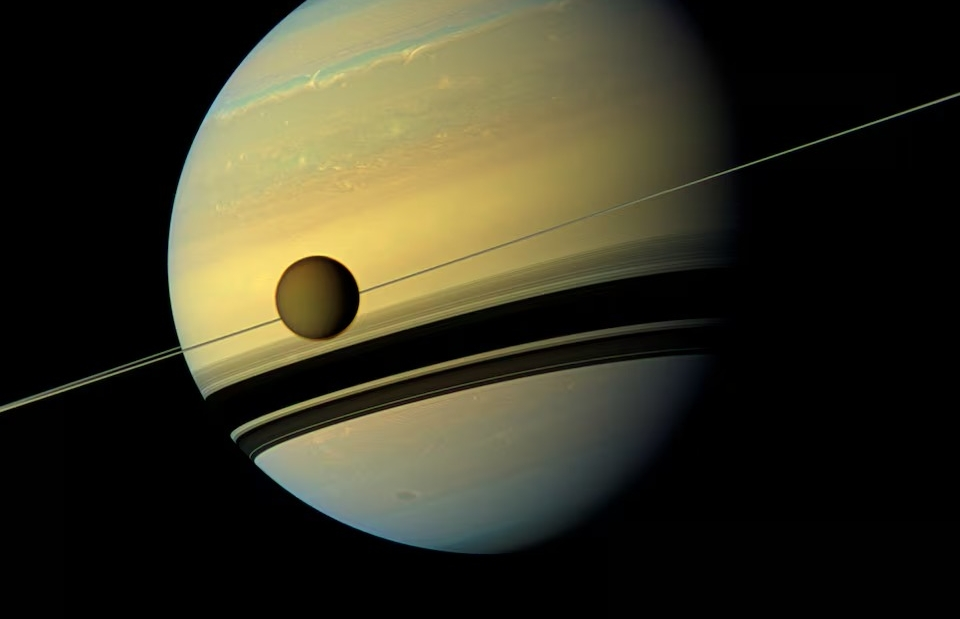
NASA’s Cassini mission, which explored Saturn and dozens of its icy moons, including Titan, ended with the spacecraft’s suicide dive into the planet’s atmosphere in 2017.
But the oceans of data transmitted by Cassini in its 13-year mission are still being studied by science.
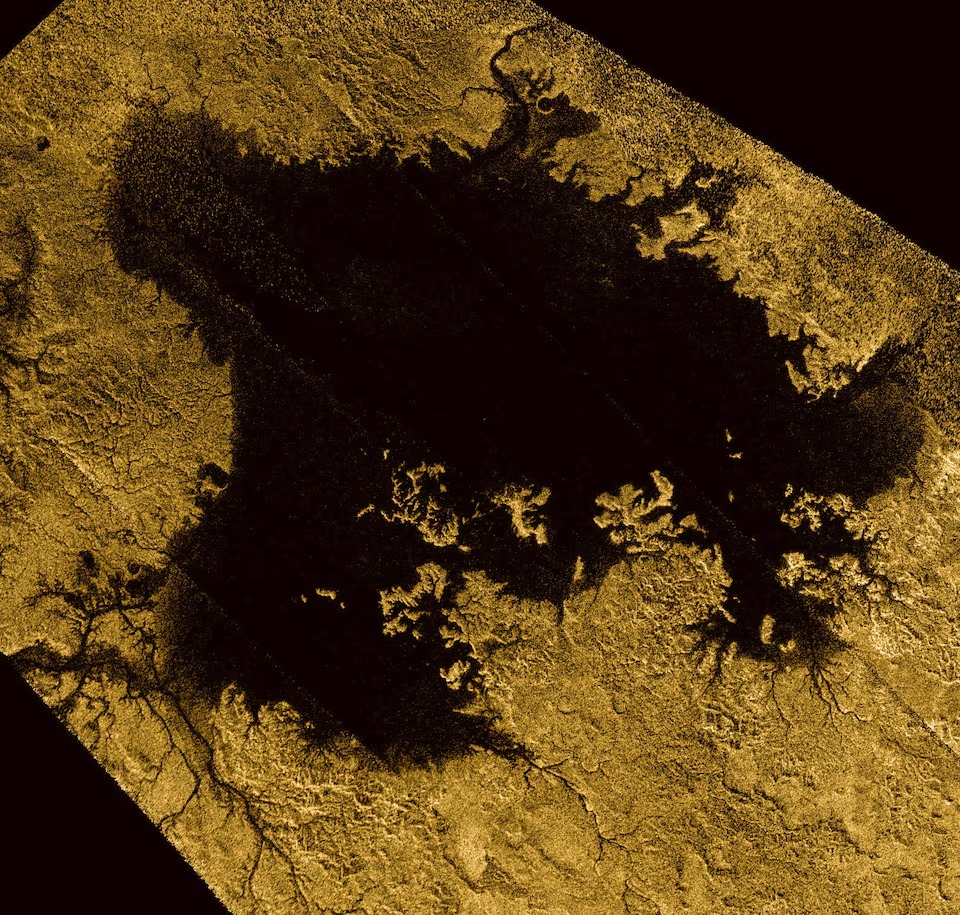
Cassini’s radar observations are now revealing new details about the liquid hydrocarbon seas of Titan, the second largest moon in the Solar System after Jupiter’s Ganymede, larger than the planet Mercury.
Shrouded in a thick, opaque orange atmosphere, Titan is the only known world beyond Earth to have seas, but they are not made of water but of liquid methane and ethane, components of natural gas.
The new study (“Surface properties of the seas of Titan as revealed by Cassini mission bistatic radar experiments“), published in Nature Communications, involves three seas near Titan’s north pole:
- Kraken Mara, the largest body of liquid, with an area comparable to the Caspian Sea;
- Ligeia Mare, second largest with an area as large as America’s Lake Superior; and
- Punga Mare, comparable to Lake Victoria in Africa.
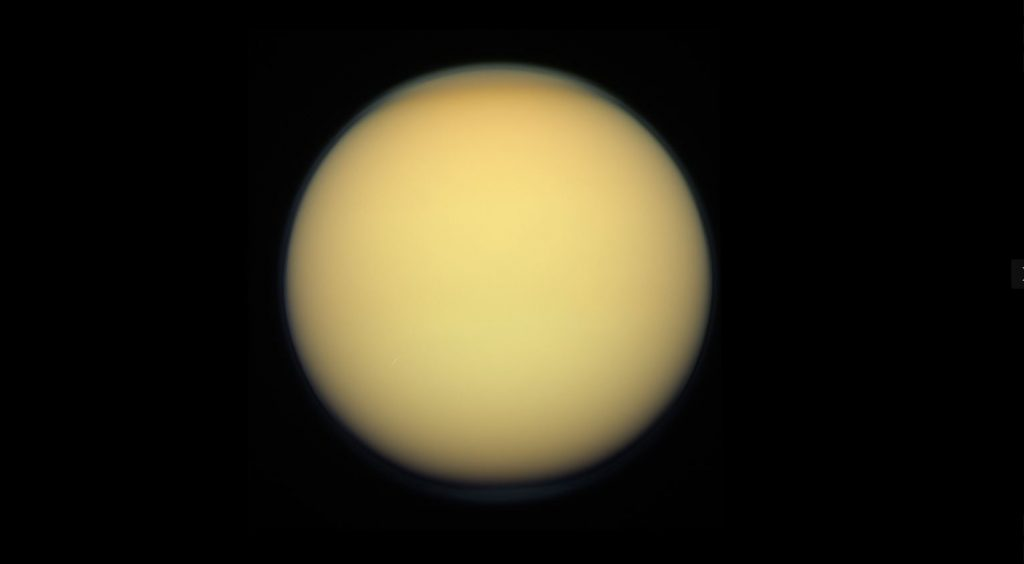
The chemical composition of these seas – more methane or ethane – was found to vary with latitude. The study also records the distribution of ripples, which indicates the existence of tidal currents in river deltas.
Titan, 5,150 kilometers in diameter, is the only known place outside Earth where liquids fall as rain from clouds, flow as rivers that end up in lakes and seas, where they evaporate to start the hydrological cycle all over again.
On Earth it rains water, on Titan it rains methane.
Cassini’s data indicate that Titan’s rivers transport pure liquid methane, which eventually mixes with the ethane prevailing in the oceans, much as freshwater in Earth’s rivers mixes with seawater in estuaries.
“Titan’s seas are pulled by Saturn’s strong gravity, like our own seas, and the tidal range on some coasts can be as much as a foot [30 cm]. “Because the tidal period—Titan’s day—is long, as long as 16 Earth days, the tidal cycle is slow, so tidal currents are generally weak,” said Ralph Lorenz of Johns Hopkins University, a member of the research team.
The analysis was based on “bistatic” radar data collected by Cassini during three close passes in 2014 and 2016. The craft aimed the beam at Titan’s surface and the reflections were recorded by an antenna on Earth.
This method offers richer data than “monostatic” observations, in which radar reflections were recorded by Cassini itself.
“This is possibly the last untouched data set left to us by Cassini,” Pozziali commented.
Potentially, Titan could harbor some kind of microbial life, as a subsurface ocean of liquid water may be hidden beneath its icy surface.
“Are heavy organic molecules produced in Titan’s atmosphere probiotic in nature?” Pozziali wondered.
“Has the organic material ever come into contact with liquid water? We believe that interactions of this kind may have led to the appearance of life on our planet by producing molecules that can generate energy or store information.”
