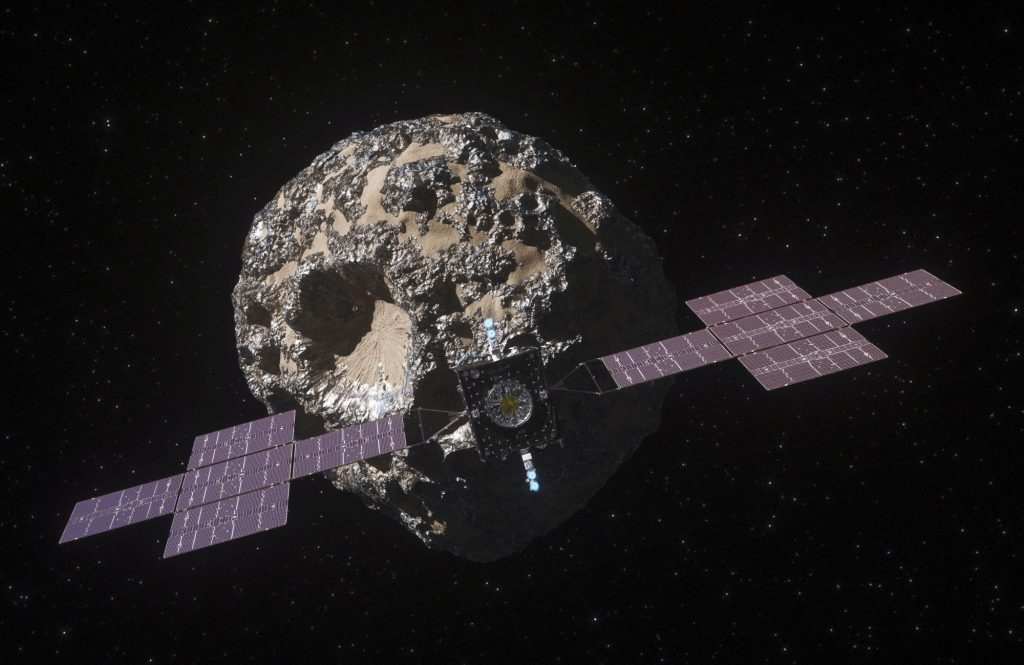
After resolving technical issues that led to a year-long delay, NASA is preparing to launch the Psyche mission in the fall to explore a highly unusual asteroid of the same name, which is estimated to contain ten million trillion worth of metals dollars.
The $1.6 billion Psyche mission is the first to examine a metallic object in the Asteroid Belt, between the orbits of Mars and Jupiter.
It was originally scheduled to take off last summer, but the launch was delayed due to problems with the flight software, which will keep the craft in the correct orientation and keep its antenna pointed at Earth.
The independent panel that reviewed the plan estimated the mission would be ready for launch in October, NASA said this week.
Asteroid 16 Psyche, with a diameter of around 226 km, is one of the largest objects in the Asteroid Belt.
Observations with ground-based telescopes and interplanetary radars have revealed that, unlike most other asteroids composed of rock and ice, asteroid Psyche is composed almost entirely of metals—iron, nickel, and possibly smaller amounts of gold and cobalt.
The iron it contains is estimated to be enough to meet every need on Earth for several million years.
The most likely explanation for the asteroid’s unusual composition is that it is the core of a medium-sized planet that was destroyed in violent collisions in the early stages of the Solar System’s evolution.
In large bodies such as the planets, the heavy metals gradually sink to the center, leaving the lighter rocks at the surface. At the center of the Earth, for example, lies an iron-nickel core about the size of Mars.
Due to its large size, the asteroid Psyche is on the list of candidate worlds for future space mines.
Of course, NASA did not plan the mission for financial gain: the study of the iron asteroid is expected to provide evidence on the evolution of the Solar System and the formation of rocky planets like Earth.