Proposed EU sanctions on Russian Liquified Natural Gas (LNG) will mark the first step towards phasing out Russian gas from the European bloc by 2027, further complicating Moscow’s LNG expansion plans her.
However, the European Union remains unlikely to significantly curb Russian gas imports until the new global LNG supply becomes fully operational in 2026. According to media reports, the European Commission is drawing up plans to impose restrictions on Russian LNG as part of the 14 “sanctions package” against Moscow for its invasion of Ukraine. The restrictions reportedly include a ban on transshipments from EU ports to third countries, along with sanctions on three key Russian LNG projects:
- The Arctic LNG Station 2,
- The LNG terminal of Ust Luga settlement and
- The Murmansk factory – which are still under development.
EU sanctions need unanimous approval from member states, which are due to debate the proposal in early May. Two of Europe’s biggest natural gas consumers, Germany and Italy, have said they would support the measures, but talks remain at an early stage and other member states may oppose the proposals.
- The Italian Minister of Energy and Ecological Transition, Gilberto Piketo Fratin, and the German Vice-Chancellor – Minister of Economy and Climate Protection, Robert Hambeck, stated that their countries no longer need Russian natural gas for their energy security and that they would support the Swedish Foreign Minister’s proposal Tobias Billström to include Russian LNG in the next EU sanctions package against Russia.
- The proposed measures against Russian LNG projects would likely include export restrictions on Western-built equipment and vessels used to liquefy and transport LNG, as well as other technologies, services or related financing, in addition to similar restrictions already imposed by the United Kingdom and the United States.
The European Union imposed a ban on coal and marine crude oil imports from Russia shortly after the war in Ukraine began, but the European bloc has so far failed to reach a consensus on extending its energy restrictions to natural gas. In early 2022, Russia drastically reduced the natural gas it sends to Europe via pipelines in retaliation for EU sanctions. This initially led to a severe energy crisis in Epirus, which caused rampant inflation, slowed economic growth and increased the cost to Europe’s industrial sector. However, natural gas supplies and prices have since stabilized, thanks in large part to a combination of policy interventions, supply diversification and demand suppression, as well as warmer-than-average winters over the past two years, which have further dampened demand. natural gas.
As a result, the share of EU countries’ natural gas imported from Russia via pipelines fell from more than 40% of the total in 2021 to just 8% in 2023. But EU imports of Russian LNG increased by 40% in in the same period due to a surge in heavily discounted cargoes at EU ports, making Russia Europe’s second largest LNG supplier after the United States and increasing the total share of natural gas now entering the European Union from Russia to 15% ( down from 45% before the war). This has led many EU members, including Sweden, Finland and the Baltic states, to increase their calls for an EU embargo on Russian LNG. While the European Union’s precarious energy situation has so far kept natural gas out of the scope of sanctions on Russia, the new outlook means that the EU now feels confident enough to begin applying at least some restrictions in pursuit of its broader goal of complete elimination of Russian energy imports by 2027;
1. The European Union was able to impose sanctions on imports of Russian coal and crude oil, mainly because these materials can be replaced more easily on the world market compared to natural gas, which has a more important role in the energy security of many EU countries. While it was relatively easy to reroute supply chains and find alternative sources from other oil and coal exporting countries, the European bloc’s dependence on Russian gas supplies is particularly complicated by the extensive pipeline infrastructure that immediately connects Russia to Europe and the relatively rare short-term alternatives in the global LNG market. Disrupting this supply would also exacerbate the already severe effects of Russia’s own supply cuts. Therefore, the European Union has taken a gradual approach to wean itself off Russian gas by building the necessary LNG import infrastructure (such as regasification terminals and storage facilities) and signing long-term contracts with alternative suppliers.
2. Before invading Ukraine in February 2022, Russia exported about 155 billion cubic meters of natural gas through pipelines and about 16 billion cubic meters of LNG to Europe, amounts that represented 40% of the European Union’s total natural gas imports. Russia’s pipeline gas exports to Europe, now limited to two-way flows through Ukraine and Turkey, have fallen to 62 billion cubic meters in 2022 and 25 billion cubic meters in 2023. Meanwhile, Russian exports LNG in Europe has actually increased since the beginning of the war, reaching 22 billion cubic meters in 2023.
3. Total EU LNG imports increased by 70% to 170 billion cubic meters in 2022, totaling 134 billion cubic meters in 2023, making the EU the world’s leading importer of the fuel (mainly from the United States, Russia and Qatar). LNG now accounts for around 42% of the European Union’s total natural gas intake, up from 20% in 2021. The transition to alternative energy sources, supply diversification and a reduction in overall natural gas consumption have further helped Europe to drastically reduce its total dependence on Russian gas. The European complex’s natural gas storage facilities are now 60% full and on track to reach the 90% target by the start of next winter. Natural gas prices in Europe have fallen from a record high in August 2022 of more than €300 per megawatt hour to less than €30 per megawatt hour on April 30, 2024.
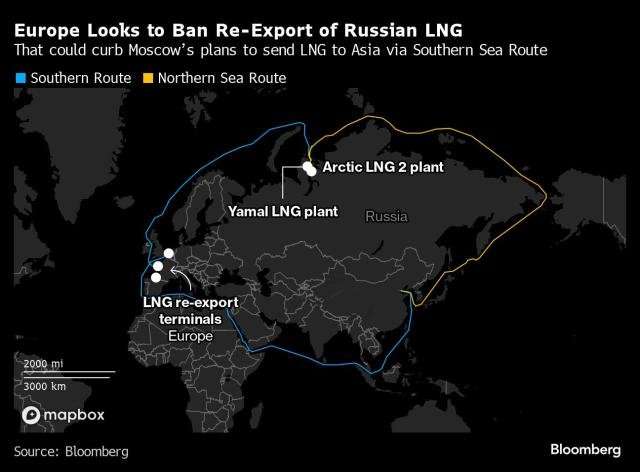
The proposed restrictions would have a limited impact on the European Union’s natural gas supplies, as they would not prohibit purchases of Russian LNG used in the European bloc. But sanctions against Russian LNG projects will further complicate Moscow’s efforts to increase LNG production. Under the proposed sanctions, EU member states would be barred from importing cargoes they intend to re-export to countries outside the European Union, which account for around a quarter of total Russian LNG imports into the European bloc.
Individual member countries such as France, Spain and Belgium (which together account for nearly 90% of total EU LNG imports) are unlikely to completely stop importing discounted Russian LNG at their ports until an import ban forces them to across the EU. However, the European bloc is unlikely to impose such a blanket embargo anytime soon due to a continued lack of consensus among member states, as European governments remain under pressure to keep their energy supplies and prices under control, which means that the European bloc will likely continue to import Russian LNG until significant new LNG supply from Qatar and the United States emerges in 2026.
In this context, the European Union will likely respond to the planned phase-out of Russian natural gas by 2027 only through gradual steps to avoid new energy crises. Meanwhile, proposed EU restrictions on Russia’s three Baltic and Arctic LNG projects would further complicate Russia’s LNG expansion plans by making it more difficult to secure the vessels, technology and financing needed to complete and operate of these works. Indeed, the new EU sanctions will likely include measures strengthening already existing US and UK restrictions on the supply of Western-made equipment for Russian LNG projects, which would further hamper Russia’s ability to realize its goals of increased LNG production.
- According to estimates by the approved independent Center for Research on Energy and Clean Air (CREA), founded in 2019 in Helsinki, Finland, 22% of Russian LNG imported from the European Union is not it is consumed in the European complex but is traded in ports in Belgium, France and Spain and then re-exported to other countries elsewhere, mainly in Asia.
- As with LNG imports, EU member states that continue to rely heavily on (now greatly reduced) pipeline deliveries of Russian gas to the EU are either unwilling to break long-term supply contracts with Russia (such as Hungary ), or they cannot legally do so without an EU-wide procurement contract ban (such as Austria).
- According to a forecast released in 2023 by the Russian government, it expects the country’s LNG projects to produce between 44 and 39 million tons of LNG by 2026. However, 2004-founded Oslo-based energy exploration company Rystad Energy of Norway, estimates that Russian LNG production complexes will produce only 36.3 million tons by 2026.