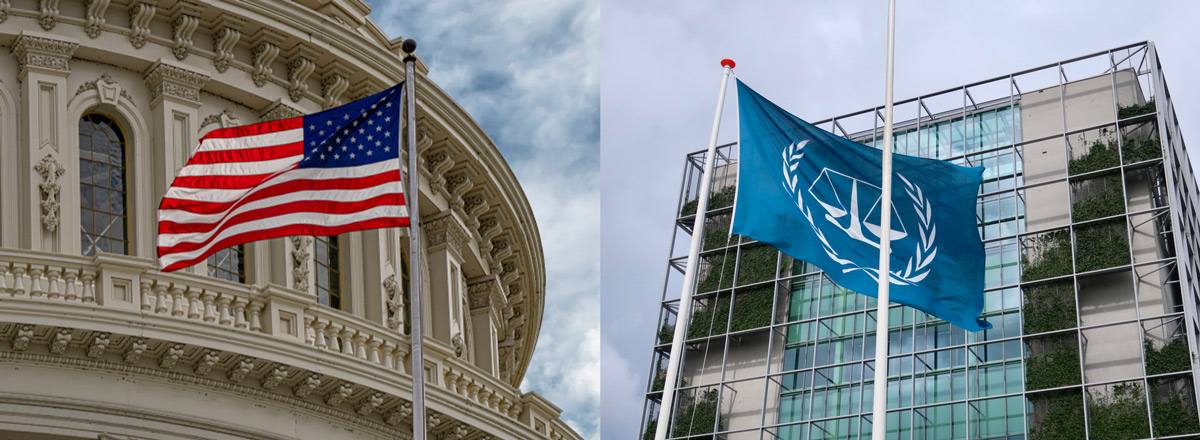
The International Criminal Court (ICC), based in The Hague, Netherlands, is the world’s first and only permanent international court dedicated to prosecuting individuals for the most serious crimes of international concern.
Established in 2002, the ICC focuses on genocide, crimes against humanity, war crimes and the crime of aggression against other states. It intervenes when national justice systems are unable or unwilling to hold perpetrators accountable for these serious crimes. The ICC aims to prevent future atrocities by ensuring that those responsible are brought to justice. At least that’s the theory and the prevailing narrative.
The ICC for Yugoslavia
Predating the ICC by three years, the International Criminal Tribunal for the former Yugoslavia (ICTY) was established in 1993 to deal with crimes committed during the Yugoslav wars. As it turned out, the ICTY was set up for one purpose only: to arrest Milosevich on false charges, imprison him and then let him die in prison before his trial day in this so-called international court. It is noteworthy that his trial at the International Criminal Tribunal for the former Yugoslavia (ICTY) had been ongoing for several years at the time of his death.
The ICC is after Putin
The US has applauded the ICC when its actions align with US interests. Case in point was the recent push for a warrant against Vladimir Putin. These cases reinforce the US narrative of promoting international justice as it serves US interests.
Detailed On 17 March 2023, following an investigation into allegations of war crimes, crimes against humanity and genocide, the International Criminal Court (ICC) issued arrest warrants targeting Vladimir Putin, the President of Russia, and Maria Lvova-Belova , the Russian Commissioner for the Rights of the Child.
They were accused of being responsible for the war crime of illegally deporting and transporting children during the Russian-Ukrainian war. This warrant against Putin marks the first time the ICC has issued such a warrant against the leader of a permanent member of the United Nations Security Council.
Following this warrant and under ICC regulations, the 124 member states are required to arrest and transfer, if they enter their territory, Putin and Lvova-Belova to ICC detention facilities.
Russia has repeatedly described the ICC’s arrest warrant as outrageous and legally invalid, and has stressed that the country is not a member of the body.
US senators threaten ICC not to touch Israel
However, the United States’ facade of international justice crumbles when the ICC turns its sights on Israel. The Court’s possible investigation into genocidal acts by Israeli officials in the Palestinian territories has drawn strong opposition from US senators.
In detail, letters from US senators, interspersed with threats of sanctions against ICC officials and judges, exemplify a strong tone of caution. This clear hypocrisy undermines the US’s so-called commitment to global justice and exposes the enormous duplicity of American foreign policy. In detail, this group of US senators openly and publicly threatened the ICC that any act against Israel would be taken as an act against the United States.
It is alleged that behind these US senators’ desire to indiscriminately defend Israel’s actions is lobbying by AIPAC. The American Israel Public Affairs Committee (AIPAC) is a powerful lobby group that supports a strong relationship between the US and Israeli governments. AIPAC exerts significant influence through political lobbying, fundraising for candidates, and grassroots mobilization.
Additionally AIPAC is credited with shaping US foreign policy in the Middle East, securing billions in military aid for Israel and influencing the public debate on the Israeli-Palestinian conflict.
But critics argue that AIPAC’s influence stifles debate about the most beneficial US policy in the region and indiscriminately prioritizes Israel’s interests.
However, resorting to threats against the ICC weakens the US’s global standing as a supporter of a just, rules-based international system. The current situation paints a disturbing picture: here the American superpower is dictating ICC decisions to serve its own interests.
Is the ICC a true international court?
The question of whether the International Criminal Court (ICC) can truly be impartial in a world characterized by power struggles and anarchic dynamics, as aggressive realism suggests, is complex and subject to debate.
Aggressive realism, a theory in international relations associated with scholars such as John Mearsheimer, argues that states are primarily driven by the pursuit of power and security, leading to competition and conflict in the international system. In such a world, states prioritize their own interests over international institutions, and power imbalances shape the final outcomes.
When considering the ICC in this context, several challenges arise:
1. Political influence
Powerful states may seek to influence or manipulate the ICC to serve their own interests. This could include pressuring the court to avoid investigating or prosecuting individuals from powerful states, or using their influence to undermine the court’s credibility.
2. Enforcement
The ICC relies on the cooperation of states in the execution of arrest warrants and the enforcement of its decisions. If powerful states refuse to cooperate or actively oppose the ICC’s actions, it can undermine the court’s effectiveness and impartiality.
3. Selective justice
Critics argue that the ICC has disproportionately targeted people from African countries, while largely ignoring alleged crimes committed by powerful states in the West or their allies. This perceived bias can undermine the legitimacy and impartiality of the ICC.
Conclusion
In conclusion, the time has come when the ICC faces significant challenges to its usefulness and operation from the superpower of the US in favor of Israel. In a world characterized by power politics and the degree of its exercise, the truths of aggressive realism are no longer difficult to hide.