



Gold has been a reliable means of payment in cultural and religious communities for thousands of years. As early as 1200 BC, the Chinese were already using gold as a medium of exchange (Source: Anthony C. Sutton “The War on Gold”). In stark contrast to gold, Sutton illuminates the devastating effect on economies of unbacked paper money (or fictitious money).
An early unknown historical example is the paper money experiment of the Chinese in the thirteenth century, which failed miserably. Similarly, the French notes issued in the revolutionary period, between 1789 and 1796, not only resulted in a complete loss of value but also plunged the French people into chaos and terror.
The suspension of gold purchases to prop up the British pound from 1797 to 1821 also had far from glorious events, resulting in a significant erosion of the pound’s purchasing power and causing significant financial hardship to much of the population .
Similarly, the issue of the famous Continentals by the government of the new colonies in America during the Revolutionary War from 1775 to 1779 also turned into a real fiasco. Continentals quickly became obsolete and soon discredited in the minds of citizens and in their economic practices.
Let us not forget the painful hyperinflation in Germany during the Weimar Republic, when the purchasing power of the paper “mark” collapsed in November 1923 and necessitated the replacement of the disgraced paper mark by a new currency, the rentenmark.
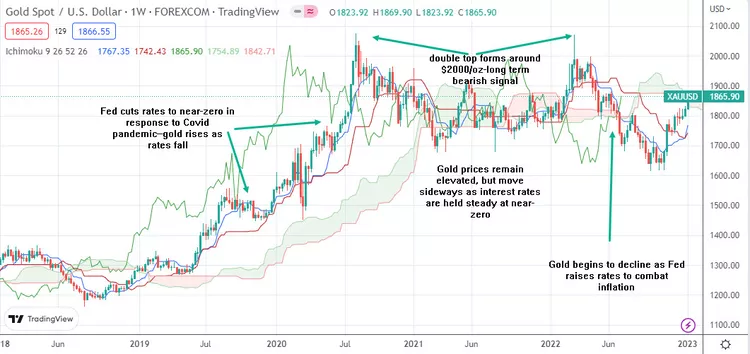
Totalitarian regimes don’t like gold
The inherent economic virtues of gold — real money:
1. Gold exercises disciplinary power over the economic act and the economic sphere more broadly.
2. Gold-denominated money limits the opportunities for those in power to abuse money for their own gain.
3. In stark contrast to unbacked (fiat) money – that is, that which is issued by governments through central banks – the amount of gold cannot be increased arbitrarily and not without cost.
This is precisely why the financial elite and governments are fighting gold as money to this day, in what has been called a “total assault on gold”.
In this context we can point out:
When we project the early monetary experience into the modern era, it should not surprise us to learn that all totalitarian societies, from John Law’s France to Hitler’s Third Reich to Stalin’s Soviet Empire, have waged war on gold. In a dictatorship, all remnants of rule must be concentrated in the hands of the ruling elite.
On the other hand, the historical context surrounding the gradual removal of gold from circulation can be described as follows:
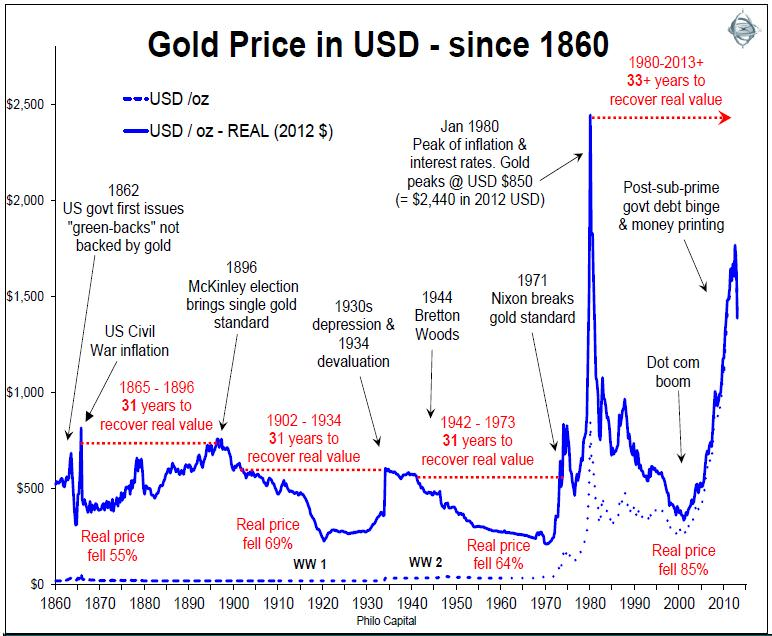
The last quarter of the nineteenth century was the golden age, often referred to as the era of the classical gold standard. All the major currencies—the dollar, the British pound, the French franc, and the German mark—had their gold counterparts.
However, many nations had suspended the ability to redeem gold for their reserves during World War I (the US being a notable exception) in order to print additional money to finance their war effort.
The Bretton Woods system, adopted in 1944, attempted a partial, if very fragile, restoration of gold-money from 1945 onwards. However, the US did not play by the rules of the game Issuing dollars without the support of a stable value resulted in causing rising inflation. Consequently, the Bretton Woods system began to decline in the 1960s.
On August 15, 1971, US President Richard Nixon declared that the dollar could no longer be redeemed for gold.
In doing so, the US government effectively imposed a monetary standard on the world that remains in place to this day.
John Exter, the former vice president of the New York Federal Reserve Bank, sums up the consequences: The paper dollar has become a “nothing,” like all paper money in the world today.
Therefore, a “nothing” currency must be traded on the market every minute of every day against the “nothings” of all other central banks.
We are in a world of inflationary notes—a state of affairs in monetary circulation unprecedented in history.
The useful conclusions
1. Throughout monetary history, gold has consistently served as money—in fact, maintaining its status as the primary medium of exchange, a role that remains unchanged to this day.
2. Throughout history, those in power have tried – whenever they had the opportunity – to remove gold from circulation for political rather than economic reasons and replace it with their own money.
3. Perhaps most importantly, the war on gold is far from over.
It is important to recognize, however, that today’s war on gold is being waged differently than in the past. Today’s state-controlled educational institutions provide limited scientific coverage of the monetary role of the yellow metal, leading to a decline in the younger generation’s knowledge of gold-based money. At the same time, modern fiat money (the currency of central banks) is praised as a great achievement for which there is no better alternative.

