



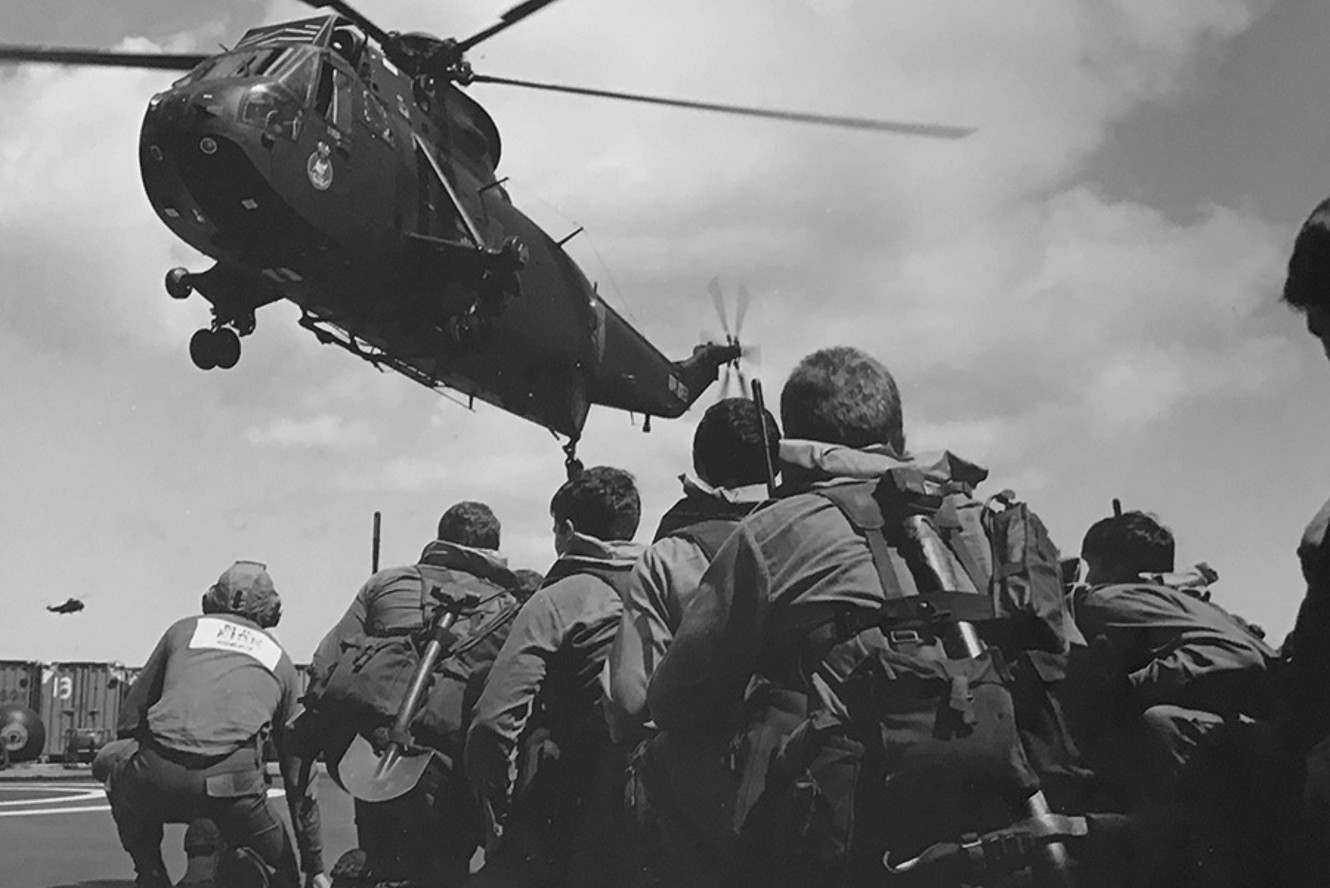
The following analysis deals with the Falklands War in order to highlight useful operational lessons. As a general introduction, the Falklands War, which began with an Argentine invasion of the Falklands Islands in April 1982, led to a dynamic intervention by the British and ended with the defeat of the former, is a timeless example of the importance of the projection of naval power and how it it is a determining factor in the creation and maintenance of overseas power. Simply put, a country that wants to be considered a Great Power cannot but be able to project naval power over all its possessions at any time in a way that produces decisive results.
Before the war – how the Argentines decided to invade
Although there were diplomatic talks about the Falklands and the Argentine junta was facing significant financial difficulties, Argentina did not seem prepared to invade the islands. It was their perception that British naval power was in decline that prompted them to take this action. The public announcement of the reduction of conventional naval bases for the purchase of Trident submarines (SSBN) and the cessation of patrols of the support ship HMS Endurance in the Antarctic gave the impression of withdrawal to the Argentines. But the most important “test” of the British reaction was the invasion of the Argentine Navy on the east coast of the island of South Georgia in which the British Royal Marines were forced to surrender after they shot down an Argentine helicopter and hit the corvette Guerrico several times. This action brought no significant British reaction.
On March 26 the Argentine Fleet was at sea without its direction and intentions being known. The departure of the Argentine fleet did not reach the highest levels of British leadership until quite late, on April 1, when the British leadership was informed that the Argentine task force was aiming to land on the islands. By April 19, diplomacy had completely collapsed as Argentina wanted full sovereignty over the islands, while Great Britain wanted Argentine forces to withdraw from them before talks could begin.
The British campaign
The British formed a task force of two aircraft carriers, destroyers, frigates and other support ships. This force had the air support of 20 Sea Harriers as well as various types of helicopters. The closest supply and support base for the British was Ascension Island which is more than 4,000 miles from the Falklands. The Argentine Air Force countered with 180 fighter-bombers including Mirage III, A-4 Skyhawks as well as transport, support and training groups forming a force of 450 aircraft. The Argentine Naval Air Force was adding another 130 aircraft including 6 Super Étendards carrying Exocet missiles.

The main problem was the distance. The Falklands are 8,000 nautical miles from Great Britain and the nearest base was, as mentioned, Ascension Island. Great Britain was not the maritime power of the past and having embraced its new role in NATO had limited its capabilities for overseas campaigns. Time actually worked in favor of the British as 18 months later they would have decommissioned the aircraft carriers Hermes and Invincible which were the heart of the British task force.
The distance created intractable administrative problems. The British solved these with merchant ships, 54 in number, the best known being the Canberra and Queen Elizabeth 2, which were used to transport personnel. Merchant ships took on a number of roles from tankers to hospitals. The base on Ascension Island was too far away to be used operationally, but was used to transport personnel who flew there and continued the journey by sea. Aerial refueling was used to refuel the Harriers.
The ANSK of the British task force commander was the following: achieve the withdrawal of Argentine forces and the restoration of British command of the islands at the least possible cost in human life. The recapture of South Georgia Island was not in the original plan but there was a desire to demonstrate military superiority. Nevertheless, the operation was a near disaster as in the attempt to ascertain the positions of the Argentine forces, one helicopter got stuck on the Fortuna Glacier, two helicopters went down trying to rescue the crew with the third succeeding.
Ultimately the operation was crowned with success as the Argentine submarine Santa Fe was decisively fired upon and a sufficient number of marines were landed to neutralize the enemy forces and regain control of the island. Great Britain had achieved what it wanted in public opinion, to present an easy victory since the Argentine soldiers did not put up any resistance.
Then on April 30, a 200-nautical-mile exclusion zone was declared by the British to delimit the conflict. Entering within its limits meant immediate risk of offense. The attack and sinking of the Argentine cruiser General Belgrano by the British submarine Conqueror is certainly connected with the above. The Belgrano was sailing outside the exclusion zone but what is important in this case is that in order to break the rules of engagement that the British themselves had set, it took Prime Minister Margaret Thatcher herself to give the order.
After the strike it was announced that any Argentine ship or aircraft that came within 12 miles of the country’s coast would be treated as hostile. This completely broke the morale of the Argentine Navy. All ships returned to their bases and only a few patrol boats and supply ships attempted to break the blockade. The great naval battle never took place. In contrast, the Argentine Air Force suffered heavy losses, losing over 90 aircraft, including 26 Mirages and 31 Skyhawks.
Conclusions
War as a political phenomenon is related to the cost-benefit relationship. Simply put, an actor chooses the solution of war – we are reminded here of Clausewitz’s teaching that war is the continuation of politics by other means – when he estimates that the benefit he will get will be greater than the potential cost. This armed conflict arose after two cases. Argentina assumed that the UK would not react and the UK assumed that Argentina would not dare. Finally, Argentina dared and Great Britain reacted. The British did not realize the special emotional weight these islands have for the Argentine people and the Argentines did not calculate the strength of the wounded British imperial ego. It is true that Great Britain never realistically saw a political solution to the problem.
On the operational side, lessons emerge in how the UK solved the logistical issues with the use of merchant/civilian ships as well as the use of the Ascension Island base. An important element is also the violation of the rules of engagement ordered by the British Prime Minister herself that led to the sinking of the Belgrano. It is a psychological action that, with the physical destruction of a unit of interest, effectively dealt a decisive blow to the enemy’s morale.


