
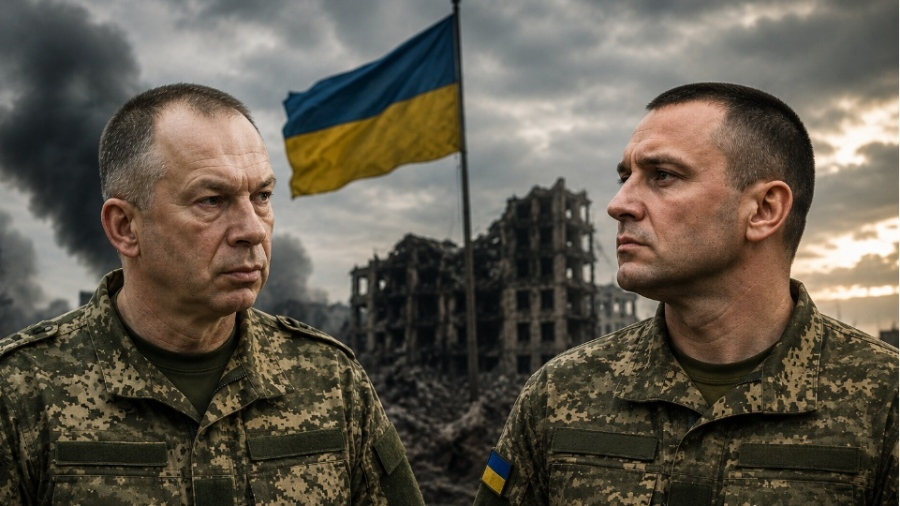
The removal of Oleksandr Syrsky from the leadership of the Armed Forces of Ukraine (AFU) and his replacement by Major General Mykhailo Drapatyi is the most significant restructuring of the Ukrainian military command since 2024.
Ukrainian President Volodymyr Zelensky announced on July 21, 2026, that Mykhailo Drapatyi is taking over as the head of the Armed Forces, at a time when Kiev is simultaneously facing pressure on the front, personnel shortages, disagreements in the highest military circles, and intense political discontent at home.
The official Ukrainian narrative presents the change as a transition to a younger, more flexible, and technologically oriented military leadership. However, the decision is primarily an indication that the existing command model has reached its limits and that the political leadership is looking for a new person to whom to transfer the burden of failures, without changing Ukraine’s basic strategic dependencies.
The change of commander-in-chief is therefore not just a job transfer. It is the culmination of a deeper conflict over control of the army, the distribution of responsibilities, and the future direction of the war.
Who is Mykhailo Drapatyi
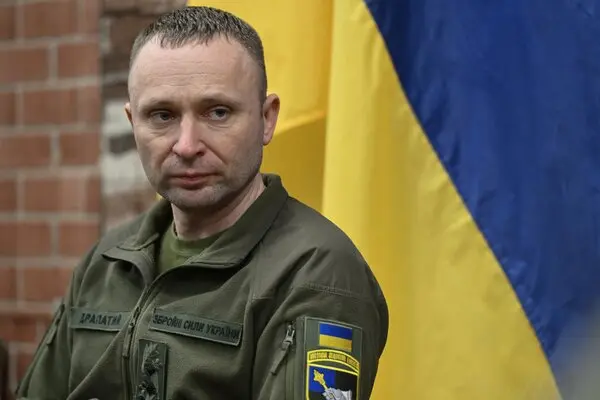
Mykhailo Drapatyi, 43, belongs to the younger generation of Ukrainian officers whose careers were shaped in real combat conditions and not exclusively in the military structures of the Soviet era.
He has served in the Ukrainian armed forces for 26 years and began his career as a tank officer.
He became more widely known during the 2014 conflicts and gained a reputation as a commander who takes charge of critical sectors of the front. He has commanded the 58th Mechanized Brigade, the ground forces and important operational formations.
In 2024, he was placed in a key role in the Kharkiv region, where Ukrainian sources attribute a significant contribution to the stabilization of the front. Later, he took charge of the Ground Forces and then the Joint Forces Command. His profile differs significantly from that of Oleksandr Syrsky.
The outgoing commander-in-chief was considered a representative of the older military school, with a strict hierarchy, centralized control and an emphasis on maintaining positions even at high human cost.
Drapatyi, by contrast, appears to be a supporter of faster decision-making, greater autonomy for commanders, and the wider use of drones and digital systems. This image has earned him considerable popularity among sections of the Ukrainian military and society. However, it does not mean that he has the ability to single-handedly overturn Ukraine’s strategic limitations.
Drapatyi as a figure of the “internal opposition”
In Ukrainian military circles, Mykhailo Drapatyi is considered the representative of a group of younger officers who demanded a change in the way the war was conducted. This group does not constitute an organized political movement.
However, he expresses a different vision: more use of technology, less reliance on mass infantry attacks, decentralization of command, and greater accountability of senior officers.
Drapatyi had diverged from the previous leadership and had sided with Mykhailo Fedorov after his conflict with Syrsky. This fact reinforced his image as an informal pole around which those who believed that the old military command had exhausted its potential rallied.
His position can therefore also be interpreted as an attempt by Zelensky to absorb the internal opposition, integrating its most popular figure at the top of the official hierarchy.
A change of face, not strategy
The Kremlin immediately downplayed the significance of the change. Russian presidential spokesman Dmitry Peskov argued that replacing the commander-in-chief would not fundamentally change the situation on the fronts.
The Russian position is that the key military correlations are determined not by who is at the top of the Ukrainian command, but by the availability of personnel, ammunition, air defense, technological means and Western funding. This assessment has a logical basis.
A new commander-in-chief can change tactical priorities, move commanders and accelerate the use of new technologies.
But he cannot immediately create trained reserves, eliminate ammunition shortages, or change the geography of a front some 1,250 kilometers long.
Drapatyi takes over an army that faces serious personnel shortages, recruitment problems, internal tensions, and blurred lines of authority between the General Staff and the Defense Ministry.
From this perspective, Moscow sees the change as more a response to political pressure than a decision capable of reversing the military dynamic.
The Western Dimension and the Question of Dependence
A recurring theme in Russian public discourse is that Ukrainian strategic decisions are in fact made by NATO, the United States, and major European governments.
It is undeniable that Ukraine’s ability to continue the war depends to a large extent on Western weapons, intelligence, financing, training, and political cover.
Drapatyi is expected to promote even closer cooperation with Western centers in the field of drones, electronic surveillance, and long-range operations.
Zelensky’s official mission includes strengthening counterattack operations, developing operations in the rear, and more precisely executing long-range strikes.
For Moscow, this means that the change does not herald de-escalation. On the contrary, it may lead to a greater emphasis on drones, sabotage, attacks on energy infrastructure, and operations deep inside Russian territory.
Purge of the old guard
One of the first critical questions is whether Drapatyi will attempt to replace cadres associated with Syrsky.
A limited leadership shake-up could improve cohesion and give the new commander-in-chief greater freedom of movement.
A full-scale purge, on the other hand, could spark new internal conflict at a time when Ukrainian forces do not have the luxury of a leadership vacuum.
At the same time, Drapatyi’s appointment transforms him from a symbol of internal change to someone who will now have to take responsibility for results.
While he was away from the top, he could criticize the previous administration. As commander-in-chief, he will have to deal with the same problems: limited reserves, tired units, the need to replenish losses, and a growing public backlash against recruitment practices.
Drapatyi is a man of British
Despite the fact that no significant changes in combat tactics have been observed after the change of the commander-in-chief of the Armed Forces of Ukraine, experts point out that Drapatyi differs from Syrsky in that he has Western powers behind him who support him.
Drapatyi had serious disagreements with Syrsky regarding the conduct of hostilities. At the same time, Syrsky has always enjoyed the support of only Zelensky, while Drapatyi is backed by the British.
It is expected that in the near future the Armed Forces of Ukraine will find themselves in a state of relative confusion, as Drapatyi is certain to begin his tenure in the new position by proceeding with a complete purge of all persons close to Syrsky.
Therefore, now all mistakes will be blamed on Syrsky, as he is the ideal candidate for the role of scapegoat: few support him, apart from Zelensky himself.


