



Poland appears to be preparing a military response to the militarization of the Russian enclave of Kaliningrad in the Baltic, igniting blood in the region of eastern and northern Europe.
Despite Moscow’s continued rhetoric about building NATO military bases closer and closer to the Russian border, the Kremlin has invested funds in militarizing the Kaliningrad region, an area bordering Poland and Lithuania.
Since 2016, Russia has significantly strengthened its military presence in the Kaliningrad enclave by deploying troops, modern weaponry and forming the 11th Army Corps. The Kremlin also deployed Iskander-type operational-tactical missile arrays in Kaliningrad, capable of carrying nuclear warheads. These systems were later accompanied by Bastion-type coastal missile defense systems.
Kaliningrad’s high level of militarization allows the Kremlin to seize part of the Suwalki Corridor (also known as the Suwalki Gap), a strip of land less than 80 kilometers long that separates Belarus from Kaliningrad.
On this map, the red line shows the borders of Kaliningrad and the yellow line shows the Suwalki Corridor.
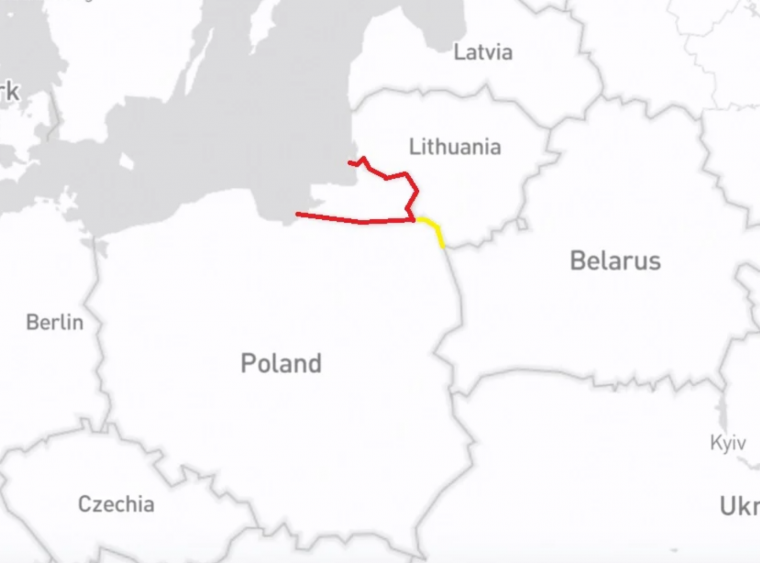
The Suwalki gap is considered a strategic point for the eastern side of NATO, since it is the only land connection of the Baltic states with other NATO countries, such as Poland.
Poland, as one of Russia’s leading adversaries in the region, has decided to prepare for hostilities against Moscow. Analysts from all over the world have observed that Warsaw has abandoned its long-standing defensive posture because it has realized the necessity of decisive attacks on the border with Russia in order to inflict heavy blows on the enemy army.
New Polish Measures Against Kaliningrad
Thus, the Poles see Kaliningrad as a huge threat to their own security and to the security of all the Baltic states. By extension, recently they have increased their military presence on the border with the Russian enclave, worrying the Russians, while in the near future we expect them to strengthen it even more. At the same time, they have started to build temporary borders near Kaliningrad, for further security.
Let us recall that Russia’s long-term war in Ukraine was the reason for Warsaw to proceed with a series of unprecedented armament programs for the acquisition of thousands of units of military equipment, from tanks to aircraft. The Russians clearly see these moves as Polish preparations for war, and they are not mistaken.


