Since the evening of February 28, 2026, Dubai has been one of the places where the Iranian campaign of retaliation has “touched” highly symbolic and valuable political infrastructure. We are talking about damage to Dubai International Airport, fires from drone debris, the famous luxury hotel Burj Al Arab, the artificial island of luxury homes Palm Jumeirah and the port of Jebel Ali.
The main reason for this action is that Dubai, and especially its international airport, is at the core of the United Arab Emirates’ model as a service state. A blow that causes a temporary closure to this central air transport hub is not measured only in damage on the ground. It is measured in stranded passengers, disrupted routes, delayed cargo, triggered contracts, insurers raising premiums, and airlines reassessing the risk of their routes. Thus Tehran is hitting a point where even a “small” disruption produces a global footprint within hours, especially when the entire region enters airspace closures and massive flight cancellations. And of course the same applies to Dubai’s overall position in global transport and trade.
Here Iran can combine ballistic missiles with drones and change the pace and threat profile. Ballistics compress response time and require an immediate cycle of detection, identification, and engagement. Drones allow saturation, deception, and strain of the sensor chain and interceptor munitions. In this context, the UAE relies on a multi-layered defense with systems such as THAAD and Patriot missile launchers, a grid that can have a very high success rate, but always operates within narrow time windows. While even a successful interception can scatter fragments and debris, and this is enough to cause fire, panic and disruption of critical facilities.
The next reason for this Iranian strategy is messaging to neighboring states that are considered part of the American security architecture. The Iranian perception is that bases, military facilities, sensors and support for the US create “co-responsibility”. Thus, the pressure does not only target military facilities. It targets political stability and economic functioning, so that the leadership of a Gulf state can feel the intensity of the crisis internally. Dubai is offered because it is the showcase of prosperity and the “machine” that produces the image of security and regularity.
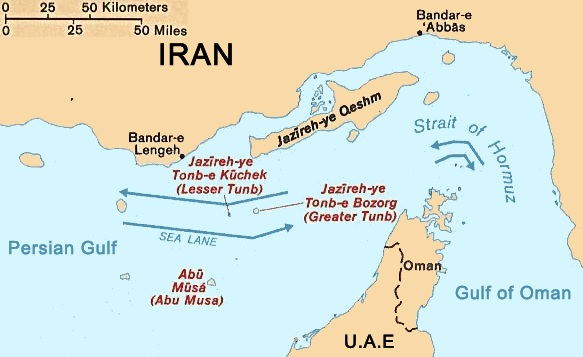
Furthermore, the friction between Iran and the UAE has existed for decades. Where the permanent dispute is over the sovereignty over the islands of Abu Musa, Greater Tunb and Lesser Tunb (Iran has occupied them for decades), an issue linked to the control of the wider area around the Strait of Hormuz.
An important issue is also the normalization of relations between the UAE and Israel, which Tehran sees as an upgrade of the threat in its neighborhood. Iran sees not only potential trade relations, but also potential cooperation in information, technological synergy and Israel’s access to an environment full of critical infrastructure and international flows.
Thus, Iran is hitting Dubai because it is the most effective target of pressure on the UAE. It is the commercial, economic, emblematic international hub where every military action spills over into aviation, tourism, shipping, capital movement but also into the prestige of the region. The UAE, for its part, is obliged to further strengthen the protection of critical points, improve civil protection, cooperate more closely with allies and attempt to maintain the operation of its hubs. The big variable is the pace of attacks and their duration. If the waves of Iranian strikes continue for days, the result will look less like an episode and more like a protracted conflict that changes global market behavior and increases pressure for political decisions. Something that could push the UAE to join in the attacks on Iran…