The region of the Middle East has always been in the spotlight and especially after the end of the Second World War, due to the national movements that led to the independence of the states of the region and because of its oil and commercial routes.
In the current era when the riots continue in Iraq, Iran, Lebanon, Syria, etc. because of war conflicts (Syria, Yemen) but also because of the poverty, deprivation and anger of citizens (Lebanon, Iraq, Iran) for their uncertain future many wonder whether these situations are accidental or if some external factors such as they usually report various governments of the Middle East foment these conflicts.
by Thanos S. Chonthrogiannis
©The law of intellectual property is prohibited in any way unlawful use/appropriation of this article, with heavy civil and criminal penalties for the infringer.
The US Plan for changing borders in the Middle East countries
In today’s analysis we will present to our readers the US plan for the division of countries and the change of borders in the countries of the Middle East. This project was known in specific US circles since 2001. This project was presented by US Army Lt. Col. (ret.) Ralph Peters in an article titled Blood Borders: How a better Middle East would look and originally published in the Armed Forces Journal, via Wikimedia.
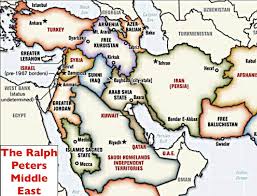
Photo by Ralph Peters, Source: Armed Force Journal, Wikimedia
When the US uncovered the Middle East, plan drafted by US Secretary of State Condoleezza Rice (2005-2009) and US Vice-President Dick Cheney (2001-2009), nobody gave much attention. Today, however, we see that all these drastic changes that began in the “Arab Spring” in 2011 and make the world feel surprised for everything that is happening around it form another backdrop in the Middle East, noting that many are finally approaching the time of completion of this US plan.
Within a short period of time we experienced the division of Libya, Iraq, and Syria, and it is already approaching Iran’s time, which may have been the original objective of the specific US plan.
The purpose of this US plan is how to shape the new borders in the Middle East based on the different ethnicities that live in the current states of the Middle East so that the new countries with the new borders that will emerge they ensure, above all, the protection and security of Israel and the US allies in the region.
An example of the emergence of a new state is the creation of the state of Kurdistan, which will be an ally of Israel and which will operate geographically as Israel’s shield against its enemies, which in this case is Iran.
Whether this is achieved will depend on several factors and strategic mistakes which will make potential opponents on the chessboard in the Middle East and whether these mistakes will become exploitable by potential opponents.
US strategic analysts have been involved and continue to deal with this project with the primary objective of creating an independent Kurdistan and as it appears on the specific map of Ralph Peters and despite the temporary and apparent “betrayal” of the United States to the Syrian Kurds.
The fact that a semi-autonomous state entity has already been created in Iraq and a second counterpart in Syria is being prepared is the first steps to create an independent Kurdistan in the next decade.
The Iraqis complain about poverty, deprivation and external interference in their country. The USA for their part wants to gain something from these riots to stem the bonds and co-operation between Iraq and Iran.
But the fact that the Iraqis do not want to lose territorial integrity by giving it as part of the new independent Kurdistan is forcing the Iraqis to work closely with Iran, and since Iranian state includes large population group Kurds who will in turn form the vehicle for the loss of Iran’s territory so that this is then added to the new Kurdistan state. Iran’s concerns in this case are justified.
The correct strategy of the countries in which live large population groups Kurds
The main strategy that the countries of the Middle East can contrast against the US strategy, countries whose territories live large population groups Kurds is the full recognition of civil rights and the provision of a semi-autonomy status in these population groups so that they are not oppressed by the central governments which would in this case lead Kurds populations sooner or later to revolutions of independence and guerrilla warfare as is done in Turkey.

In this case, the connecting link between Iraq, Iran, Turkey and Syria both in the current era and in the future are the Kurdish populations living in their countries and which countries do not want in any way to lose territorial integrity in order to formulate the new independent state of Kurdistan.
Essentially, US policy in the Middle East for the implementation of the above plan is constantly stumbling either from Iran working closely with Turkey, Syria, Lebanon, Iraq and Yemen and/or from Russia whose military descent into Syria has, for the time being, saved Syria from its official territorial division.
Russia is cooperating with Iran, Turkey, Syria either by maintaining trade relations or by selling arms and weapon systems to these countries, without eluding us that China is coming to support these countries in the background. Iran is seeking to stay in the executive power of Adil Abdul-Mahdi in Iraq while haggling with the Kurds on the central government budget.
A second strategy and alternative to the first strategy will be if Iran chooses to stop its rivalry with Israel so that these two countries stop being considered enemies. In this case, the change in Iran’s stance will affect the whole of the Middle East and there will be no need to implement this US plan. But this strategy seems unlikely to be adopted by Iran and its strategic planners.
The US response to this strategy
Suddenly US Vice-president Michael Richard Pence visited Iraq (November 23, 2019). His visit was not even known by the President of the country, Bahram Salih. Michael Pence of course did not go to Baghdad but to the US military base at Ayn el Esad, where 5200 US soldiers are in order to fight ISIS. He celebrated with US soldiers on Thanksgiving Day.
Then the US Vice-president called on Iraqi leaders to visit him on this US base, but they did not respond. Michael Pence spoke by phone with Iraqi Prime minister Adil Abdul Mahdi whom he advised to depart from Iraq.
Then the US Vice-president went to Erbil in the capital of Iraqi Kurdistan where he met with the President of the semi-autonomous region Necirvan Barzani and Prime Minister Masur Barzani. The meeting took place at the airport of the city, part of which the USA uses.

The political world of Iraq from both the governmental parliamentary coalition and the parliamentary opposition did not have a good eye on this visit. They thought it was a rude behaviour on the part of US Vice-president Michael Pence, and just as the US President Donald Trump’s visit to the same military base last Christmas. The Iraqis would prefer a visit by the US Vice-president to Rojava and not to Iraq.
The Kurds on their side agreed with the Iraqi central government to give the Iraqi public enterprise State Organization for Marketing of Οil (SOMO) 250000 barrels of oil a day. The deal will be set from 1/1/2020 and the oil will be transported through the Baku-Tbilisi-Ceyhan pipeline to the Eastern Mediterranean (Ceyhan).
The semi-autonomous Kurdistan located on the territory of Iraq will collect 13% of the oil revenues. In short, the Kurds stand on the side of the Iraqi central government, which in turn does not want the territorial division of Iraq and Iran.
On the other hand, US Congress urges the imposition of sanctions on Turkey mainly for the purchase of the anti-aircraft & antiballistic Russian system S-400, but also for the political autonomy that Turkey pursues within NATO. However, Donald Trump’s messages of friendship to Turkish President Erdogan are intended to bring him together and bring Turkey back to the west side.
But if the President of the United States cannot manipulate the President of Turkey and his policy then it is likely that he will give the green light to overthrow him and replace him by more pro-Western and popular Turkish politicians such as the mayor of Istanbul that seems to be the new rising star of the Turkish political scene.
The basis of the US plan to change borders in the Middle East countries is based on the one and only strategic principle of the British Empire “divide and conquer” by taking as a constant variable the self-determination of the peoples which means that each different ethnicity living in the Middle East should not only be suppressed by living in a state of another nationality as a minority but should have its own independent state consisting only of its own nationality (clean states in terms of nationality of the citizens).
If the U.S. can create civil strife in Iran or Iran lost part of its territorial integrity, then the implementation of the specific US Plan will focus on the last link that is Turkey, which will follow the faith of the other states in Middle East.