
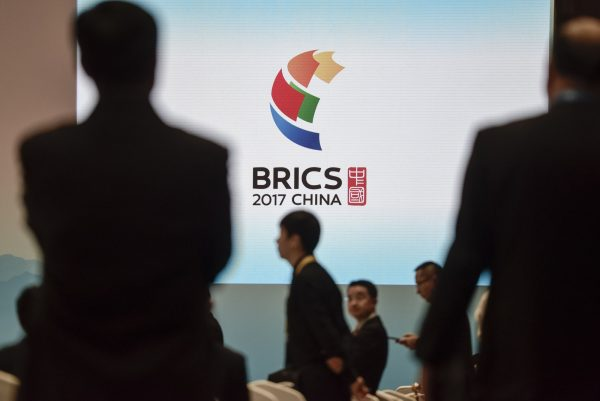
The BRICS members – China, Russia, India, Brazil, South Africa – are now estimated to be the world’s largest economic bloc based on purchasing power parity (PPP). According to data recently published by the British economic research company Acorn Macro Consulting, they surpassed the G7 group (USA, Germany, France, Italy, United Kingdom, Japan, Canada) in share of global GDP with 31.5% compared to 30.7% .
This position could be strengthened by their expansion. With this issue high on their agenda, among many others, the foreign ministers of the BRICS group are meeting today and tomorrow in South Africa.
Essentially preparatory to the organization’s summit in August – on whose “table” even the idea of a common currency has fallen – the two-day meeting is considered decisive.
A “golden” section is being sought that will establish the BRICS in the role of the representative of the so-called Global South, as an alternative model to the G7, i.e. the seven most industrially developed countries.
A key step in this direction is therefore the admission of new members, in the first enlargement of the bloc in more than a decade. The first and only one to date was with South Africa in 2010. Now 19 countries are reportedly crowding at his “doorstep”.
The first group, he said, includes Saudi Arabia, the United Arab Emirates and Iran. Interest extends from Latin America and Africa to Asia. Efforts to strengthen trade in local currencies are also part of the talks.
The New Development Bank (NDB)
The New Development Bank was created as a counterweight to the IMF and the World Bank, where – according to the South African Institute for Security Studies – the BRICS have less than 15% of the voting rights.
At the bank’s annual meeting on Tuesday in Shanghai, its new head and former Brazilian president Dilma Rousseff also announced the expansion of the NDB.
Its constitution states that all UN member countries can be members, but ensuring that the BRICS vote share cannot be less than 55%.
As stated on its website, the United Arab Emirates, Bangladesh and – recently – Egypt have already joined its fold. Uruguay has submitted a candidacy. Saudi Arabia is now also in discussions.
A move that is expected to give NDB greater financial strength.
The challenge for the BRICS bank is its capital boost, tested after the Russian invasion of Ukraine.
Difficult balances
The BRICS moves come amid a shaping Cold War arena, spanning from diplomacy to economics, against the backdrop of Russia’s invasion of Ukraine and escalating geopolitical competition between the US and China.
At the recent G7 summit in Hiroshima – where India and Brazil were invited – the central messages from the leaders of the “seven” were their unwavering support for Kiev against Moscow and their distrust of Beijing.
In the Asia-Pacific region, meanwhile, the efforts of the US and its allies to contain China are intensifying through the creation of blocs – such as the Quad, in which India participates – and a network of trade and security pacts, such as the AUKUS.
It is against this backdrop that last year China opened the discussion on BRICS enlargement, giving the group greater leverage and credibility. The prospect, however, seems to cause some members to have reservations.
For the time being, however, a solution is being sought for the participation of Russian President Putin, as an arrest warrant is pending against him from the International Criminal Court, on the charge that he is responsible for war crimes in Ukraine.


