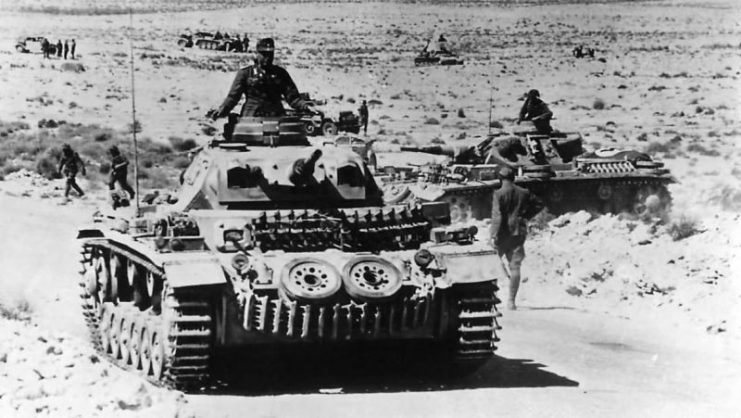
Since 1940, the war in North Africa has strongly resembled a tidal wave, with the two opposing armies repelling each other now towards Egypt and now towards Libya.
1942, however, was the catalyst for the final victory of the Allies in this particular theater of operations, after the double defeat of the Axis forces (under the legendary Rommel) at El Alamein. Rommel, at the head of the famous Afrika Korps and the Italian units, turned once more towards the Italian colony of Libya, pursued by General Montgomery’s 8th Army.
But this time the Allies were determined to clear North Africa once and for all.
For this purpose, on the night of November 7-8, 1942, the execution of Operation “Torch” began, that is, the landing of powerful Allied forces in Morocco and Algeria, with the aim of encircling and exterminating Rommel’s forces.
The decision for the “Torch” operation was made on 24/7/1942, after an agreement between President Roosevelt and Churchill in the White House. At the time this decision was taken, the military situation on that particular front was critical for the Allies.
The stormy Rommel had taken Tobruk and pushed the 8th Army back to the last viable defensive location, El Alamein. Everything would be played there. One more victory was enough, and the swastika would cross the Suez, while before it the road to the Persian Gulf and the Indies would be wide open.
Rommel, however, was left without reinforcements in the face of the ever-strengthening opposing army. Thus, when he finally attacked the site, he was repulsed, and was subsequently defeated at the Second Battle of El Alamein and expelled from Egyptian territory. On November 8, 1942 Rommel’s Armored Army with the XX Afrika Korp and the XXI Italian Army Corps and other smaller units was trying to hold on to Marsa-Matrouch.
Designs and powers
At the same time, further west, on the coasts of Morocco and Algeria, 100,000 American and British soldiers were landing, but facing strong resistance from the French colonial forces loyal to the Vichy government. At Casablanca and Oran the Americans were repulsed by the French, who, two years behind schedule, were fighting hard.
Contrary to what was happening in Morocco, the allied landing operations in Algeria were crowned with success. However, the French were divided and this was shown by the efforts of some senior officers to unite their divisions with the Allies. Unfortunately, these efforts failed and the troops controlled by officers loyal to Pétain continued to resist.
The American forces, in the face of the stiff resistance they encountered, were forced to act against the flanking supports of the opposing defenses, with secondary amphibious actions and airborne landings in the areas around Casablanca and Oran. Throughout November 9 the situation remained confused. The French continued to fight entrenched in the towns, while the Allied forces attempted to encircle the French positions. In a naval battle that ensued, the British lost two light craft and the French three.
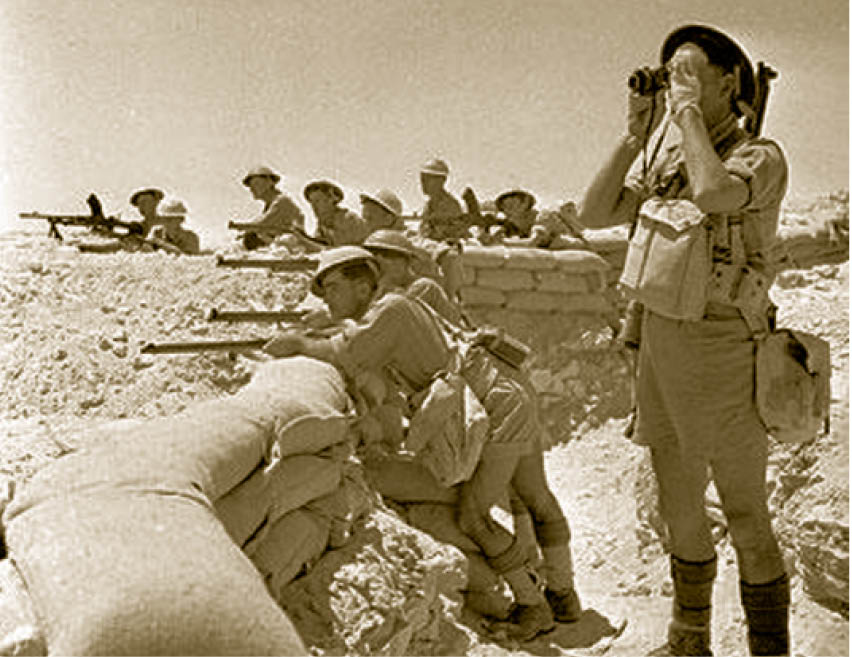
In the meantime, the German Air Force also entered the fray, trying to attack the Allied fleet. But he failed and suffered very heavy losses. The next day the Allies managed to consolidate their positions on the beachheads they had achieved.
French resistance was also gradually diminishing, a sign that French forces under Admiral Darlan would eventually join the Allies. Indeed, on November 11 the French troops stopped resisting in Morocco and Algeria and joined their opponents until a few hours ago.
In response, the Germans, in cooperation with the Italians, launched Operation Anton, invading the territories of the Vichy government, while at the same time troops were beginning to land in Tunisia to create a bridgehead and cover Rommel’s Army. which was continuing its retreat in Libya.
The Allies, along with French Moroccan and Algerian forces, began their advance into Tunisia. Later, they were joined by French soldiers stationed in Tunisia. The Germans, developing extraordinary activity, managed to expel the French from Tunisia and stop the advance of the Allies.
The German commander, Lt. General Nehring, with the 90th Panzer Corps was able, by continuous attacks and counterattacks lasting 10 days, to defeat the British 5th Army Corps, which he forced to retreat, causing him great attrition.
On 9 December all Axis forces in Tunisia were joined by the newly formed 5th Panzer Army and placed under the command of General von Arnim. This army, together with Rommel’s African army (which had retreated to Tunisia in pursuit), later formed Army Group “Africa”. The Army Group eventually included in its ranks 16 divisions or their equivalent, of which five were armored.
Specifically, the remnants of the Afrika Korp (21st and 15th Panzer, 90th and 164th Infantry Divisions), the Italian 101st Infantry Division “Trieste” and 131st Armored of the “Centaurs”, the 16th MP “Pistoia”, the 1st Infantry Division “Superga” “, the Fascist Youth Infantry Division (Giovanni Fascisti), the 80th Infantry Division “Spezia”, the German “Hermann Goering” Infantry Divisions 334th and 999th, the 10th Panzer “Breich” (later Mandoffel), as well as the Italian Sahara Group (6 infantry battalions, 12 artillery divisions) and the non-divisional Tiger I tank divisions.
Note that a German infantry division numbered 10,500 men, while a panzer division consisted of 95 tanks. In reality, however, these forces were largely worn out and incomplete in material and personnel, with no hope of improvement, since the British Navy controlled the Mediterranean and the Allied Air Force now had air superiority.
The situation worsened even more after the blowing up of the Gorgopotamos bridge, as the Germans themselves testify in the war diary of the Supreme Command of the Armed Forces (SCAF): “Due to the destruction of the bridge at Thermopylae, the restoration of which will take 6-8 weeks , the movement of the Thessaloniki-Athens trains was reduced from eight to two and a half daily”.
For their part, the Allies had gathered the equivalent of 21 divisions (four armored) on the North African front. These forces were largely replenished and had ample provisions.
The Axis powers eventually lined up almost parallel to the Tunisia-Algeria-Libya seropositive line. The southern end of their front was covered by the fortified line of Mareth.
This line had been built by the French, earlier, as a “shield” against a possible Italian attack through Libya. It had works made of concrete, with excellent shooting ranges.
In front of the site was dominated by the bed of the Zigzau stream, which was 4 meters deep and in some places ten times as wide, and was a most serious obstacle, especially if a force attempted to cross it under the fire of the defenders. This strong position was manned by the Italian XX and XXI Army Corps and the German 15th Armored Division and 164th Infantry Division. These forces were covered on their right exposed flank by the Sahara Group.
Rommel, effectively Army Group commander, with his famous “quick eye” perceived the situation and planned (covered by the Mareth Line) a counter-attack against the British and Americans on the western flank of the front. To this end he assembled two German ADs and the 131st ID.
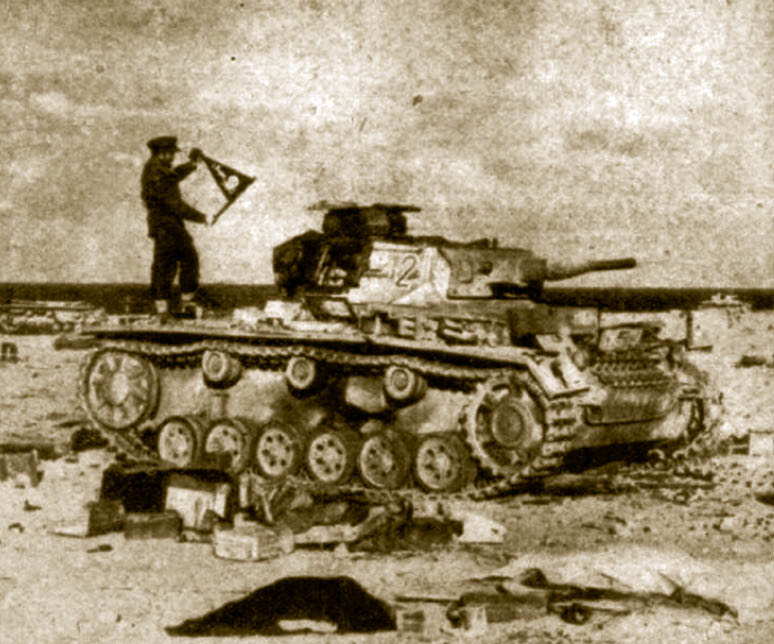
With these forces he attacked towards Fayd and Gafsa, overturning the Americans and British who rushed to help. After overturning the American 9th Infantry Division, it occupied the Kasserine Neck directly threatening the important transportation hub of Temesa. Finally, the Allies managed, by hastily transferring reserves to the threatened sector, to force the “Fox” to withdraw. But they had lost 253 tanks and 125 guns, and 4,000 prisoners.
At the same time, Montgomery’s 8th Army was ordered into action against the southern front, to the relief of the hard-pressed Americans. Montgomery, with the Highlanders’ 51st Infantry Division (ID) and the “Desert Mice” 7th Armored Division (AD), advanced towards Medenine, which he captured, finally halting in front of the Mareth Line.
These weak British “vanguards” had their left flank exposed, a fact that could not have gone unnoticed by Rommel. The German marshal immediately planned a counterattack that would strike the 8th Army on its left flank, with the aim of destroying its forward divisions.
Rommel once again assembled his armored divisions (15th, 21st, 10th) and ordered the launch of Operation Capri against the 8th Army. Unfortunately for the German leader, the exposed flank of the 8th had concerned not only him, but also his particularly cautious opponent, Montgomery, who ordered the 2nd New Zealand MP to deploy on a S-SE front, covering the gap. Within 24 hours this division had set up defensively and varied to such an extent that it was not detected by the enemy.
So Rommel, without suspecting anything, but also without performing a careful reconnaissance (follower of the direct hit), dropped the 141 tanks that all three of his divisions together had on the enemy lines.
There the “reception committee” was made up of the field and anti-tank artillery. By nightfall Rommel had been forced to retreat, leaving on the battlefield some 650 dead and wounded and 52 of his prized tanks. During the “Capri” operation, on March 10, the battle of Ksar Rylan took place, in which the Hellenic Holy Society distinguished itself.
After the defeat, Rommel, who had to defend a front of a total length of 625 km, proposed to Hitler and Mussolini a retreating maneuver and redeployment of the Army Group (in the form of a bridgehead) in the area of Bizerte and Enfitaville, with the capture of Metzès el Daddy in the center.
But his proposal was not accepted (later this solution was adopted de facto), although it was the only logical option, since the defense of such an extensive front by such overworked and unsupported units, against such a powerful enemy, was essentially impossible. After his proposal was rejected, Rommel took sick leave and left North Africa for good.
In the meantime the Allies were “stuck” against the Mareth line. With the arrival of reinforcements, however, Montgomery planned to break it up. Operation “Pygmachos”, as it was called, envisaged a frontal attack on the site, with a simultaneous outflank from the west. The frontal assault was undertaken by the British 50th and 51st ID and 201st Armored Brigade, with the 1st and 7th AD in second echelon, ready to exploit the slightest breach.
The maneuver force consisted of the 2nd New Zealand ID, the 8th Armored Brigade, Leclerc’s French forces and Christodoulos Tsigande’s Holy Company. The action of the maneuver forces was coordinated by General Freiberg.
The Axis forces consisted of four Italian and two German divisions in the first echelon and the 15th and 21st Panzer as reserves. The last two had a total of only 100 tanks. The guarding of the flanks of the main resistance site was undertaken by the Sahara Complex, defensively installed on the heights guarding the passage to El Hamma.
At 22:30 on 2 March, the British artillery began preparatory fire against the defenders of the Mareth Line. Half an hour later the first units of the 5th Infantry Division began the attack, with the assistance of the 5th Tank Regiment, against the positions of the Fascist Youth Division (Giovanni Fascisti).
But the well-timed fire of the Italians and the Zigzag Stream degenerated the attack, while a counter-attack by the 15th Panzer neutralized almost all of the British “bridgeheads” on the left bank of the stream.
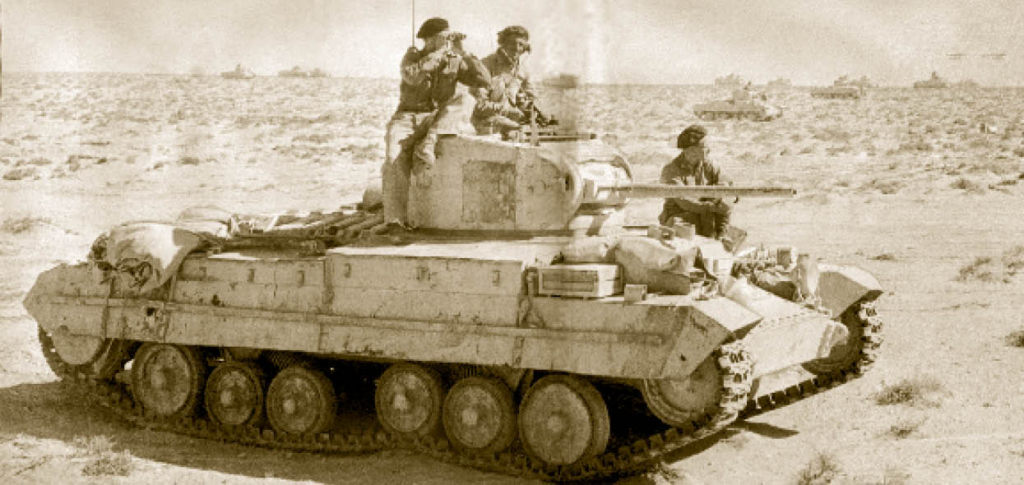
After these, Montgomery, realizing that it was impossible to break through the Mareth line frontally without suffering enormous casualties, readjusted his plans and threw all his weight into the supercarious maneuver, reinforcing Freiberg’s force with his reserve armored divisions. By the afternoon of 26 March, the Sahara Group and the 21st Panzer which had come to its relief, had broken up and were retreating towards El Hamma, pursued by the British, French, Greeks and New Zealanders. The efforts of the Italians and Germans to block the breach with the 15th Panzer did not succeed and so on March 28 the British occupied El Hamma, threatening to encircle the defenders of the Mareth line.
The Italian General Messe, the local commander, by constant retreating maneuvers avoided the pincers of the Allies, and on March 31 his forces established themselves defensively between the Gulf of Gabes and Cote El Jerid, along the Acarit stream.
During this time, however, Messe’s 1st Army (formerly the African Armored Army) had lost 16 infantry battalions, 130 guns and 60 tanks. Messe and his staff organized the site as well as they could, which was a fortress in itself, since the Akarit stream was a serious obstacle for the attackers.
Italians and Germans estimated that Montgomery would not attempt a raid against the new location before mid-April.
The 8th Army commander, however, had no intention of allowing his opponents to recover from their earlier defeat. Thus, on the afternoon of April 5, the 8th Army launched a surprise attack against the Akarit location. By the early hours of the morning, the site had been broken up, following fighting from the cluster.
The next morning, the Germans attempted to block the breach with a counterattack by the 15th Panzer Division and the 90th MP. However, they were repulsed and retreated under the pressure of two British Armored Divisions (1st and 7th). It should be noted that the 15th Panzer, once commanded by Rommel, formed the core of Afrika Korp.
The battle of Wadi (stream) Akarit had been won by the Allies. But the price was heavy. Of course, the omnipresent Holy Society had also participated in the battle, but leaving there, “perpetual guard” of the inhospitable Tunisian land, Ilarchos Grigorios Bourdakos. The Axis forces had also suffered much wear and tear. Nevertheless, they managed to retreat again.
Parallel to the attacks of the British 8th Army, the Americans, under General George Patton, undertook offensive operations in the west-southwest sector of the front in cooperation with the French 19th Army Corps. Patton’s forces in Morocco soon occupied Gafsa and El Getar, reaching as far as Foduk.
Von Arnim, the commander of Army Group “Africa”, had no choice but to fall back to the line Enfitaville-Po Di Fa-Metzez-El Bab-Bizerta. It took Hitler and Mussolini two defeats and considerable attrition to convince them of the correctness of Marshal Rommel’s proposal. In the meantime the Allies advanced, trying to maintain contact with the retreating opponents. The Holy Society, as a forerunner, entered Sfax and Susa, where it was enthusiastically received by the Greeks of the parish there.
Last battles
The African campaign was drawing to a close. Italians and Germans had retreated to the last line of defense, with forces completely exhausted.
Von Arnim’s divisions were questionable as to whether they had regimental strength. The 15th Panzer, this elite division of Afrika Korp veterans was left with only 15 tanks, and the 164th of the same Corps had two thin infantry battalions without artillery.
The Allies, on the other hand, made good their losses to a great extent and staged the final assault. The attack was opened by the 8th Army, whose 50th Infantry Division captured Enfitaville. But the British halted in front of Zagwan, Tunisia, unable to breach the site. In the other sectors, the Americans, British and French began to push the enemy front everywhere, after first repelling a strong German counterattack
The Axis forces, constantly pressed, defended step by step. Every village, every hill and anything that met the conditions was turned into a stronghold of defense to be captured by the lance. For 15 days the Allies, despite the all-round pressure they exerted on the enemy front, made little progress.
Even slowly, however, the Axis powers were losing ground. The mission of the final breakthrough (operation “Volcano”) was assigned to the British 1st Army, which was also reinforced by divisions of the 8th.
In the early hours of May 6, 1943, 600 British guns unleashed a ferocious fire on a front just 1.5 miles (2.5 km) into the junction of the German 334th Infantry Division and ‘Hermann Göring’, blowing up men, trenches, vehicles and command posts.
With the first light of day the allied air force continued the artillery work in depth. With the cessation of artillery fire, the Gurkhas of the 4th Indian Infantry Division attacked and after a few hours of hard fighting broke the location. The time of the “cavalry” had come. The British tanks passed through the breach and attacked the rear of the enemy. But the stubborn Germans did not give up.
They mustered 20 tanks under the command of the 15th Panzer and counterattacked against 600 British tanks! Unfortunately for them, the laws of numbers have been relentless. Thus, by afternoon, the 15th Panzer was gone and the “Desert Mice” 7th Armored Division, with the famous 11th Hussar Regiment in the foreground, liberated Tunis. In the center, the French occupied Ponte-di-Fa, while the Americans entered Bizerte.
The dissolution of the German 5th Panzer Army was now a fact and its commander, General von Faerst, seeing the futility of the struggle, surrendered his forces. Further south, the Italian 1st Army was still holding its positions. But it was only a matter of time before she crashed, since her back was now exposed.
On 11 May, the French entered Zhaguan, having neutralized the remnants of the 21st Panzer. The commander of the Army Group, General von Arnim, was also taken prisoner nearby. The next day Africa Corp also capitulated.
General Grammer, his last commander, sent his last signal at dawn that day: “The ammunition is used up. Weapons and materials were destroyed. The German Afrika Korps, as ordered, fought to the last straw. The German-African House will be resurrected. Long live the Safari.”
In the afternoon of the same day, the last remaining units of the Italian 1st Army surrendered their weapons.
Its commander, General Messe, was promoted to field marshal moments before he was captured, signaled by Mussolini who simultaneously ordered a cease-fire. Thus ended the war in the North African theater of operations.
After Stalingrad, the Axis had suffered another crushing blow, suffering total losses of 340,000 men – among them 22 generals. Only 638 men of Army Group “Africa” managed to escape by air…
Conclusions
The destruction of the Italian and German armies in Tunisia, just four months after the collapse of Stalingrad, was the “tombstone” in the plans of Hitler and Mussolini. Defeat on the African front was a harbinger of Allied attacks in southern and western Europe.
Italy, in particular, was mortally wounded by this defeat. Apart from the fact of the loss of its colonial possessions, it now became a direct target of the Allies. The new failure of the Italian arms, which had already been humiliated in all the theaters of operations in which they fought, had a direct impact on the morale of the Italian people.
So a few months later, when the Allies landed in Sicily, the Italian resistance collapsed and the Germans were forced to hold a second European front from 1943.
In terms of the purely military aspect, the Tunisian battle had a preordained outcome before it began. For this reason the mission of the 5th Armored Army in North Africa must be considered rather a wrong move, since the chances of success were small and the costs high.
The Germans, in trying to save one army, lost two. Hitler and Mussolini, instead of taking care to wrest what they could from Rommel’s Army, sent other forces (which were difficult to supply at least) to literally fight with their “backs against the wall”. The Allies, in undisputed control of sea and air, managed to isolate the theater of operations and wipe out the pitiful remnants of the once proud Panzers.
After this defeat, the way was opened for “Operation Husky”, as the Allied invasion of Sicily was called. The operation began on the night between 9 and 10 July 1943 and strategically achieved all objectives as planned.
Greece played an important role in the success of the operation, as the Germans believed that the landing of the Allied forces would take place on the coast of Greece, specifically in the Peloponnese, where the Allies would establish naval bases in the area of Kalamata and air bases in the area of Araxos.