



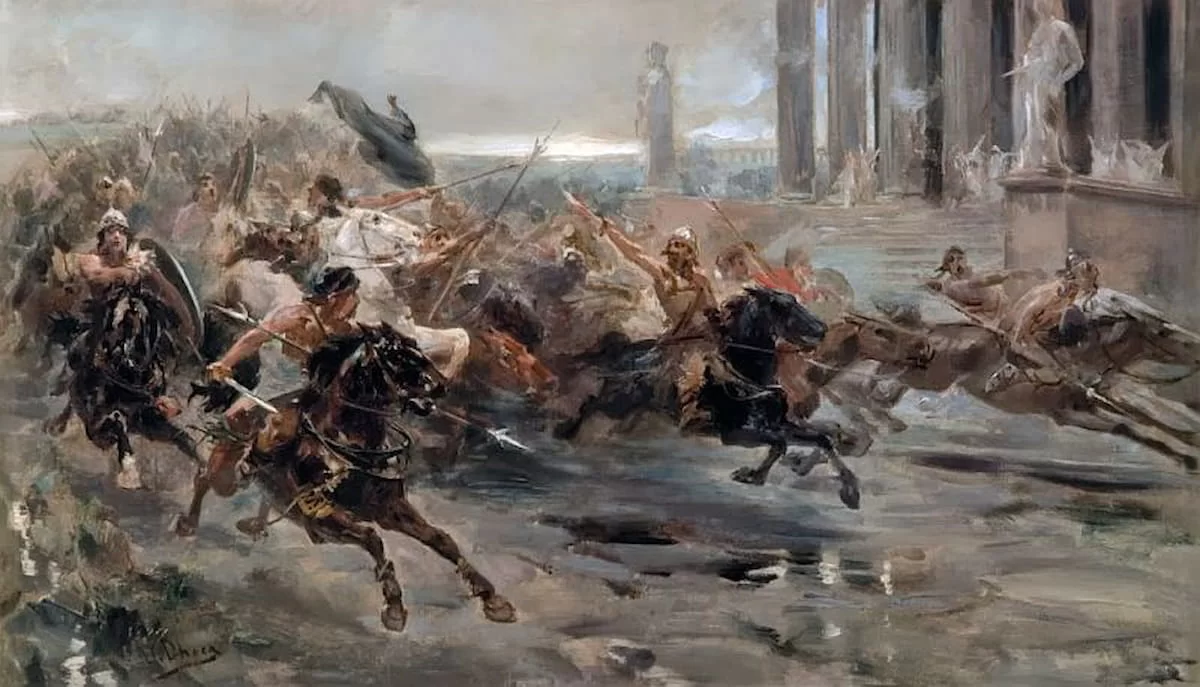
The great barbarian Attila was finally defeated by his allied rivals and the empire of blood he had founded fell apart. Attila, the king of the Huns, the leader of the barbarians, the living symbol of flowing blood, fire and destruction. He was the man who succeeded, by the power of his sword, in uniting all the barbarous nations and turning them against civilization
Already from the end of the 2nd century AD. the Roman Empire was clearly showing signs of decline.
Within this framework, the Huns, a people of barbarian horse archers, who derived their origin from the steppes of Turkmenistan, made their appearance on the historical scene. The contact of the Roman Empire with the Huns was indirect and took place through the Germans. The Germans, pressed by the Huns, invaded in the 4th century AD. within the boundaries of the empire.
Along with them, the first Hunnic elements also invaded the eastern imperial territories. The Huns were few. The bulk of them had remained across the border. The Huns had arrived around 374 AD. on the banks of the Volga. They had started from the distant steppes. From there they moved further west and after crossing all the major rivers of south-eastern Europe, they reached the Danube.
The Huns, being the nomads that they were, settled in the fertile Danube valley, in the areas of present-day Moldavia and Romania. Thus the Huns managed to spread, at the end of the 4th century AD. from Siberia to the Caspian Sea and from Samarakandi to the Danube. The Huns were the terror of the Germans, because of their war spirit and their ferocity.
That is exactly why the Romans thought of using them as the opposite awe of the Germans. No one believed that this small nomadic tribe was to play such an important role in world history. Everything would change when the Huns would acquire a unified and worthy leadership. The Huns initially lived peacefully in the Danube valley.
But they could not stay quiet for long. A large group of them, led by Oktar, turned towards central Europe. Although initially the Huns were successful, they were eventually defeated by the Christianized Burgundians (a German stock). The rest of the Huns who remained on the Danube accepted the proposal of the emperor of the East Theodosius II and in exchange for 350 pounds of gold per year allied with the Eastern Empire. A third division of the Huns, under Uldis, moved west and offered their services to the Western Empire.
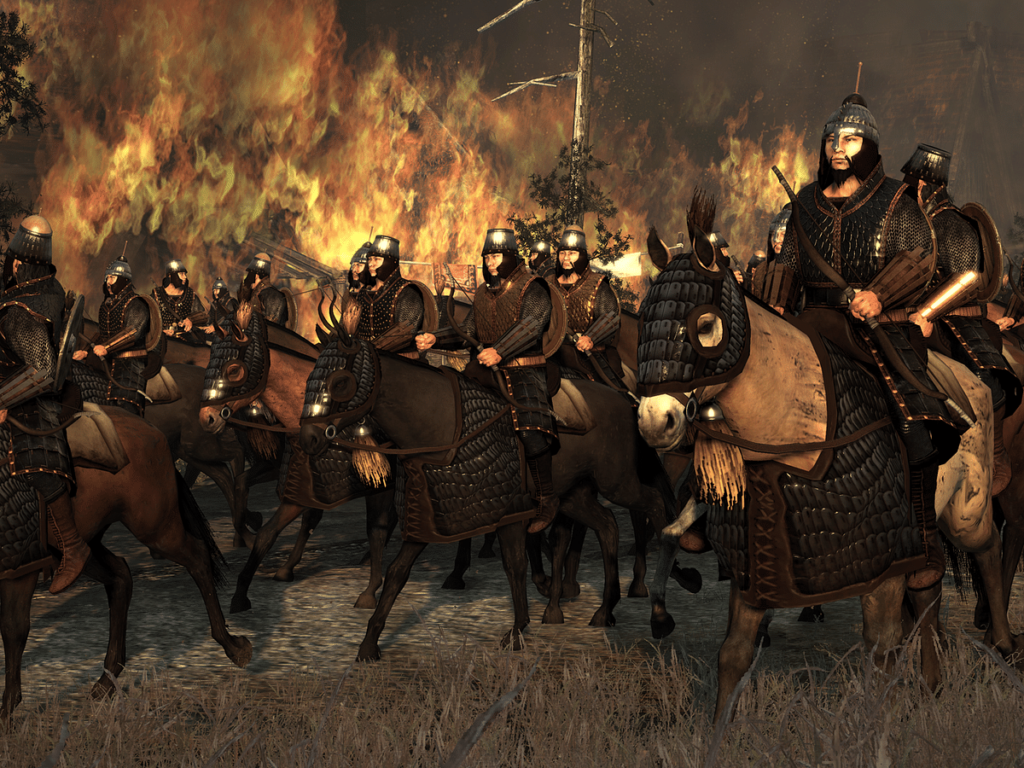
The small, ugly-looking Asians caused awe to the Romans when they appeared. Their opponents described them as strange humanoid monsters, spawn of demons, who spend their entire lives on horseback. They didn’t even dismount to sleep.
Simply when the sun set and night fell these creatures would lean on their horse’s back and sleep. The only thing they didn’t do on their horses was mating, as they typically reported.
In 395 AD in a wooden hut, next to the banks of the Danube, the Hun king Majuk was celebrating the birth of another son. The child was named Attila (Atli Etzel, in the Hun language), which meant “little father”. A few months later, another boy was born in Silistria in present-day Bulgaria, who was named Aetios. The two boys their age could never have imagined what the Fates had in store for them. They would find out 56 years later in the Catalunian fields.
The Hun prince was sent as a hostage to Rome after the death of his royal father. After his captivity ended and he returned, Attila gradually neutralized all other claimants to the Hunnic throne, including his own brother. Having strengthened his position, he launched a large-scale attack against the Byzantine Empire. But eventually he retreated, being bought out with large sums.
Attila, having covered his back in every way, was now ready for the “Great Conquest”, for the overthrow of the Roman Empire. He thought of attacking the Eastern state first and again. But Marcian’s ascension to the throne of Constantinople contributed to Attila’s decision to leave the Eastern Empire alone when he realized that the new emperor was ready to confront him.
Markianus was a soldier, originally from Thrace. He was hyperactive and brave. He was not afraid of Attila, and right from the start he made it known to everyone. So when the Hunnic representatives of Attila came to Constantinople to collect the servitude tax that Theodosius II was paying to the Hunnic king, Marcianus not only did not pay the money, but told them to convey the following message to Attila: “If he wishes, let him come and collect them himself. I will wait for him with my men, who are as good as his men.’
So he decided to turn first against the Western Empire, which he considered completely decadent and ready to surrender to him. After all, the emperor of the West, the aloof and cowardly Valentianos III, was not a particularly worthy opponent for him. The only person who could give him trouble was the “last of the Romans”, the brave Aetius.
As an occasion for his claims, Attila dug up from the depths of his mind an old story with Honoria, the sister of Valentianus, who had promised him eternal love and as proof had given him her ring when he was a hostage in Rome. So he demanded from Vallentianus, sending his ambassador, to give him Honoria as his wife. He also demanded half the empire as a dowry. Honoria was nothing more than a pretext to carry out his preconceived decision to launch an unprecedented attack on the Western Empire.
The Battle of the Nations
As the winter of the year 450 AD approached, the climate of uncertainty within the empire intensified. Marcian in the East, unaware of Attila’s true intentions, was gathering forces. In the West, Aetius continued preparations as best he could, also unaware of the exact place and time that Attila would launch his attack. Aetius, however, managed to ally himself with the Visigothic king Theodoricus, who was also in danger from the Huns. But the Hun king was also completing the final preparations for the “Great Conquest”.
Aetius believed that Attila had two possible axes of attack. One was via the Rhine and the second via the Austrian highlands-plain of today’s Trieste-Podus valley. The first road was suitable for the development of cavalry masses, since along it there was a province for horses. The second route was more difficult for horsemen, but it led directly to the vital geographical space of the Western Empire, the Italian peninsula. In this case, however, Attila followed the dictates of the indirect strategy and chose the route through Gaul. Possibly he aimed to exterminate the Visigoths first, whom he considered easier opponents.
In January 451 AD thousands of Huns, Gepids, Alans, Rugians, Franks, Thuringians and also Slavic fighters gathered on the east bank of the Rhine river in the area opposite the present day city of Strasbourg. The sources state that Attila had managed to gather there the whole of his formidable army, about 700,000 men. This number is probably over-inflated, or it includes civilians, who always followed the army on campaigns.
However, Attila’s fighting force should not have been less than 300,000 men, since only his vassal nations had about 100,000 fighters. Of this total, 60 to 70% were horsemen.
Aetius was informed by spies of Attila’s departure from his capital. He was also briefed on the first steps of the vast army. But gradually the flow of information ceased, and the Roman general again began to make assumptions about his opponent’s movements. Aetius reckoned that the Franks and Thuringians, who lived between Alsace and Saxony, would offer even little resistance to the Unnic hordes.
However, this did not happen and the Franks killed their Roman-loving king and joined Attila, while the Thuringians joined almost together. Aetius therefore, left with fewer and fewer allies, suddenly learned that the Huns had reached the Rhine and that they had even begun to cross it in ships, hesitantly at first, fearing a Roman ambush, en masse a little later, through floating bridges they had built. Before long, Attila’s huge army was encamped around the great city of Trier (modern Trier).
Attila encountered relatively serious resistance, for the first time since the start of the campaign, from the Burgundians, under Ginder, who resided in present-day Lorraine. But he defeated them and then divided his huge army into two divisions. The first was ordered to move north-west towards Arras. The second division, led by himself, marched along the valley of the Moselle and reached the town of Bensazon, which he leveled. The same fate had the cities of Worms and Magentia, but also Colmar, Tongre and Arras. Mets’ tying followed.
Attila’s hordes were moving swiftly and burning everything in their path. Anyone who resisted was slaughtered without a second thought. Already the Hunnic Cavalry had spread over a vast area, from the Swiss Jura mountain range to the Atlantic ocean. Carrying out his plans, Attila moved thousands of his men towards the Liger. His army crossed the Seine at Nozan. He then unleashed his hordes against Troy. The city was completely destroyed. On May 2, 451 AD Attila became master of the fords of the Liger and encamped before the walls of Orleans.
The bishop of the city, Anianos, had taken over the direction of the Defense and had taken care of equipping and organizing the inhabitants into rudimentary military units. The brave bishop had also taken care to send word to Aetius to hasten to the aid of the city. What was at stake in Orléans was not the existence of the city as such, but the survival of Rome’s allies the Visigoths, and by extension the survival of the Empire, but also of civilization in Europe.
After analyzing the strategic situation, based on the new information he received from the bishop of Orleans, Aetius moved with his army for Arles. Before departing, however, he sent a letter to the king of the Visigoths informing him of Attila’s progress and inviting him to join his forces with his own.
In the meantime, the people of Orléans were forced to surrender due to lack of food. As soon as the Huns entered the city, they immediately began the massacres and looting. But then Aetius arrived. Through the open and foaming gates, Aetius’ men entered the city, surprising the looting and drunken Huns. The Huns fled as soon as they received the first onslaught of the Romans.
In vain the enraged Attila tried to restrain the flight of his men. The barbaric Asian surfer continued his flight until he was many kilometers away from the city. But he left behind thousands of his dead. The Huns fled to Campania.
Back in Orleans, Theodoric was pressing Aetius to pursue the retreating Huns. But the Roman general did not agree. He thought it unwise to risk pursuing Attila on the great plain, where his Equestrian superiority could prove decisive. On the contrary, Aetius left his army to rest in Orleans and only the next day he moved north, in pursuit of the defeated Huns.
At the same time gloom prevailed in Attila’s camp. Defeat, the first the barbarian chieftain’s arms had known, had frightened his men and put an end to the mystical delusions of Attila’s invincibility. The Huns were not invincible, and their opponents knew it.
Attila continued his northward retreat. He wished to reach the vast plain of eastern Campania, near the city of Salon. On the great plain his indomitable Cavalry would take revenge on the enemies for the defeat of Orleans. According to the testimonies of the time, Attila had met a monk before the battle, who had told him the following: “You are the scourge of God and the hammer with which Divine Providence strikes the world.
But God crushes when He wills even the instruments of His vengeance, and gives His sword from one hand to another, according to His infallible will. Know then that the Romans will defeat you, for power does not come from earthly things, but from God.” Attila, however, did not fear, he continued to move and, shortly before nightfall, he camped north of the plain of Moriak. On the plain he had established as a rear guard a strong division of Gepids. At the same time the allied army of Aetius continued the pursuit of the Huns.
Aetius had marshaled hard German horsemen as a vanguard. The Germans, under Merobaeus, continued their movement, and by the last light of day had reached Moriak, near the position where Attila’s Gepids had taken up their position. The latter had seen the clouds of dust from the horses of the Germans and had become alarmed, thinking that the whole army of Aetius was approaching against them.
In the meantime the Merovian Germans had become aware of the presence of the Gepids. Soon they were attacked with roars, despite the fact that it was already dark. A fierce battle then broke out in the darkness, with no one able to recognize friends and enemies. In the confusion, many men from both armies fell. Finally, however, the Gepids, always believing that they were being attacked by the entire allied army, fled in disorder, pursued on foot by the Germans.
The Gepids continued to flee even after they reached the position where Attila’s army was. Panic soon spread throughout the army. In the meantime, the few German horsemen of the Merovians had now arrived inside the Unnic camp. Like demons, chanting their terrifying war hymns, the Germans rushed upon the Huns already panicked by the Gepids, and drove them to disorderly flight.
The entire horde of several thousand men was put to flight by the charge of no more than 2,000 horsemen. Attila again attempted to regroup his unruly troops. But fear proved to be stronger than him. After this new accident, all that remained for him was to move as quickly as possible to Salon, where he had ordered the gathering of the remaining parts of the army, which were operating in north-western Gaul.
There, with his entire army gathered, he planned to crush the allied army, which was also numerically inferior to his own troops.
It was July when Attila finally managed to gather his army near the city of Salona, in what became known as the “Catalunian Fields”. Many historians dispute the view that the famous Catalunya fields were located near Salon. To this day, the exact location where the most terrible battle of the medieval world took place has not been determined.
It is more likely, however, that the battle was actually fought on the great plain of Campania, near the city of Salon, where the topography of the land favored the Huns. Also, the exact date of the battle has not been determined, leaving the field open for speculation. It is most likely that the battle took place on July 20, 451 AD.
On the evening of July 19, the Unnic troops, led by their formidable king, were encamped south of Salon, around the ruins of an old frontier Roman fort. Within the half-destroyed enclosure, Attila ordered the carriages with his supplies and headquarters. At the same time the allied army had arrived opposite the Huns, at a distance of a few kilometers. Aetius had made the most of the information he had received from Merobaeus and had correctly assumed that Attila would be waiting for him in the Catalunian fields, in favorable ground for him.
At first light on July 20, Aetius moved his divisions into battle formation and ordered the advance on the enemy. His objective was the capture of a small wooded hill, which dominated the center of the otherwise smooth landscape. Attila also realized the value of the hill. Unfortunately for him, however, he had not taken care to understand this since the night before, miscalculating that Aetius would not approach their positions before the 21st of July. But now that he was surprised to see the entire allied army facing him, he angrily ordered a part of it to hasten to capture the hill at any cost.
This particular hill was indeed of great tactical value, since whoever possessed it had an excellent field of vision for the enemy’s movements, but also a first-class support point. The Hun horsemen, faithfully executing the order of their leader, galloped towards the hill at the utmost speed of their horses. But their movement was perceived by the son of the Visigothic king, Thorismund. The Huns first pressed the divisions that occupied the hill, and almost overran it. But then they received the attack of Thorismundus on their exposed left flank and fled. The hill had been won for the allies.
Aetius, after this first success, deployed his army, supporting the center of his faction on the hill. The Franks, Burgundians and Saxon foot soldiers lined up on the hill in dense formations. In front of their front, on the edges of the hill, the Alan horsemen lined up, with the aim of acting as a mobile front to protect the infantry.
In case they were hard pressed, the Alans were ordered to break their formation and move half to the left wing and the other half to the right. If the Huns then continued their attack against the hill, the Alans would again attack them from the flanks, while they would already be “hooked” by the German Infantry.
On the right wing were the forces of the Visigoths led by their king Theodoric and his son Thorismund. The Visigoths lined up in two lines. The first was composed of foot archers, whose purpose was to break the initial momentum of the Hunnic attack, and the second was composed of their famous heavy cavalry, which would attack the Huns as soon as the latter showed signs of disorganization.
On the left wing Aetius commanded his Roman Army. His infantry lined up next to the hill, his right being covered by it, while his cavalry lined up on the extreme left. The legionnaires lined up in dense formations too, at a great depth. Each legionary division also had an organic sub-unit of archers, which had the effect of increasing its endurance against the famous Unnic cavalry.
Attila, for his part, seems to have commanded his army rather conventionally, according to the teachings established among the Huns. Probably the entire front line consisted of cavalry. The Huns had no infantry of their own, and all the infantry divisions of the barbarian army were composed of German vassals. Knowing the line-up of Aetius’ army, we can assume that Attila lined up his army in a way that best matched the line-up of the opponent. That is why we assume that the entire first line of battle was composed of cavalry, and in fact light Unnic, but also heavy Ostrogothic.
Attila’s Hunnic horsemen could pin the two strong wings of the allied army while other horsemen, perhaps heavily armed Germans, would launch a heavy attack to overturn his Alan horsemen or even to overturn Aetius’ legionnaires. Once this objective was achieved and only then would Attila throw into battle his precious infantry, which alone could drive the opposing infantry from the hill, capture it and hold it.
The time was 10.00. The two armies stood still, facing each other. Aetius counted on the indiscipline of the Huns to help him. He knew that the barbarians did not like long hours of waiting, which irritated them and demoralized them. Aetius was certain that the waiting attitude he intended to maintain would lead the barbarians to launch a swift, untimely and uncoordinated attack.
And he judged correctly. At noon, even Attila himself could not hold his men together. Small at first, larger later, detachments of Huns would abandon their lines, rush in and be repulsed in waves by the allies with ease, leaving many comrades behind dead. Aetius, clearly pleased, watched his expectations come true. In order to intensify the irritation of his opponents, he decided to inspect his arrayed forces.
The sight of the haughty general was a first-rate tonic for his units. His soldiers cheered him with cheers, rhythmically banging their weapons on their shields, and creating a veritable pandemonium. A few hundred yards farther on, the Huns watched gloomily at the grand sight, and heard, not without an inward fear filling them, the cheers and the clang of the adversaries’ guns.
As soon as Aetius had finished riding, he returned to his seat. He did not accept Theodoric’s proposal to launch an immediate attack against the enemies, taking advantage of the enthusiasm of the men. Aetius insisted that they should wait.
It was past noon. The time was approaching 15.00 and the same irritating immobility prevailed in the two armies. Disorder, shouting and confusion had taken over the Unni faction. It was obvious that Attila could wait no longer. Suddenly the air was filled with sky-high screams. Drums and trumpets began to sound. Attila, prominently in the center of his line, was giving orders.
Seconds later, thousands of horsemen rushed forward. Aetius saw the raging mass galloping towards them and ordered his infantry to thicken their formation. Before the order was well executed, the Hun horsemen had arrived in front of the Alans, pressing them suffocatingly.
The Alans were hard pressed, but, with their flanks covered by Roman legionnaires and Visigothic archers, withstood the pressure and held off the Hun’s charge. The same is repeated on the allied right, where the brave Theodoricus, not only stopped the enemy attack with his archers, but counterattacked with his heavy cavalry and, after overturning the Hunnic and Ostrogothic Cavalry, attacked the satellites with his spearmen Attila’s Ostrogothic foot soldiers. Finally he was repulsed and retreated to his original positions. On the other wing, the Roman legionnaires also took undisturbed the attacks of Attila’s Germanic Infantry and Hunno-Germanic Cavalry.
Only on the extreme left was the Roman cavalry seriously pressed by the elite opposing cavalry. Nevertheless, he withstood the enemy pressure and repelled the attack. Attila, seeing the army’s attack failing along the entire length of the front, decided to gather his elite Hun warriors and with them attempt a final assault to break the enemy’s center.
At the same time the divisions of his German vassals were to pin down the Romans of Aetius and the Visigoths of Theodoric, so that they could render no aid to the threatened centre. The battle was entering its most critical phase. The elite Hunnic Cavalry charged with unimaginable speed against the Alans and overthrew them. Attila’s second-echelon reserve infantry were in turn thrown into the fray.
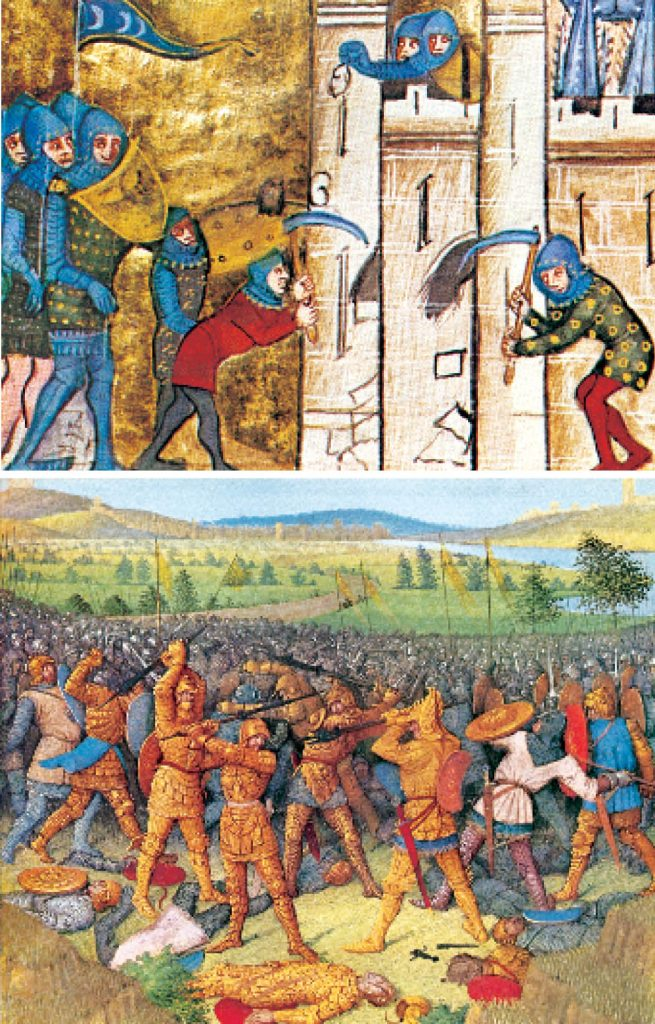
The infantry, supported by the cavalry, approached the shield wall of Rome’s allied Germanic fighters. Soon the clang of arms could be heard everywhere. The opponents now fought with an unprecedented, incredible fanaticism. Even maimed men attempted to grab their opponents with their teeth. The intensity of the battle in the center did not leave the opposing divisions on the two wings unaffected. Aetius seeing the Huns engaged in a deadly struggle of attrition in the centre, decided to counter-attack the wings. The Visigoths, on the right wing, moved first. They were always led by their old king Theodoric.
Spear in hand, Theodoric rushed into battle first. Before long, both he and his horsemen were involved in a fierce fight with Attila’s Ostrogoths and Huns. The Visigoths gradually gained ground, forcing the enemy to retreat. But then the fateful thing happened: Theodoricus fell hit by enemy spears. His men froze at the sight of the dead king. But then Thorismundus appeared. “For Theodoric,” he cried. “For Theodoricus,” his warriors also screamed and rushed furiously at the enemies.
The Visigoths cut to pieces any opponent they found in front of them, not caring about the losses. They fell with wild fury upon the wall of the Ostrogothic satellites and routed them. While this was happening, Aetius on the left wing ordered those under him to advance. The Romans, the only regular army of the time, advanced in formation as a veritable human wall, sweeping away the barbarians they encountered.
They counterattacked to intercept their advance. The Germans and Huns fought with extraordinary bravery. Heedless of their dead comrades, the Gepids used the corpses as pedestals to climb over the Roman shields and strike them with their swords. Hunnic horsemen did the same. Nevertheless, the Romans endured. When the enemy climbed onto their shields, the legionnaires raised them to hold them up and cut their legs with their swords.
The counterattack failed. Aetius’ men continued their advance. The Visigoths also managed to crush their opposing enemies and reached the Unnic fortifications, outside the old Roman fort. The Unnic center also after the collapse of the wings retreated in turn so as not to be cut off. Attila then realized that all was lost.
Night lay dark over the battlefield, which was littered with the corpses of 300,000 men. Around midnight, Attila saw many fires burning in the enemy camp. The scouts he sent informed him that the enemy were mourning the death of their leader. Overjoyed, Attila, thinking that the dead man was Aetius, ordered the war drums and bugles to sound and the men to cheer. Suddenly the horrible night was disturbed by the sonic pandemonium of the Huns. Aetius, alarmed, ordered his men to be on the lookout, ready to repel any night venture of the defeated, but ever-feared adversary.
Aetius, after honoring the dead Theodoricus, called a council. In the discussion that followed, both the barbarian allied leaders and his own staff pressed him to attack the fortified Huns. Aetius, however, was adverse to such an undertaking, considering the horrendous losses his army would suffer in such an operation. After this, Aetius’ German allies left. Only the Romans were left in the camp.
Attila ignored the suggestions of his subordinates to attempt a new attack, even when his scouts informed him that only the Romans were left in the enemy camp. The Romans, however, were led by Aetius, the man whom Attila feared, the only man who held the bloodthirsty barbarian leader in awe. Attila gave the order to prepare for departure at first light.
The next day dawned. The fires in the Roman camp were slowly dying out. Only the targets roamed the ramparts of the camp. Beyond the horizon the chariots of the Huns began to roll slowly to the northeast, for the Hungarian plain. The warriors followed, rapacious. The guard officer woke Aetius. He announced to him that the Huns were leaving.
The victor wrapped himself in his cloak and proceeded to the main gate of the camp. He carefully watched his barbarian opponents withdraw. Suddenly a horseman broke out of the mass and approached. He stopped short and looked at the corpse-strewn field. Then he saw Aetius. He raised his hand and with one movement greeted him.
Romeo also raised his hand and greeted him in the same way. Then Attila, for he was the horseman, turned to his army, whipped his horse, and perished. Aetius stood gazing at the battlefield in the cool of the morning. He had smashed the “hammer of the universe”.


