


With the deal on Iran’s nuclear program still pending – and the question of whether and to what extent it will be able to “unwind as the war in Ukraine continues and as the US prepares to enter the 2024 election cycle – the Iran is looking for other outlets for its oil, but also for its economic transactions in general.
And it seems to be largely looking… east. That is, in the direction of China.
Tripling of Iranian oil exports to China
According to estimates, Iranian oil exports to China have roughly tripled in the past three years. In particular, in 2020 exports were at the level of 324,000 barrels/day, to increase to 584,000 and 770,00 barrels/day respectively in 2021 and 2022 and according to the indications from January 2023 until now they have reached the height of 1 .1 million barrels/day.
This increase is of particular importance for Iran. And this is because the country received a very serious blow to its oil exports when the US government, under the presidency of Donald Trump, decided in 2018 to unilaterally withdraw from the agreement on Iran’s nuclear program and thus reimpose unilateral measures on Iran.
US sanctions on Iran mean that not only can US companies not trade in Iranian oil, but it also creates a particularly stifling environment for foreign companies or banks that would like to do business with Iranian companies, as they face sanctions from US authorities even when the their countries have not imposed similar sanctions.
One such typical practice is the occasional seizure of Iranian oil cargoes even on the basis of US court rulings linking Iran to terrorism support and ordering the seizure for compensation purposes. It is no coincidence that various cases of Iranian authorities detaining foreign tankers are in retaliation for such seizures.
The result of the escalation of US sanctions was in the first instance a real collapse of Iranian oil exports. According to estimates, the result of the change in American policy was that Iran’s oil exports fell from over 2 million barrels per day at one point even to a level of just over 400,000 barrels per day.
But then the demand from China and other countries that do not share in the US sanctions seem to have led to the recovery, at least to some extent, of Iranian oil exports.
Iran insists things are getting better
In any case, recently representatives of the Iranian government have put forward optimistic estimates for oil and gas condensate exports, claiming that Iran’s relative production capacity has currently reached 3.8 million barrels per day.
In fact, recently the Minister of Oil of Iran, Javad Ouji, claimed that in the last 20 months, his country managed to close deals worth 40 billion dollars with friendly countries.
One reason for this increase in exports is that Iran can offer relatively lower prices, attracting oil-hungry customers such as China.

The importance of participating in the Shanghai Cooperation Organization
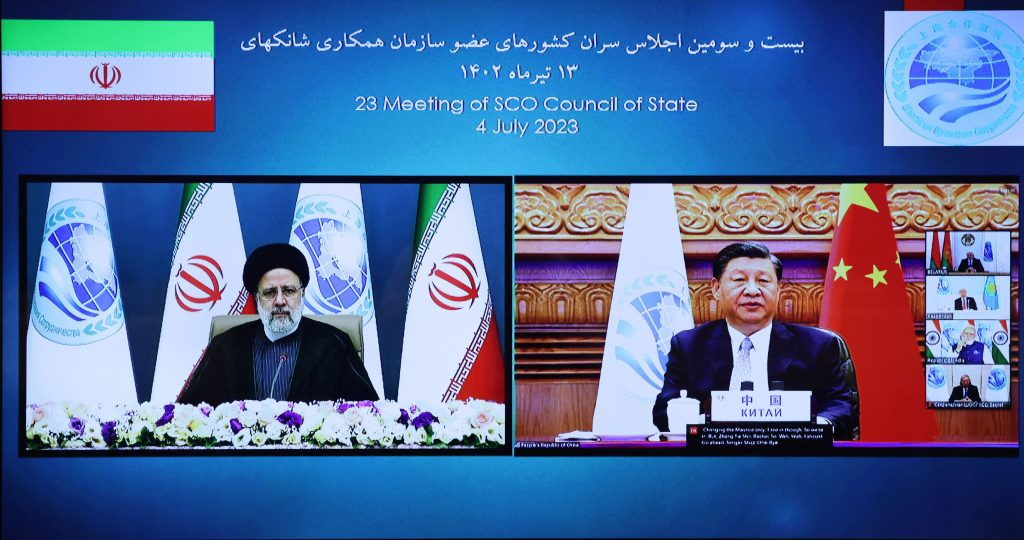
The completion of Iran’s accession process as a full member of the Shanghai Cooperation Organization marked a more comprehensive choice to upgrade cooperation with Russia and China.
In a way, it signals a more comprehensive assessment of the Iranian leadership, especially the “conservatives” who are now in power, that at this time there is no scope for upgrading relations with the West, even though this has long remained a key pursuit and was, after all, the main reason that Iran had accepted the nuclear deal.
However, with the prospect of the continuation and escalation of sanctions on the part of the US, sanctions that are formulated in such a way as to essentially bind other Western countries in their practical application, the turn to the east became almost a one-way street .
Anyway, as recently highlighted by the official Iranian news agency itself, Iran’s trade, excluding oil, with the member countries of the Shanghai Cooperation Organization between March and August 2022 increased by 31%, reaching $17 billion .
Certainly, the Shanghai Cooperation Organization remains a rather loose structure and had neither the features of economic integration that we observe in other forms of interstate cooperation, nor the “tight” defense structure of NATO. However, even at the symbolic level it is an upgrade of Iran’s cooperation with Russia and China.
Mainly, together with the upgrading of economic cooperation with China and cooperation in the level of supplying drones from Russia, it signals that the Iranian leadership appreciates that we are moving at an accelerating pace into a more divided and multipolar world and is making the choice to coordinate more with the pole in which Russia and China play a leading role.
In addition, joining this organization facilitates China’s cooperation with other countries that belong to it, such as India, in which the Iranian leadership is looking for important investments.
If we add to all of this the Chinese investments in Iran that have already been discussed and are being planned, as well as the various plans for large transit axes that will implement the “One Belt, One Road” strategy and which include Iran, we can understand the importance that has this “turn to the east” of Iran.
Republicans push for new sanctions against Chinese doing business with Iran
All this has alarmed the US and especially those sections of the US establishment that have a traditional hostility towards the Islamic Republic.
Against this background, it is no coincidence that recently a group of eight Republican senators, led by Marco Rubio (Florida) and Jim Rees (Idaho), sent a letter to US Secretary of State Anthony Blinken and Treasury Secretary Janet Yellen, in which they still impose more sanctions against Chinese citizens as well as Chinese companies involved in the Iranian trade of oil and other petrochemical products.

