

On the North African front, Rommel tests the endurance of the British 8th Army at the Gazala Pass, with the port of Tobruk as a prize.
Taking the initiative, reinforced with supplies, Rommel was determined to defeat the British in the field and pursue them into Egypt. This time, however, the “Fox” would not make the same mistake as last year, bypassing the fortified port of Tobruk which would be a thorn in his side. He was determined to understand and use it by shortening his supply distances. Resupply had proved key to any action in the fast-paced desert war.
The German forces had proved extremely dangerous due to the superior and heavily armored Panzer III tank as well as the Panzer IV. The small force of the Luftwaffe had succeeded in gaining dominance of the airwaves and to the excellent staff work of Rommel’s headquarters, the ingenuity of the staff at all levels had to be added, providing solutions where needed, such as the use of the most powerful Flak anti-aircraft guns 18 of the 88 mm as anti-tank and support, with decisive results against the light British armour.

American M3 Grand main battle tank is unloaded at a British Army installation for immediate deployment to the front. 167 tanks were received by the 8th Army just before the battle of Gazala and together with a significant number of 6-pounder anti-tank guns would have made some difference to the front if all battles were judged by material alone.
On the other hand, the British did not sit and wait. Supplies arrived by sea and greatly reinforced the 8th Army, including American Grand tanks that also had the most powerful 75 mm gun in the breech, giving for the first time a significant advantage to the motorized forces. Tobruk, whose strategic importance was made clear in the earlier conflict, was reinforced with supplies, armaments and new lines of minefields, barbed wire and machine guns.
Rommel’s first move was to outflank the British lines from the south, but dangerously extending his supply lines. The unexpectedly strong defense of the French garrison at the Bir Hakim site forced the Germans to run out of water in the middle of the desert and become trapped between British minefields.
The British tried to embarrass him, but Rommel boldly positioned himself between their supply lines and the strike forces and waited. At the same time, making good use of his Italian allies, he commissioned them to clear the minefields and build new transit routes.
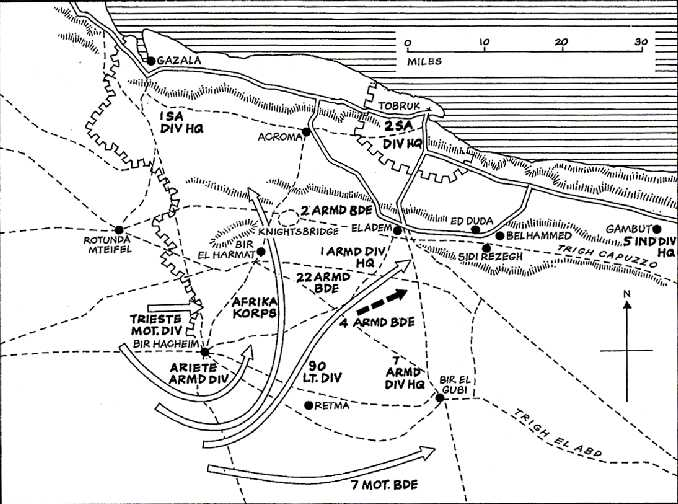
Niall Ritchie, commander of the 8th (with General Auchinleck, commander of British Middle East forces constantly watching over him) charged head-on but was decimated. Poorly prepared at staff level, hastily organized and executed, the British attack had some chance of “crushing the snake’s head” but despite the hardships and courage of its soldiers, it was crushed itself.
The British braked and Rommel attacked starting on 26 May 1942 from the coastal road near the village of Gazala (mainly with Italian forces) while the bulk of his troops moved from the south. In a series of skirmishes until June 17th he had inflicted heavy losses on the British, forcing them to withdraw, leaving behind Tobruk which was captured on June 21st (within a day).

The victory at Gazala and the capture of Tobruk are considered the greatest hour of the Deutsches Afrika Korp (DAK) and the most important success of Rommel’s career. The news was celebrated in Berlin with triumphalism laced with propaganda as Hitler congratulated Rommel by awarding him the baton, the youngest General in German military history to win it, aged just 51.
Twenty-five days later, with both sides exhausted, Auchinleck would halt the German advance at El Alamein. DAK’s success at Tobruk and the prospect of an invasion of Egypt absorbed all available Axis forces and supplies in Africa, postponing the planned invasion and occupation of Malta (Operation “Herkules”).
The losses of the British amounted to 50,000 dead, wounded and prisoners (35,000 only the garrison of Tobruk) while Germans and Italians will lose about 3,000 each and more than 500 tanks. At the end of the operations, however, the Germans had less than 50 tanks operational so they could not continue the attack. The Italian XX Army Corps had just 11 tanks and the German 90th Light Division fielded fewer than 1,700 men.
The British will breathlessly fortify Egypt and turn Malta into a new thorn in the side of the Axis, taking over from Tobruk. DAK’s overextended communication and supply line would prove to be his Achilles’ heel once again. Unable to attack, difficult to reinforce and with the British organizing day by day, he would conduct a series of operations to break British resistance as long as he could (operation “Aida”) but with little effect.