



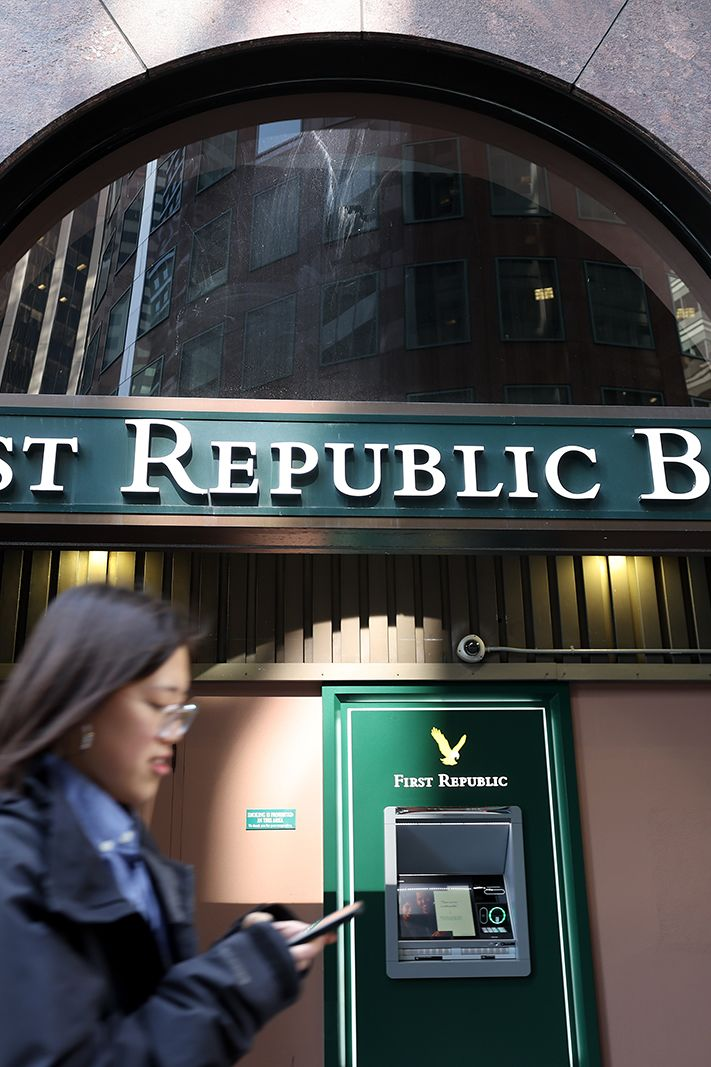
The collapse of First Republic Bank was the second largest bank failure in US history. The single biggest bank failure was that of Washington Mutual in 2008. The bank’s market capitalization in February was $25 billion. Now the value of the securities held by the shareholders has simply been wiped out.
The bank faced the problem that many banks face today. It had granted a very large number of loans with low interest rates, mainly mortgages, while today it itself has to face higher borrowing costs, due to the rise in interest rates that the FED has been engaging in lately as part of the effort to deal with the intense inflationary pressures of last interval.
But, as in the case of Silicon Valley Bank, the mechanism that ultimately triggered the bank’s collapse was a massive flight of depositors as the bank’s problems began to become known. It is estimated that the flight of deposits from the bank – which was the 14th largest creditor in the US – reached 100 billion dollars.
The initial attempt to prevent the collapse of the bank was made by other banks who rushed to deposit about 30 billion in the bank, but this could not reverse the situation and the course towards collapse.
Private individuals enter as saviors
To avoid the risk of depositors losing their deposits, especially if they exceeded the $250,000 limit, which is the guarantee limit based on federal law, it is clear that an effort was made to activate the private sector. This was undertaken by the FDIC, the Federal Deposit Insurance Corporation, an institution funded by American commercial banks and one of the creations of the Roosevelt era and the experience of the 1929 crisis.
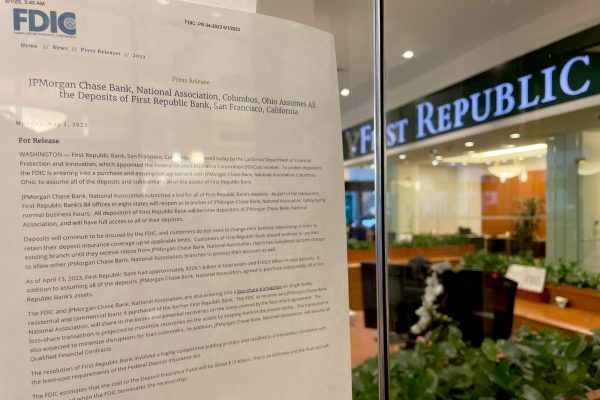
It was in this context that the buyer of First Republic’s deposits and loans and bonds was eventually found. This was JPMorgan Chase. And although in doing so the acquiring bank exceeds the federal limit of holding more than 10% of total deposits, the exception applicable to the case of a failed bank acquisition was nevertheless triggered.
All winners?
The whole development was met in the US with various expressions of relief. On the one hand, the possibility of losing deposits, which would have awakened the worst memories, was avoided. On the other hand, the entire deal did not include additional funding from the federal government, so the Biden administration cannot be accused by Republicans of government waste.
And of course the big winner is JPMorgan Chase itself, which will pay the regulatory authority 10.6 billion dollars, while the FDIC itself will have a cost of about 13 billion, while it will also offer JPMorgan a five-year loan of 50 billion dollars. JPMorgan will thus acquire $185 billion of interest-bearing loans and other securities and is estimated to have annual profits of at least $500 million a year (some analysts believe that the related annual revenue may reach as much as one billion dollars). In addition, the FDIC has agreed to assume the cost of any defaulted loans.
However, despite this image, it is by no means a given that we are dealing with a “good ending, all is well”.
The depth of the banking crisis
To understand the magnitude of the banking collapses of recent months, it is enough to consider that the three American banks that collapsed in recent months (Silicon Valley Bank, Signature and First National) had total assets of 532 billion dollars. This is larger than the combined size of the 25 bank failures from 2008 to 2022…
If we look at the fact that all this coincides with the collapse and takeover of Credit Suisse, it becomes clear that there is a more general issue with the banks.
Obviously and in each case one can see different problems. Another thing e.g. the long history of problems at Credit Suisse and the problems of US banks related to the upheaval brought about by the change in interest rate policy. Certainly, the fact that the bank run has now been greatly facilitated by technology also counts, as huge sums can be transferred at the push of a button.
But it is clear that there is something deeper. This has to do with both the banking system and the state of the global economy.
Let’s not forget that bank failures are usually violent “corrections”, i.e. moments where what the banks “pre-approved” – as investment, profitability, macroeconomic condition, etc. – does not correspond to what is happening in the economy.
This may have to do both with the financial system’s innate tendency towards such mismatches (or ‘bubbles’), and with problems in the global economy as shown by symptoms such as elevated inflation, or – which is the most common… – a combination of both.
In this sense, the relief from the “resolution” of the issue, or the almost coercive assurances that no further collapse is expected, are more wishful thinking than reality.
The combination of inflation, the looming recession, rising interest rates (and the realignment of yields in a range of securities that bring wider upheaval as the near-crisis of the UK pension system showed) all suggest that it is anything but the storm in the global financial system.

