Although the US has repeatedly defended keeping its own forces on the ground in Syria, and even with elements of control over the country’s oil wells, as a forced option to be able to continue to coordinate with Kurdish militias in the fight against the Islamic State, increasingly those who argued that they mainly claimed to have a reason for the next day in Syria are more vindicated.
This has become particularly clear lately against the background of the multi-layered dynamics of normalization of relations with the Damascus government that are underway in the region. This, in turn, reflects the long-established correlation that makes it clear that “regime change” in Syria is not possible. And this is because in fact from 2015 onwards the government forces with the cooperation of Russian forces, Iran and other pro-Iranian forces such as Hezbollah managed to regain control over most of the country. Even the stagnation in relation to the situation in the Idlib enclave, which is still controlled by the evolution of al-Qaeda in Syria, has to do with the consensus that Turkey has obtained for now that its forces will not be targeted opposition that it supports, rather than with an inability to exert more pressure.
It is against this backdrop that the US seems to be looking for ways to intervene in this juncture and to find ways to stem the dynamics that are developing against the backdrop of a world that is both increasingly divided and increasingly complex.

The importance of Saudi Arabia and Iran reapprochement
The recent rapprochement between Iran and Saudi Arabia, after Chinese mediation, two countries that supported opposing sides in the civil war in Syria, also forms a dynamic of rapprochement with Damascus. There has already been the massive shipment of aid from Saudi Arabia to Syria to deal with the effects of the devastating earthquakes, while recently it was announced that discussions are underway for the two countries to regain consular services, as a step towards the full restoration of diplomatic relations. which would also open the way for the return of Syria to the Arab League.
The rapprochement with Egypt was preceded, but also steps towards rapprochement with the United Arab Emirates. Let us not forget that especially the Gulf countries also see the investment opportunities that will be offered by the post-war reconstruction of Syria, which still has several wounds from the war, to which were added the great disasters caused by the recent catastrophic earthquakes.
Turkey’s turn
Added to all this is the somewhat more pragmatic attitude adopted by Turkey, which is directly involved in the Syrian crisis, since it supported armed opposition tendencies, the so-called Syrian National Army, and of course it has military forces on Syrian soil in the context of the effort to prevent the possibility of forming a quasi-Kurdish state entity.
However, gradually it seems that Turkey also realizes that a political solution, which would ensure precisely that there would not be an autonomous Kurdish potential state right on the border, would be the only way out, given that there cannot be “regime change” that was the original declared target.
In fact, the logic that a de-escalation of Turkish involvement in Syria is needed is an element on which the current opposition could also converge.
Of course, this is unlikely to take shape before the Turkish elections on May 14, as everyone waits to see if there will be a change of government, but Erdogan in particular would like to show that he is on the way to a solution to the Syrian crisis.
We note here that recently the particularly strong climate of solidarity with the Syrian refugees that has existed for a long time seems to be faltering in Turkey – Turkey accepted, after all, the largest number of Syrian refugees – and therefore the Turkish government would like to show that it is opening up roads to return to their homeland.
American strategy in Syria
Officially, US forces are simply responding to attacks they receive in Syria and are not escalating. So according to the official account, on March 23 an anti-Islamic State coalition base was attacked by a drone, killing one American private contractor and injuring five American servicemen and another contractor. The US claimed it was Iranian-made. In response, facilities using groups linked to Iran’s Revolutionary Guards were hit.
However, Iranian authorities have also accused the US of operations in the region aimed at increasing destabilization in Syria.
The question that arises is whether and to what extent the US today is consciously choosing to exacerbate the situation in Syria in an attempt to stop a trend of normalizing relations between Damascus and the other Arab capitals.
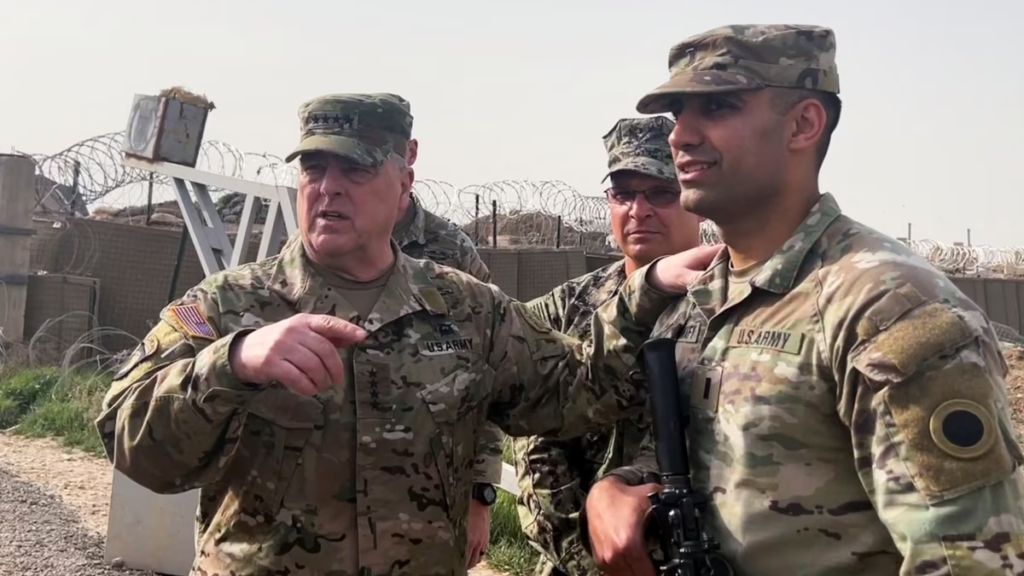
It is no coincidence that the US forces in Syria were visited at the beginning of March in a rather unexpected visit by the Chief of the Joint Chiefs of Staff of the US Armed Forces General Mark Miley himself.
It is no coincidence that on March 27 a letter was sent to President Biden and Secretary of State Anthony Blinken in which almost 40 experts on Syria and former US officials, among them the former head of CENTCOM General Kenneth Mackenzie or former top CIA officials such as John McLaughlin , or William Roebuck former deputy US special envoy to the anti-Islamic State coalition, with the signatories insisting that local normalization undermines the international community’s ability to advance a political process in Syria and that a US military presence in Syria must be maintained and collaboration with armed opposition tendencies.
Israel moves in a similar tone, which considers that the situation created in Syria with the civil war significantly strengthened the position of the pro-Iranian forces, hence the frequent Israeli bombing of targets in Syria. Israel, too, would prefer the US to remain on Syrian soil precisely to avoid the possibility of further strengthening the position of the Syrian government.
All this has to do with the fact that the developments in Syria have objectively strengthened the position of Russia, which not only insisted on supporting the Assad government, but actually took on the role of regulator of developments, not only with military assistance in operations against of the Islamic State, but also of other armed Islamist groups, but also with the way he managed to manage Turkey’s presence on Syrian soil, culminating in how he now supports Turkey’s rapprochement with Syria. The longer the crisis is prolonged, hotbeds of tension are maintained, the political and territorial reunification of Syria is not completed, Russia cannot claim to be the winner of any peace process in Syria. Ultimately, the US would not want Russia to count a success in Syria.