

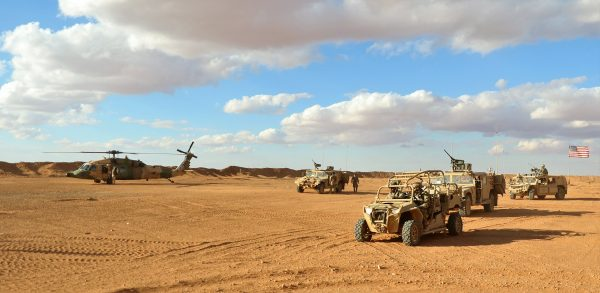
Although the US has made the political choice to limit its presence in the wider Middle East, it still maintains a military presence in northeastern Syria in a particularly critical region, which not only remains under the control of the Kurdish-dominated Syrian Democratic Forces militias that are key US allies in Syria, but also includes important oil fields
In fact, the Syrian government has repeatedly blamed the US government for the cumulative revenue losses it has as it cannot tap into its oil and natural gas wealth, but also for the fact that the US has transferred Syrian oil to its bases in Northern Iraq.
Officially, the US maintains that its military presence is justified by the continued need for operations against the Islamic State, which, although weakened, maintains forces in the region. After all, they had cooperated with Kurdish forces in major operations in the region, such as the siege of Raqqa.
However, in reality, the presence of US military forces in Syria, despite their small numbers, means that the area where they are located, schematically that which is partly under the control of the “Syrian Democratic Forces”, including the oil fields, is put “outside limits” for all those involved in the conflict, who would not wish to directly confront the US: the Syrian government forces, the Russian forces, the Iranian-influenced forces and of course the Turkish forces who have explicitly claimed the request to expand the “security zone » them to the areas currently controlled by the Kurds.
Attempt to secure the presence of American forces on Syrian soil
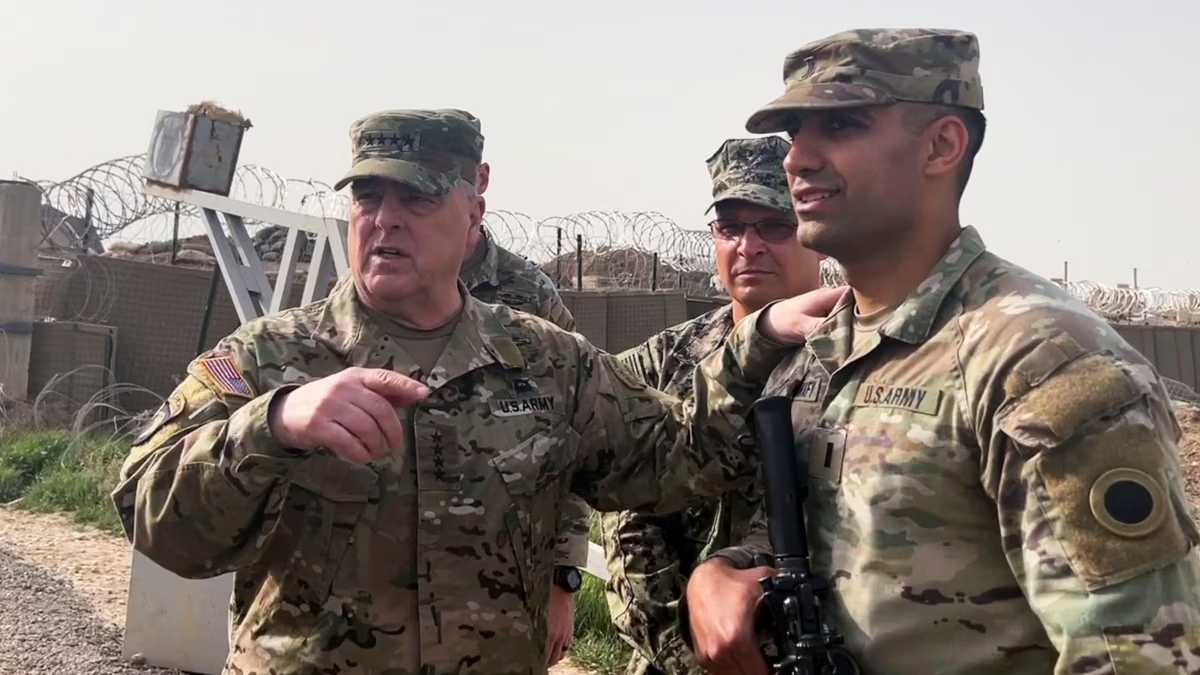
It is against this background that the surprise visit of the Chairman of the Joint Chiefs of Staff of the US Armed Forces General Mark Miley last Saturday to northeastern Syria and the encampment of less than 1,000 US military personnel who remain on Syrian soil to support the Kurdish militias in the confrontation acquires particular interest. with the Islamic State.
At first glance, it seems almost paradoxical to choose the highest-ranking American officer to appear at a relatively small US base, even if it is from there that the wider coalition against the Islamic State is being coordinated. And surely the excuse cannot be that he went there to assess efforts to prevent a resurgence of Islamic State activity or simply to review measures being taken to prevent drone attacks by militias close to Iran.
All of this points much more to an attempt to send the message that the Biden administration is keeping its commitment to continue supporting Kurdish militias in the region and not abandoning the Syrian field.
Mostly, however, they refer to a clear attempt by the US not to send the message that it is not leaving Syrian territory. That is, that they may not have great powers but they are not going to let the situation in Syria and any political solution succeed the current situation evolve, simply based on how the dynamics of those directly involved in the conflict evolve.
This also has to do with the way it is clear that at the moment it is very difficult to have “regime change” in Syria and that the developments have objectively strengthened the position of Russia and Iran, i.e. the forces that supported the Assad government. After all, even Turkey, which expressed its displeasure with Miley’s visit, has also accepted that it cannot avoid consulting with the government of Syria, Russia and Iran for the next day and ensuring that there is a quasi-Kurdish state entity on Syrian soil. The fact that at this moment there is a recognition by the Gulf states that this is the situation is also important, hence the effort to restore channels with Damascus, especially since there are also the economic opportunities of rebuilding the country.
However, at the same time, the US does not have a more comprehensive strategy for Syria, which could shape a different situation. Nor do they have the political option to send much more forces, and they certainly don’t have any “opposition” power to back it up, if we consider that the main enclave of the Syrian opposition, i.e. Idlib, is dominated by the evolution of al-Qaeda in Syria.
In addition, the Biden administration is already facing pressure from the Republicans who control the House of Representatives for a plan to withdraw American armed forces from Syria. In fact, the Republican congressman from Florida Matt Gates has filed a legislative proposal to end the American involvement in Syria.
However, it appears that at this stage the Biden administration is primarily interested in sending the message that the US remains in the eastern Mediterranean, assuring Israel – which is worried about the strengthening of Iran’s position – that it still cares about its security, form a bulwark on the axis of Russia, Iran and Syria, and of course ensure that Syria, where earthquake devastation has added to the open wounds left by the civil war, remains a relatively weakened country.