



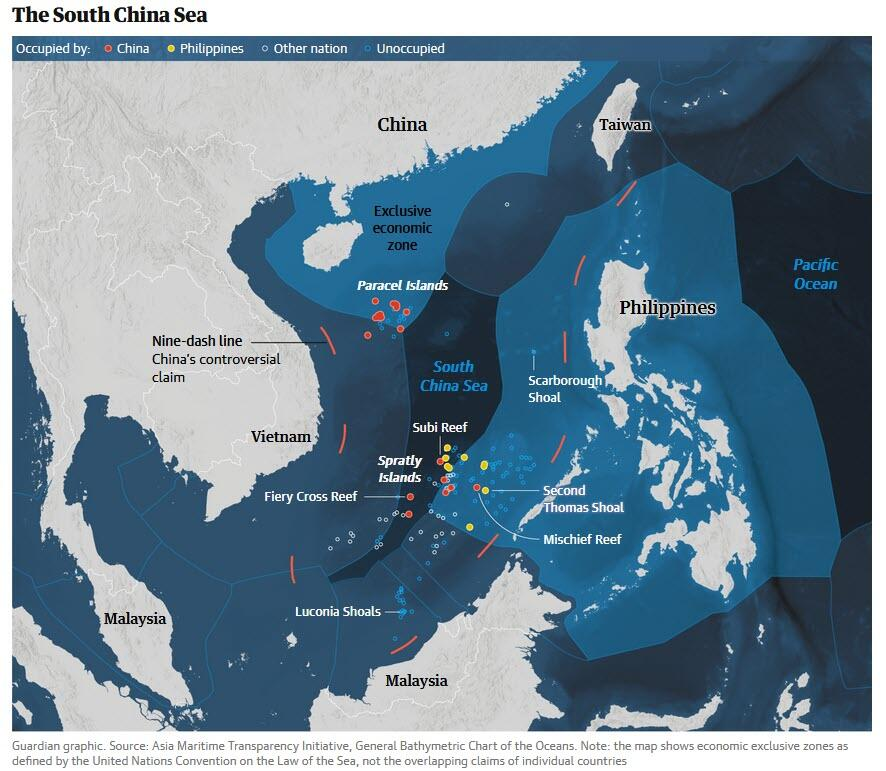
East Asia is once again at the center of international concern as tensions between China and the Philippines in the South China Sea take a worrying turn.
China, intensifying its naval aggression, appears to be changing strategy, now actively involving the People’s Liberation Army Navy (PLA Navy), in addition to the already known presence of its Coast Guard and paramilitary groups.
The climax of this escalation came on August 11, 2025, when a Chinese warship collided with a Chinese coast guard vessel during a pursuit of a Philippine patrol boat (BRP Suluan) near the Scarborough Shoal. The reef, also known as Bajo de Masinloc, is located within the Philippines’ Exclusive Economic Zone (EEZ), just 125 nautical miles from the island of Luzon.
China steps up pressure – Philippines resists
For years, Beijing has claimed the area based on the controversial “nine-dashed line map,” which was explicitly rejected by a 2016 international arbitration ruling that ruled in favor of the Philippines. However, China has blatantly ignored the ruling, continuing to display aggressive behavior toward Filipino vessels and fishermen.
“We are seeing a change in tactics from China. They are now using their Navy. This is a symbol of their aggression,” said the Chief of the Armed Forces of the Philippines, Gen. Romeo Brawner. He stressed that the Philippines is not causing tensions but is protecting its own fishermen, who have been operating on the reef for decades.
The BRP Suluan’s operation involved providing fuel and ice to the fishermen. When harassed by the Chinese vessels, the skilled handling of its crew prevented an immediate collision – instead, the two Chinese vessels ended up colliding with each other, causing serious damage to the Chinese Coast Guard’s CCG 3104.
US, conditions and the day after
The tension comes at a time when the United States is strengthening its ties with the Philippines, a strategic ally in the region.
The two countries’ mutual defense treaty of 1951 was recently updated to cover hostilities in the South China Sea. Although Manila has not yet invoked the treaty, the presence of the PLA Navy raises tensions to dangerous levels.
General Brawner was categorical: “The Philippines is supported by the law. The 2016 decision overturned China’s claim to the Bajo de Masinloc Reef.”
The Philippine Coast Guard fleet is set to meet with the military leadership to review its strategy. There is even consideration being given to sending the country’s Navy ships closer to the reef to support humanitarian missions, something that has so far been avoided.
Parallel tensions with Japan
China has not only had tensions with the Philippines in recent times. According to the Japanese agency Kyodo News, an incident that occurred in July 2024 was revealed, when Chinese ships opened warning fire at the Japanese destroyer Suzutsuki, which allegedly entered Chinese territorial waters off the coast of Zhejiang province by mistake.
The incursion, as Japanese sources claim, was due to a malfunction in the ship’s naval navigation system, which was monitoring Chinese military exercises in international waters. The incident ended with the dismissal of the Japanese ship’s captain for negligence, but it highlighted the speed with which China proceeds to use military force, even against US allies.
The Sea is “Boiling”
This double front that China is opening – with the Philippines and Japan – is triggering serious security concerns in East Asia. The use of warships, collisions between ships and the firing of warning shots are no longer rare events, but signs of a more systemic militarization of the region by Beijing.
Although the Philippines does not intend – for now – to respond with force, the situation remains extremely fragile. A miscalculation or an unforeseen reaction could trigger a crisis that no one wants, but everyone seems to be approaching.

