



Environmental changes have increased temperatures in Central Asia faster than the global average.
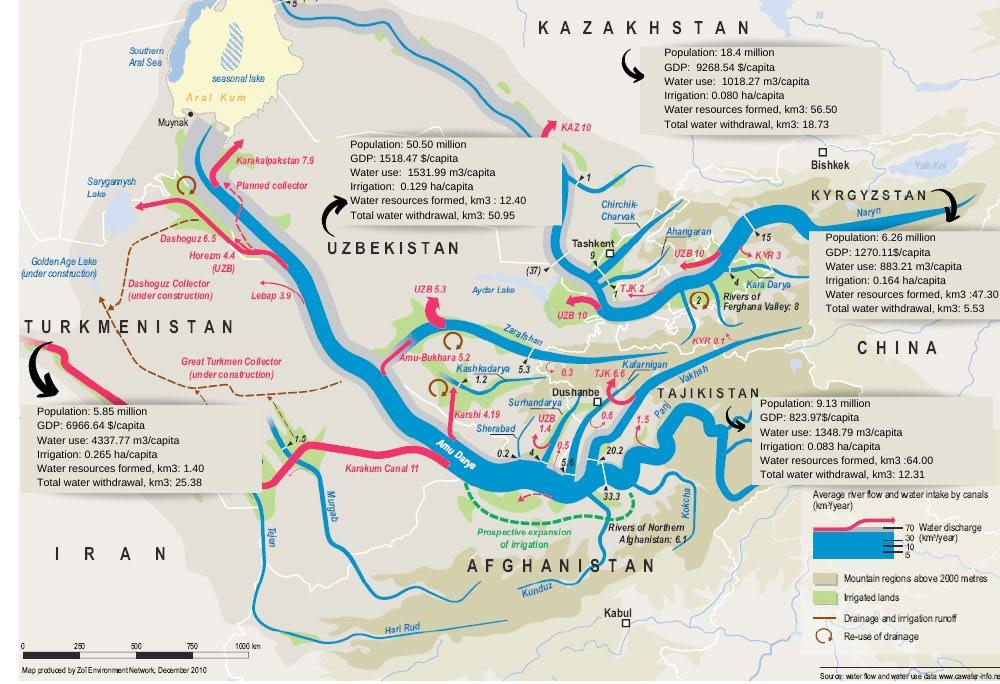
While upstream Kyrgyzstan and Tajikistan have abundant water, Uzbekistan relies entirely on a steady water supply for its food security.
On November 3, Uzbek Foreign Minister Vladimir Norov and his Kyrgyz counterpart Jeenbek Kulubaev signed a bilateral agreement in Bishkek under which Kyrgyzstan agreed to cede to Tashkent the area around the Kempir-Abad reservoir, covering 4,485 hectares, with in exchange for more than 19,000 hectares elsewhere. The deal effectively gives Uzbekistan control of the reservoir, a burning issue that has helped raise tensions between the two Central Asian neighbors. On November 17, the Kyrgyz parliament approved a controversial border agreement, and on November 29, Kyrgyz President Sadir Japarov ratified the agreement, allowing joint management of the reservoir.
Central Asia has historically been plagued by tensions over access to water resources. Even the administrative divisions under the Soviet Union constantly fought battles over the allocation of water and pasture. In this context, with the introduction of private land ownership in Kyrgyzstan, some leased Tajik pastures were declared the property of Kyrgyz citizens. Although multiple factors (e.g., strategic, political, and ethnic) contribute to the escalation of border tensions between Central Asian neighbors, water resource management is a persistent issue, often triggering conflict. Over the past decade, more than 150 clashes have occurred on the joint Kyrgyzstan-Tajikistan border, with casualties on both sides. In September 2022, 24 Kyrgyz people lost their lives as a result of the escalation of armed conflicts on the border. Water is vital to the agricultural and energy sectors of Central Asian states and, by extension, to their economies. Hydroelectric projects are of particular concern as they can generate electricity that is consumed both domestically and abroad. A strong example is the Nurek hydroelectric project in Tajikistan, which will have a planned capacity of 3,000 megawatts.
In addition, hydrogeographic features often serve as the basis for international boundaries. Even when fully agreed upon and demarcated by neighboring nations, their strategic value lends itself to conflict. Since the fall of the Soviet Union, the failure of Kyrgyzstan, Uzbekistan and Tajikistan to fully demarcate or agree on over 1,000 kilometers of their shared border has made border and resource conflicts common.
According to Gulmuria Borubaeva, Head of Department at the Border Control Service of the Kyrgyz State Committee for National Security, a key reason “for the ‘water conflict’ in Central Asia was the ‘Golovnoi Vodorazdel’, the main catchment area from which the flow of mountain rivers between the three countries that the Ferghana Valley crosses: Tajikistan, Kyrgyzstan and Uzbekistan”. Golovnoi Vodorazdel, with the Isfara River and the Tortkul Reservoir near the Vorukh Slavery, has become the center for water politics and growing tensions in the region.
Every year, conflicts arise during the irrigation season from April to June over the use of water resources between Kyrgyzstan and Tajikistan, which share about 40 water channels. While Kyrgyz farmers living downstream complain that Tajiks living upstream use most of the water, Tajik farmers living downstream complain about the minimal amount of water reaching their land.
Recently, however, the increase in the frequency of violent disputes at the joint water distribution points between Kyrgyzstan and Tajikistan indicates the increasing seriousness of these disputes. For example, in April 2021, a deadly border conflict between the two sides was sparked by a dispute over water rights. In September 2022, another border clash between the two turned into a dangerous escalation involving heavy weapons. The death toll in this conflict was 63 people.
Given the current state of affairs, what is fueling these tensions over water resources in Central Asia? According to experts, environmental changes have raised temperatures in Central Asia faster than the global average, and this is melting glaciers on the Tibetan Plateau – also known as the “third pole” – disrupting the distribution of water in the region. As a result, some scientists predict that the region will become increasingly drier, with more areas effectively turning into deserts. Accordingly, the Central Asian state has experienced some of the worst droughts in five years, resulting in a shortage of water for irrigation and hydropower.
Climate changes have also caused areas north of the region to receive more rain than the south, exacerbating water loss problems downstream. While the upstream regions of Kyrgyzstan and Tajikistan have abundant water, Uzbekistan relies entirely on a stable water supply for its food security. Thus, we can expect that claims over the water resources of the fertile Ferghana Valley region will increasingly fuel conflict across Central Asia. Only cooperation between these countries in water management will help mitigate these threats in the near future. In this sense, the latest Uzbekistan-Kyrgyzstan agreement on joint water management could be a step in the right direction for a sustainable regional water policy.
