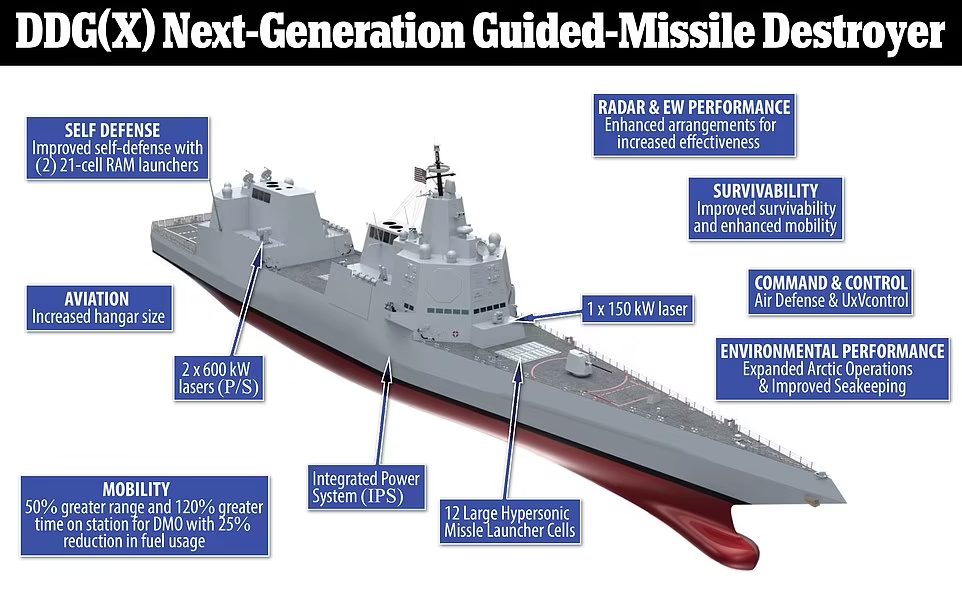
According to the latest Congressional Budget Office (CBO) report, the cost of each new US Navy DDG(X) destroyer could reach $3.4 billion (for more information please read the report “An Analysis of the
Navy’s Fiscal Year 2023 Shipbuilding Plan“).
According to the report the US Navy has underestimated the total annual cost of newbuildings by $4-5 billion over a period of 30 years into the future. As part of its planning, the US Navy has designed three alternative shipbuilding options (Alternative-1/2/3). According to the CBO report, option 1 is budgeted, by the Navy, at $689 billion, option 2 at $696 billion, and option 3 at $763 billion.
All the budgets concern all the constructions and for a period of 30 years. However, CBO estimates that just buying the new ships the Navy has planned would require $795 billion for Option 1, $834 billion for Option 2, and $881 billion for Option 3. The difference in the budget has to does with the final cost of new destroyers and attack submarines. Specifically, CBO estimates that the DDG(X) program could cost $3.1-3.4 billion per ship. This estimate results from the increase in size of the new destroyers, compared to the “Arleigh Burke” Flight III.
As the report states: “The new DDG(X) will have the same or superior combat capabilities as Arleigh Burke Flight IIIs, have a larger hull, more power, more stealth features and ergonomics for their future upgrade.” The US Navy estimates the cost of each DDG(X) at $2.1-2.4 billion per ship. However, the CBO report cites cost overruns in other Navy programs, such as the Zumwalt-class ships, whose costs increased by 45 percent.