



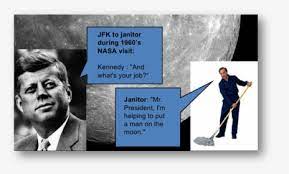
“I’am helping put a man on the moon, Mr. President!” Response of a NASA janitor carrying a broom to the President of the United States J.F.Kennedy during his visit to the NASA space center (1962), when he was asked “Hi, I’m Jack Kennedy, what are you doing?”. It was the period when NASA was trying to send the first successful human mission to the Moon.
The expression is proverbial. Business schools are taught over time in leadership courses as an example of successful strategy implementation. Her lesson is simple. When even the least strategic employee, such as a department cleaner, identifies with the central strategic goal, and works in that direction, then unique results are achieved.
Such alignment leads to sympathy, cooperation and partnership towards the ultimate goal. Unfortunately, such a level of sympathy is rare. Usually, great innovations and multilateral efforts are also frameworks of conflict and controversy, because they do not achieve sufficient levels of sympathy. Why? The goal is not always clearly articulated and known; The answer is “yes”.
Rarely, however, is the problem with the target. On the contrary, the problems are located mainly in the interpretation of the goal, and consequently in its implementation. This is because the implementation of such strategic goals, in essence, requires compromises but within conflicting perceptions.
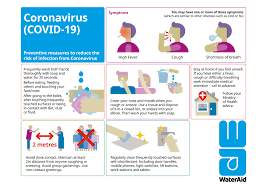
A typical example is the treatment of Covid 19. Undoubtedly, the strategic goal of all countries is the successful management and reduction of cases. However, both the definition of what successful management means (ie zero cases and the number of deaths at a level equivalent to or less than the simple flu?) And its implementation practices (eg mandatory masks everywhere; compulsory universal vaccination; restriction of individual movements; interactive applications and messages?) arise from multidimensional decisions.
Different social groups define success or failure in different terms, and often support conflicting implementation practices. Like the controversial Swedish model, instead of the Chinese version of hard lockdown at the beginning of the pandemic. Or like the constant confrontations between market representatives and religious leaders over the logic of measures in their countries.
But are the rules enough to inspire sympathy? This is where NASA’s original lesson comes in handy. It aptly highlights an additional dimension: the dynamics created by the inspiration of the narrative. It is cinematically rendered by the effortless response of the NASA employee. Such visionary narratives create the broader logical, but above all emotional, context in which even differentiated approaches are inspired and accompany the common goal.
In addition, they allow different groups to support the goal through customized, and preferred by, implementation practices. They thus offer the adhesive that holds together divergent perceptions. Social frictions are increasing and any measures will never be universally liked to achieve the maximum possible result. In 2022 we must look for the “moon” of our own narrative, creating a flight forward despite our disagreements, accompanying the whole planet united like a fist.


You are a very bright individual!