



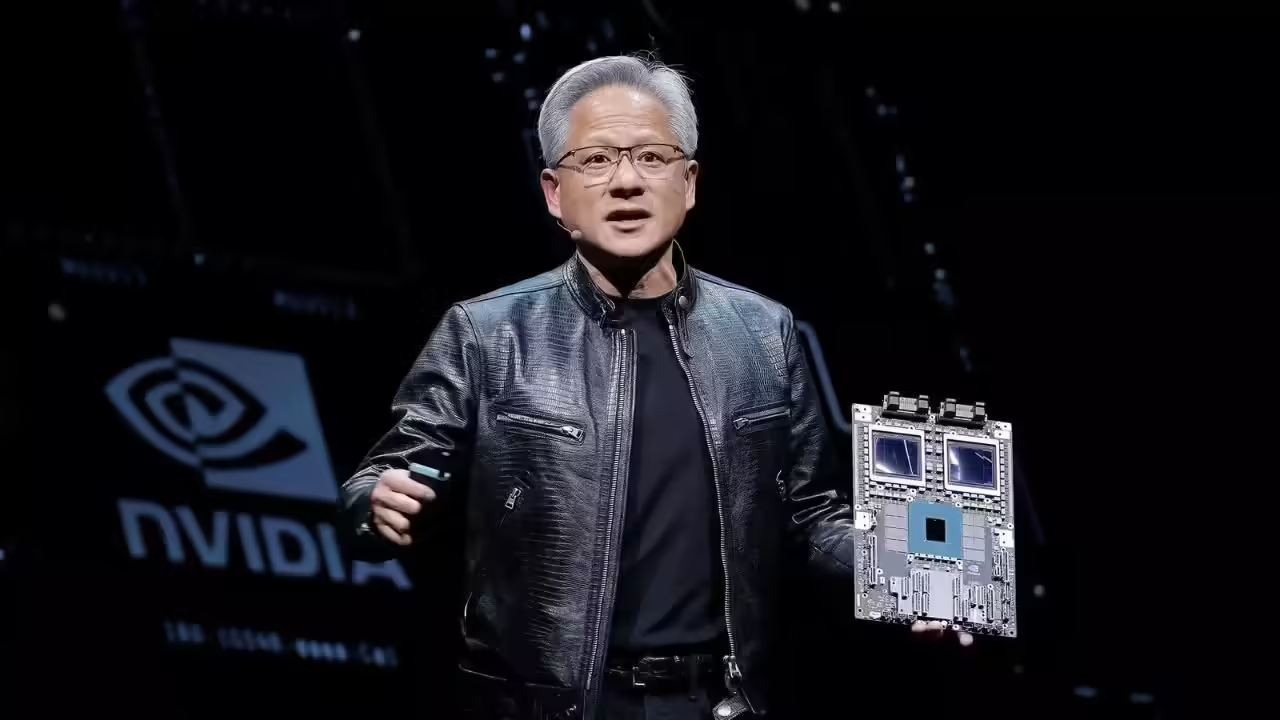
Artificial Intelligence is the obvious secret behind NVIDIA’s incredible commercial success. And perhaps only Artificial Intelligence could explain how its founder and chairman for 32 years, Jensen Huang, the “man in the black fur jacket” – his trademark look – today has a personal fortune of $180 billion. While, as the child of immigrants from Taiwan, he started out cleaning toilets in cheap Oregon eateries or teaching reading and writing to illiterate, juvenile delinquents.
In his case, even the famous American dream proves to be too inadequate to explain the “miracle” of Huang and NVIDIA, which is now the first private company in the world to reach – and somewhat surpass – 5 trillion dollars in capitalization, manufacturing “simply” the best integrated circuits for digital machines that support Artificial Intelligence applications.
The relative figures seem unrealistic: with a capitalization of 5.03 trillion dollars, NVIDIA is an economic power almost equal to Germany (GDP 5.09 trillion dollars) and clearly stronger than the national economies of Japan and India (4.28 and 4.13 trillion dollars respectively). Although market capitalization is not the same as a country’s GDP, comparing NVIDIA’s performance to leading national economies illustrates the true dimensions of its achievement.
Geopolitical superweapon
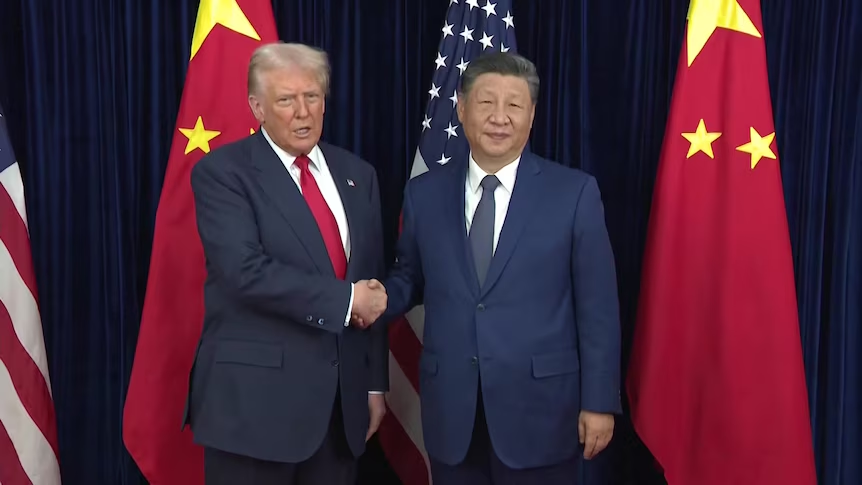
In essence, the “NVIDIA phenomenon” transcends its status as a company, as it has now transformed into a new geopolitical pole – a negotiating superweapon at Donald Trump’s disposal, which exponentially increases his chances of prevailing in the undeclared US-China war. NVIDIA, after all, is an American company, whose clientele includes several Chinese companies. In fact, its penetration of the Chinese market had reached up to 95% when it came to Artificial Intelligence integrated circuits. However, as the US-China cold war continues to rage, NVIDIA’s exports to Asia are a hotly contested issue between Donald Trump and Xi Jinping.
As for the internal balance of power, in the digital technology sector NVIDIA is ahead by $1 trillion compared to its second-largest competitor, Apple, whose market capitalization does not exceed $4 trillion. Also, based on the current picture of its finances, NVIDIA’s power is twice that of Amazon, which has a market capitalization of “only” $2.44 trillion.
However, there is obviously nothing simple about how NVIDIA managed to overtake and leave far behind every other giant in the big tech arena. That is, how this, until a few years ago, relatively unknown chip manufacturer pulverized the competition. Forcing superpowers like Apple, Amazon, Microsoft, Google, Facebook, etc. to look for ways to imitate it – and no reason to surpass it, at least for now.
What if it is a bubble?
The paradox is that NVIDIA became famous after it began to break records of profitability and growth, in contrast to the bold and ambitious business projects of e.g. Elon Musk, in which the opposite is generally true: fame and glory preceded success.
NVIDIA’s idiosyncrasies largely reflect the special character of its mastermind and leader, Jensen Huang. While he has been included in the list of the richest people in the world for several years, the 61-year-old Huang enjoys only a tiny fraction of the celebrity of Musk or Mark Zuckerberg. Following the latest jump in NVIDIA stock in recent days, Jensen Huang, as the owner of 3% of the company, has risen to 8th place on the Forbes list of the world’s richest people. And the prospect for him is to soon surpass the owners of the Louis Vuitton group, namely the Arnault family, who are in 7th place.
NVIDIA is expected to continue its gallop as the absolute dominant player in the Artificial Intelligence chip market, mainly due to its currently unrivaled dominance in data center components. NVIDIA, which started in the early 1990s with the aim of upgrading the realism in video game graphics, has now established itself as a monopoly in the semiconductors that make up the infrastructure of data centers. And given that AI applications cannot exist without the “hospitality” of data centers, NVIDIA fully justifies the title of “the most valuable company in the world.”
Huang himself, on the one hand, is adamant about Donald Trump’s “Make America Great Again” doctrine, because he was the one who insisted on boosting the production of cutting-edge technology components for Artificial Intelligence on American soil. At the same time, however, Huang assures that his company will continue to heavily fund immigrants in the US, believing that thanks to them and their bold, creative mindset, spectacular progress is being achieved in both the design and manufacture of NVIDIA’s highly advanced chips.
However, his most serious anxiety is not whether he himself will fall out of favor with Trump, which happened with Musk. Huang knows that the favor of the US president (let alone the unpredictable Trump) fluctuates depending on the balance of interests and foreign policy at any given time. Huang’s main fear is, therefore, how to protect NVIDIA from falling into the same abyss that swallowed up companies in the digital universe that were once considered invulnerable.
From Blackberry to AOL (America Online), Cisco, IBM, etc. the list of unimaginable takeovers is long – and highly instructive, for people like Jensen Huang. Who, on the one hand, proclaims that AI is not another bubble, a temporary frenzy that will eventually lead to magnificent bankruptcies of companies that are carried away by sky-high investments. On the other hand, he systematically tries to expand NVIDIA’s activities, to remain at the forefront of new generation chips and thus maintain its competitive advantage.
Computer Chips with anabolic steroids
NVIDIA’s stock skyrocketed on Tuesday, October 28, gaining 5% in a single Wall Street session. In any case, the trajectory it has been following since the beginning of 2025 is space-like, as it has achieved a 50% increase in its capitalization. The latest limit-up was associated with Jensen Huang’s announcements about the company’s immediate plans. NVIDIA expects orders for Artificial Intelligence chips worth $500 billion soon, while at the same time the installation of 7 supercomputer units is beginning, commissioned by the US government. In addition, NVIDIA is investing $1 billion in Nokia, a company that was a leader in mobile telephony, then lost its way and essentially went bankrupt, but remains active in the telecommunications sector. With NVIDIA’s financing, Nokia is returning to the spotlight as a leading player in the construction of 6G network infrastructure.
Under the leadership of Huang, a powerful but quiet digital technology tycoon, NVIDIA is opening too many areas of activity at the same time. The aggressive policy is his own understanding of shielding his company against any change in the direction of the wind in the relentless digital technology market. Thus, NVIDIA has at its core what Huang calls “accelerated computing”, that is, an entire technological ecosystem around Artificial Intelligence. Which starts from the amazing microchips and reaches the so-called “Artificial Intelligence factories”, units equipped with state-of-the-art computers, with almost unlimited data processing capabilities, in terms of colossal volume in relation to the lightning-fast speed of delivering results.
As Jensen Huang points out, “accelerated computing has paved the way for productive AI. For the first time in human history, we can manufacture our most asset: intelligence. In their effort not to miss this world-historical opportunity, companies and government entities around the world are building AI factories using NVIDIA products. Therefore, intelligence is a new kind of commodity, which creates profitable opportunities for a $100 trillion industry.”
An example of how NVIDIA is making billions is the CUDA model, a set of computing tools for developers who are moving at the forefront of AI. NVIDIA created CUDA in 2006 and to date has recorded over 53 million subscriptions. This vast CUDA user community, in turn, includes 5 million developers and 40,000 companies, many of which specialize in advanced AI applications. In other words, NVIDIA was one of the originators of a market where, now, AI has begun to yield huge profits for those who have jumped on the bandwagon of its ultra-rapid development in time.
Trillions and layoffs
After taking the quality of graphics in computers and video games off the ground, NVIDIA moved on to creating the games themselves via the cloud. At the same time, it designed and manufactured chips specifically for medical and pharmaceutical applications, contributing to the acceleration and precision of research for new types of diagnoses and treatments. It goes without saying that NVIDIA chips are at the heart of almost every robotic process, in industries such as the automotive industry and, of course, Autonomous Driving, in which Jensen Huang is heavily investing.
NVIDIA’s stock price surge was partly fueled by rumors that Donald Trump would discuss the Blackwell chip with his Chinese counterpart and whether the US government would allow NVIDIA to export one of its most advanced, strategically important products to China. Ultimately, Blackwell was left off the negotiating agenda, as the issue is considered extremely complex and thorny. The Chinese are equally suspicious and wary of the influence, even espionage, that Blackwell’s export entails, which is expected to turn into a thriller.
A thriller about the billions that NVIDIA could extract from China, in exchange for the concession of one of the greatest digital wonders of the modern world. Of those that are rapidly changing the world itself, as, unfortunately, the new armies of the unemployed can attest, people who are being laid off by the tens of thousands as redundant and without a job by the same companies that use or even try to build their own versions of NVIDIA products. In a variation of the classic saying, it seems that when Artificial Intelligence prospers, people – some, if anything – suffer.
