In the previous part of our analysis (part IV) we presented, among other things, the reasons for the sovereign state’s progress towards its final formatting. We have also highlighted the ways in which the different groups of common interests of citizens used to delay and/or cancel the implementation of Government policy.
At the same time, we presented the main problems facing the models of states and generally the European states in the Middle Ages.
But what the European models of states have accomplished during the Middle Ages is the most important. To survive. They managed to survive despite all the adversity, problems and crises they faced.
This is very important because they managed to maintain their main state institutions (Chancellery, Supreme Royal Court of Justice, Treasury/Ministry of Revenue) and at the same time without developing new institutions, they improved to a point any performance of their main institutions.
In fact, they had succeeded in winning the bet of their survival against time, creating at the same time a valuable reserve of political experience that would in future enable them to use it to correct their organizational and administrative dysfunctions.
In this part of our analysis we will highlight the course that was followed by the European states during the period 1400-1800 A.D. and how they managed to consolidate their form by making their path possible for their final formatting.
by Thanos S. Chonthrogiannis-https://www.liberalglobe.com
The stabilization of the political organization called by a single word state
From half of 1400 A.D. onwards the incidence of warring conflicts and civil wars on the European continent began to wane, enabling the economies of the then states to grow faster by offering their citizens a significant level of prosperity.

Author: Duode, Women Research Center. University of Barcelona, licensed public domain
Source: http://www.ub.edu/duoda/diferencia/html/en/galeria.html
https://commons.wikimedia.org/wiki/File:Fernardo_e_isabel.jpg
This was possible with the advent of new rulers in the kingdoms of the Realms (Tydor-England, Isabella I of Castile-Spain, etc.) who were more interested in achieving good governance and long-term on the throne and less aggressive movements against other European states.
Within the framework of achieving good governance are the achievements of security and political stability. The rise in living standards is the result of good governance, while at the same time making this increase in the standard of living in society fully visible to citizens and their state, their common highest objective, which is none other than the achievement of social welfare.
Having understood all the citizens and especially the groups of common interests, which along the way emerged as social and professional classes respectively, that their prosperity is based on the acceptance and development of state institutions began to cooperate increasingly effective both with the state and the government of the sovereign but also with the king himself.
This ever- increasing and satisfactory cooperation between citizens and the social classes with state institutions has resulted in the most effective use of human and natural resources.
A direct result of this most effective management of human and natural resources was enough continental states such as France and Spain to institutionally establish the creation of permanent armies.
England did not have a permanent army, but some basic infrastructures that in the event of war enabled them to rapidly deploy its troops (this management gave great flexibility to the English state budget because in times of peace could transfer the annual costs that would be required for the maintenance of a permanent army in other areas of the budget).
The main reason for government competence and effective governance
In the previous part of our analysis we presented, as one of the reasons for not implementing government policy, the gap between government officials who designed the policies to be implemented and the bureaucratic backbone of the state that had the task of implementing these policies in society.
But the fact that the political planners were a very small number of people in relation to the thousands of bureaucrats, showed automatically where the actions of the ruler had to move for the upcoming changes he would have to make for the proper functioning of the state.
As political decisions were taken at the King’s Council it was very easy for the king to change the faces of the Council by giving the opportunity to skilled political planners to work for him for a long time offering their required services while acquiring valuable skills and experiences. But the King had in this Council positions for his most eminent relatives and the high aristocracy.
Due to this fact, and in order not to conflict the King with the high aristocracy, he left the positions unchanged in his council and created a new council, the Working Council, whose role was vital because this Working Council made the controls and political suggestions to the King.
With this Strategy the King of each era maintained near him (controlling) the aristocracy (political decision) and at the same time through his Working Council he had at his disposal the best technocrats of the time (technocratic decision).
The members of the Working Council were usually composed of educated and experienced people who usually came from the middle and lower aristocracy, the privileged classes and of course from the officials of the Chancellery, the Supreme Royal Court of Justice and the Treasury.
It was customary to change the sovereign but not to change the members of his Working Council, as their rulers had full confidence in the skills and work of the members of the Working Council.
In this way, the Council of the King, which was composed of the superior aristocracy gradually and steadily, began to lose power and influence over decisions and to perform more of a decorative role that was used for the holidays and in general for the events of the Royal palace.
The fact that the ruler of its strategic and political decisions was increasingly based on the work of its Working Council, enabled the members of this Council to develop larger and longer-lasting channels of information between state officials and local rulers who have applied the decisions and political plans of this Council.
The result of this better information was to design better and higher – level policies.
For this type of seamless flow of information, the members of the Working Council have gradually created, around the area of competence that each of them had, a body of officials to support their work.
This state body, apart from archives and secretarial support, consisted mainly of hidden informants, spies and agents, important local agents and rulers respectively who informed about any developments at local level and generally throughout the kingdom.
The information, propaganda and briefing were two -way between these centers from and to the Working Council.
Essentially, this service was a new state more flexible, more effective without being bound by formal procedures, rules and constraints which, of course, functioned within the existing and cumbersome state which, contrary to this, was based on Cumbersome and corporeality bureaucracy.
The most efficient and the most powerful of the members of the Working Council were those members who were close to the sovereign. The position they possessed was the Office of Secretary of State. That is why they were the most trustworthy of the sovereign.
There was fierce rivalry between educated people with aspirations of men seeking office and influence who were “fighting” among themselves to find themselves in the services of the members of the King’s Working Council.
Over the years, the need for states to protect themselves from external forces and from other states in general has led to the co-construction of agents and informants in permanent buildings abroad, so-called embassies.
The main sources of information were all kinds of merchants who traded their products abroad, travelers and sailors of merchant ships.
The “war” and the “truce” between the new bureaucracy and the old bureaucracy
At the same time, “cohabitation” between the “new state-bureaucracy” created around the Working Council and the existing “old state-bureaucracy” was competitive and difficult.
The new bureaucracy of the Working Council was trying to broaden its competences and to acquire special powers by bypassing the existing old bureaucracy in the realm of government policy.
At the same time, the old bureaucracy was trying to contain its powers by working in a rivalry against the new bureaucracy of the Working Council.
This rivalry was ironed out when the old bureaucracy of the state understood that it had greater interest and was better protected since it was not involved in decisions and procedures of decisions that were unpopular in nature and generally were politically dangerous and detrimental to the safeguarding of its routine.
In addition to the above rivalry, the political decisions of the Working Council of the Monarch had initially to deal with the improper implementation of their decisions by the local rulers, since they wanted to implement political decisions according to their own interests and as they wanted.
The fact that state budgets did not have enough funds for expenditure to be used to recruit professional administrative officials and officials to staff services in the provinces by taking orders from the central government (Working Council), was an absolutely crucial factor that did not allow any state at that time to implement a pragmatic type of concentration of state administration around a central department/ministry.
Given these conditions, the members of the Working Council, in order to force local rulers to work with them on the proper implementation of their designed policies, applied the following methods:
1. Honors for local rulers and/or privileges to their families and friends.
2. Supervision of these through spies living in the areas of specific local rulers.
3. Coercion with the use of military violence towards local uprisings.
4. Exemplary punishments of offenders.
5. Application of court rulings.
6. Strengthening local security.
7. Taxes were collected regularly.
The political crises
The political crises of that period (16th – 17th century) were caused by conflicts that arose over the law of executive power. The rulers slowly and steadily saw that the stable and professional work of the Working Council, made them feel “sidelined” by the decisions of the Working Council and completely dependent on each type of contributions received on his behalf.
This created a rivalry over how the ruler began to see the action of his Working Council and especially the actions of his most relevant advisers who came from it. At the same time the ruler knew that he could not function and decide without the specialized knowledge and experience of these people.
Essentially the rivalry on the part of the ruler had to do with the breadth of power and the concession of the ruler to his skilled advisors.
The strategic decision that the sovereign would make in this case, but without granting too much power to any of his trusted advisers, was the adoption of the principle of sharing powers and tasks.
This automatically meant that more posts were created instead of one for the Secretaries of State, more committees where each of them had other government competence, etc.
The development of new state services
The fact that there were these fragmented powers among the rulers of the sovereign, of course, protected the ruler from the excessive concession of his power to his advisers but created other types of problems.
The fragmentation of power made conciliation and cooperation between these different competences-services very difficult.
The conflicts, the antagonisms of either small or high degree, hindered communication and created endless abstruseness, thus making it almost impossible to implement the pre-judged policies of the sovereign King.
This fact made it impossible to develop new governmental agencies (ministries with specific competences) that would give a high degree of efficiency to the administration of the state.
From the Middle Ages to the French Revolution (1789-1799), the administrative organization of the European states was weak to impossible and every type of crisis posed significant problems to them.
At the same time, despite the problems, the European states were stronger than any other state or empire that existed at that time in the rest of the world. The Asian empires have gradually declined, but since the early 18th century, European states have continued steadily and progressively improving their administrative mechanisms.
For the first time, public-private cooperation is taking place in the European states to achieve the common good.
The fact that in France and especially in England at local level the unpaid local rulers were tasked with implementing the central policy, assuming some political burdens, enabled these local rulers and notable’s province to become political leaders and commanders in the colonies of these countries.
The founding of the colonies also created the need for their administration while the states did not have the resources to run the administration costs of their colonies.
The colonies themselves maintained the subsistence costs of any troops stationed in them, while the political administration of the colonies had taken on wealthy people who were blameless and their actions at home were usually unpaid local rulers and notables.
Given the prior experience of unpaid local rulers in their countries by applying governmental policy in terms of taxes, security and the provision of any social services made them more suited to the administration of colonies.
In this way the middle income ranks of the provinces and cities became able to participate in the work of governance through the governance of the colonies, but without burdened the state with the administration costs.
This fact was inevitable for the state because the bureaucracy that existed up to then did not could do the work of local government of the colonies, because in the case of detachment of state bureaucrats in the colonies, the state would be underactive.
In this case, new earning opportunities were given to new social classes which until then were outside the work of governance.
In the 17th century France was very well organized as a state. England was also very well organized as a state. Russia barely managed to exist and function as a state. Germany was fragmented into kingdoms.
Most European states have copied political planning and institutions from the main models of European countries. Models of the state of England and France respectively.
With the passage of time and reaching the 19th century, almost all the then European states had a better organization and were more able to manage their human and natural resources more effectively than the same states existed in previous periods.
An additional element that might strengthen the existence of the state over time and as we presented in our previous analyses was the ethical and psychological anchoring of citizens to the institution of the state. This was achieved in two ways:
For most people (lower social and educational classes) who were attached to the King and generally to the institution of Basel, the theory that the King has chosen him by God and every citizen must obey the King’s orders without criticism and questions, was catalytic.
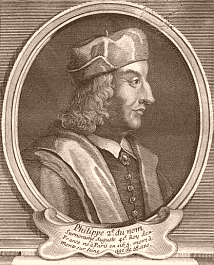
Author: Unknown, licensed public domain,
Source: http://www.istockphoto.com/stock-photo-4783365-philippe-auguste.php
For the more educated citizens who were simultaneously skeptics, there was the theory that the political organization summed up in the word state was irreplaceable for social progress and prosperity.
The sovereignty-concentration of power was necessary for the existence of the state in order to achieve its purpose.
To achieve the purpose of the state, it was understood by everyone that it should not weaken its institution, because it endangered the future of the people who served.
As the weakening of the state was undesirable, it could be justified and legitimized in the eyes of the citizens of any necessary policy and measure even if it was unjust or brutal (especially in the case of taxation).
What has been true since the 18th century is that the state is an integral part of human society. No one can imagine living outside the framework that defines a sovereign state.
The price that the citizen faces Is whether the most state and its interventions in every aspect of life dominating individual freedom of the citizen and if the less state serves better individual freedom and social well-being in a free society.
For liberals, the answer is obvious. A small sized workforce of public servants, well-equipped technologically and well-paid that can carry out their mission is the ideal case of a state.
With its minimum possible annual maintenance costs, allowing the imposition of a low type of taxation on incomes, creating the conditions for increasing wealth and investment.
While leaving any anomalies that appear on the markets to be corrected by market forces, it best serves the common goal (citizens and the state) of achieving social well-being.
At the same time the institution of democracy can better control and prevent cases where majority decisions through the enacted laws and decrees oppress the individual freedom of the citizen.
The useful conclusions we can draw for the EU
In all our analysis (Part I-II-III-IV-V, respectively) I believe that the reader can understand the historical evolution that has followed the political organization in Europe which in one word is called state.
The main elements that defined the creation and shaping of the state since the beginning of its existence were its main institutions such as:
- The institution of the Supreme Royal Court of Justice and generally the governance through the system of courts.
- The institution of the Treasury.
- The institution of the Chancellery.
In addition, the effectiveness of governance increased with the introduction of the institution of the Working Council of the sovereign. All these institutions worked to achieve in society the ever-increasing moral and psychological anchoring of citizens to their state and their ruler who was the sovereign of the state.
Without the moral and mental anchoring of citizens to the state there can be no long-term state. All the other state institutions and services gradually and after the 19th century began to be formed to take their current administrative form the states.
Based on our analysis, the reader can understand that the main disadvantages that the EU is currently presenting as a state are the following two:
1. The lack of functioning of the European-federal type-courts system in its territory, which will lead to the implementation of a smooth centralized EU Commission-led governance that will simultaneously increase the ethical and mental anchoring of EU citizens to the EU.
2. The lack of a single common budget for the euro area will allow it to implement a common fiscal, tax and economic policy on its territory.
The system of European-federal type-courts in the presence of these courts in each EU member country is this crucial factor that will create the moral and psychological anchoring of European citizens to the EU state.
The gradual implementation of European law in all forms of crimes and felonies occurring in the social life of citizens throughout the EU, with the gradual reduction of these cases in the courts of each member-country and the gradual increase in the litigation of these cases to take place in European-federal type-courts of the EU will increase the mental and ethical anchoring of citizens to the EU and its state.

This photo by Author: Tercer, licensed Universal public domain
Source: Own work, https://commons.wikimedia.org/wiki/File:European_Court_of_Justice.org
Essentially, and on the basis of our analysis, the European Court of Justice will act as the King’s Supreme Court of Justice with its courts-branches that will operate in all EU member-countries will have the role of local royal courts, while the courts of justice of each member-country of the EU will have the role of the courts of local rulers and always with regard to the analysis we have made of the historical development of the state in Europe.
In this case and with the passage of time, all EU citizens will be tied to the EU state, will cease any tendencies of secession of its member countries (e.g. Brexit-type sackings) by operating as a mound in the rise of nationalism and the extreme right in each member-country.
Unfortunately, the EU Commission and more generally the leaderships of EU member countries, as well as the Euro Working Group, seem to ignore how a state is created and organized administratively.
It looks like they’re all looking at the tree, not the forest. Which forest in the case of the EU is the administration of justice by EU courts and not by the courts of each member country.
In such a reality, the federal EU-type will accelerate, which in turn will lead to a commonly accepted federal budget, while increasing every generation of European citizens to their mental and ethical anchoring.
Because the EU follows the model-state of France and generally all EU member-countries follow the model-state of France except Germany, which after the expiry of the World War II follows the Anglo-Saxon model, it is certain that the judges who will undertake cases in these European-federally type-courts in each member-country will come from other member countries.
This is right as it will cut the umbilical cord of local corruption that exists in each member country and particularly in the member countries of the South East and Eastern EU.
While the citizens of these member-countries will know that if they are wronged by a court decision in those member countries they will be able to appeal and hear their case in the European-federal type-courts that will operate In the member country where they live.
As modern technology offers, in addition to all others, an exceptional type and real-time translation capabilities the administration of justice will be swift and unhindered by these courts.
The current justice system applicable to the European Union (EU) is based on the fact that a citizen of a member country where he is not satisfied with the decision of the Court of the member-country in which he/she lives should then make recourse (legal appeal) to all higher-level courts of the member-country concerned and where the decision of the Supreme Court of that member-country does not satisfy him then and only then will he be able to appeal to the European Court of Justice.
But with this process, the real substance that will make the EU a real state in the hearts of its citizens is lost. Ignoring the EU Commission that with the existing justice system the EU will always be a remote state mentally and morally by its citizens.
No one will defend this state and the political decisions of the Commission and the European Parliament will always enter from the microscope of any criticism, giving each populist the right to use the discontent of the citizens to increases his rates before the elections.
In this way, citizens will always be mentally and morally attached to the state of the member-country that they originate, thereby increasing the participation of citizens in nationalistic movements.
Knowing the European citizen that in any EU member-country to live, if it can appeal to the European-federal type-courts to obtain justice, then it automatically increases its adherence to the state of EU.
The EU should take an example from the US and its federal-style courts, since it wants to move swiftly towards the creation of a truly common homeland for all the peoples of the EU.
Thanos S. Chonthrogiannis
The law of intellectual property is prohibited in any way unlawful use/appropriation of this article, with heavy civil and criminal penalties for the infringer.