



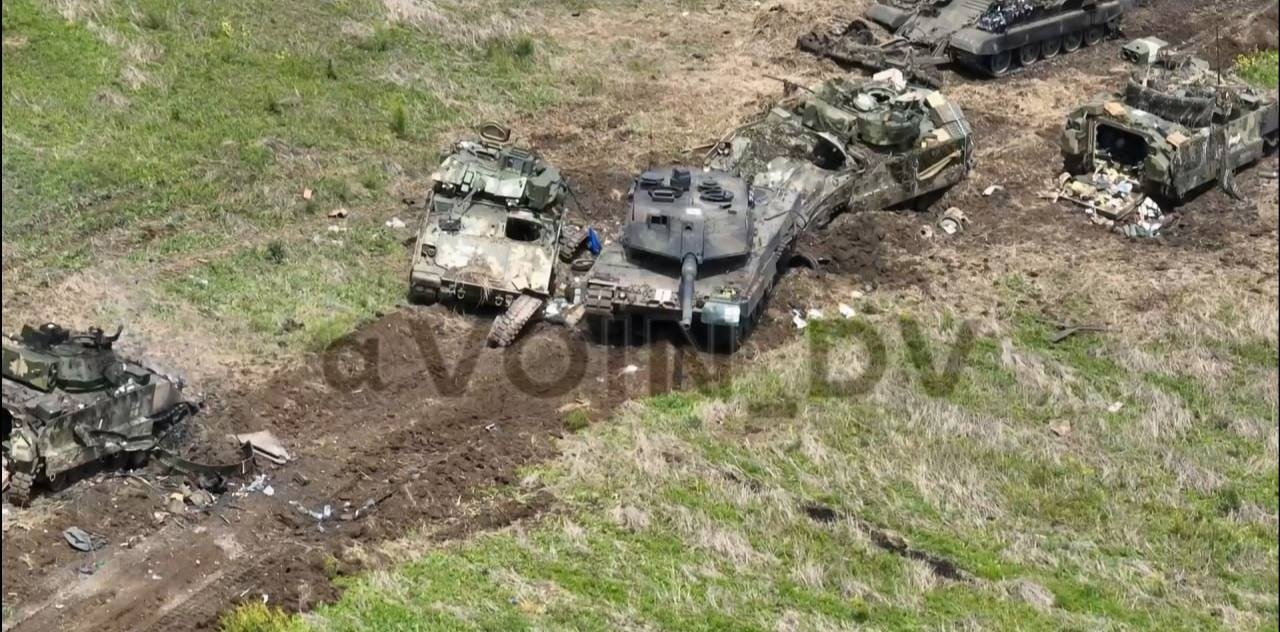
Since Saturday June 10, videos have been circulating, and several photos (snapshots of these videos) of damaged Ukrainian Leopard 2A6s and M2A2ODS-SA Bradleys, also shot down or abandoned by their crews in a local conflict in Zaporizhia. Of course, these snapshots going around the world were enough for many to start talking about either “Ukrainian failure” or “useless Western weapons”. Let’s see what is true and let’s not be in a hurry to restart the theories that in 10 days the Russians will arrive in Lisbon… After all, we heard this a year ago and we’re still here.
What are they all doing in one place?
A perusal of social media shows the critical question for the Leopard 2A6 with Bradley M2A2ODS: “what are they all doing in one place”. The answer is rather simple, as expected and operationally proven is the way they were intercepted and destroyed by the Russians.
To begin with, the areas where the Ukrainian counterattack is taking place are not unknown to the Russians, after a year of war and strong fortifications, trench construction, and constant reconnaissance activity on both sides. So everyone knows roughly where the enemy will come from, i.e. what are the most likely routes of advance, assembly and launch points, while endless drone flights – again from both sides – can show the coming attack and with great precision. Therefore, as much as some underestimate the Russians, they nevertheless know how to “play defense”. And the defense in vast flat areas is done in two ways. With mines and with… mines!
Some drivers would try to retreat by exiting the corridor, but their vehicles, mainly wheeled ones, would fall into mines. Also, at the point it must have started to “rain” Russian shells, and most likely, for such “juicy” targets, the Russians dropped some Krasnopol, i.e. 152mm laser-guided shells. The result is chaotic and dissolving and must have happened in a very short time and with a problematic response of the Ukrainians, as can be seen in the following video: where a Bradley retreating intersects the same vehicle while firing! Final assessment, the destruction of the phalanx, with losses of at least one Leopard 2A6 and 9 APC M2A2ODS-SA Bradleys. Heavy, no doubt.
In the case of the Leopard 2A6, we do not know exactly what happened, but from the gathering of vehicles, we understand that it was involved in a phalanx of armored vehicles moving on such a runway. The most likely scenario for us? The leading vehicle was destroyed by enemy artillery or an attack helicopter. Which means that the Ukrainians had not managed to shoot down or even interfere with the Russian targeting UAVs in the area, as well as any helicopters. Even the Russians managed to destroy at least one more vehicle, probably an M2A2 of the phalanx, trapping them in between.
Therefore, in order for the Ukrainians to advance, after destroying the checkpoints (fortifications from which the Russians fire against the attackers), they must open corridors for the armored phalanxes to pass. These cannot be much wider than a mine clearance vehicle. After all, such vehicles are not abundant, while the time and the possibility to dispose of many in the same place is minimal. And of course the specific ones are the first ones that the defenders hit.
Generally speaking, there is no tank today that can withstand a barrage of artillery fire, not even a APC (Armoured Personnel Carrier), especially if they find it in a place where its movement is restricted. What we can see is that several of the vehicles have been abandoned, meaning that the soldiers were ordered – or decided themselves – to leave on foot, following the corridor back to the minefield. However, if the Russians had completely prevailed in this particular battle, they would have already rounded up the vehicles and circulated the relevant close-up images on their own social media. At the moment this has not been done, we assume that the vehicles will either have been removed from the Ukrainians, or will remain in a “no man’s land”.
Many were quick to accuse the Ukrainians of poor business choice, poor training and amateurism. In war, however, such a situation is the rule, not the exception, especially when thousands of conscripts participate, without a professional relationship with the armed forces, and with all the experience they have “gathered” at the front. Even so, a head-on attack through narrow corridors has little chance of success, but people are fighting to reclaim their homeland, and they will make bold moves. Sometimes it will work out for them, sometimes it won’t.
If all the Ukrainian attacks had this effect, we would have dozens of similar videos, similar to those of Russian tank turret “launching contests”, which we saw throughout 2022. But we do not have such a thing, nor a picture of mass destruction of this kind. In any case, we cannot generalize either about “Ukrainian failure” or “Russian success” or vice versa. The front in Ukraine now has mobility after more than 9 months of static and street fighting, mainly in Bakhmut, we will wait to see the development.
Another video is interesting though: with an attack on a Leopard 2A6 by a Lancet. The Lancet cannot pierce the tank as seen, but the impact activates the automatic fire extinguishing system or simply the smoke generators (the thick white “smoke” that comes out). The Russians, however, preferred to drop a “kamikaze” drone, with the hope of putting it out of action for days or weeks (if, for example, they hit its scope). And here it would be interesting to know the “after”, i.e. if the tank remains active, if it can be repaired quickly, if it has become useless, etc.
Again in the general picture, there is no clarity as to what is happening overall in the Ukrainian attack, which for the moment looks like “recognition”, that is, with spikes in various places to “test” the local Russian resistance. The Russians destroying the dam at Nova Kahovka and flooding a vast area west of Kherson may have caused many deaths and incalculable environmental damage, but they dramatically limited the front of attack in the south. So any attacks by the Ukrainians are on a much narrower front, and easier to contain.
On Sunday June 11, we learned that at least one more Leopard 2A6 has been destroyed, while rumors are circulating that the Russians have one of the type in their hands. And that’s expected. The issue is whether the losses will have an effect (whether the attack will succeed, or the defense, if we are talking about the Russians), and whether they can be replaced by the belligerents. For example, the available Leopard 2s worldwide are few and far between for the Ukrainians. On the contrary, the T-55, T-62, T-72, T-80, T-90, even in storage, are many from the Russian side, which is slowly but surely bringing some back into service (mainly T-55 and T- 62 now). Ukraine has better quality artillery (with HIMARS and PzH2000s and Caesars etc.), but Russia has a large volume of guns and an abundance of ammo. So each side bets where it excels.
The Ukrainian attack in this way (on a narrow front after the floods) will have a significant cost in lives and material, will take a long time and will record failures. But we should also measure the endurance of both sides in continuous mobile operations, their passion, leadership, ability to gather information and quickly exploit it, boldness, ability to deceive (as much as possible), and many other elements that all together will determine the final outcome. The fact, however, at the moment, is that after so many months of war, both sides have suffered considerable damage, but have also prepared more methodically for the continuation of the war.
The conclusion
The tank top retains its value, Western weapons remain efficient, but now the need for their very organized use is strengthened: in combined force operations, with anti-aircraft cover, with strong electronic warfare systems, with very good training of crews and local commanders, with good recognition, with digital communications and network-centric administration and with self-protection systems.


