In our previous analysis, we presented some basic structures and elements that both their appearance and their implementation in society gradually created the first basic institutions of the State, the state as a concept, which appeared in the whole of Western Europe.
The fact that the models of the state developed by England and France respectively were also those which stood out from the other models of the state that appeared in Europe is due to the historical assimilation and priorities that appeared each state separately.
by Thanos S. Chonthrogiannis-https://www.liberalglobe.com
The other European models of the state
Germany as the current geographic area and the then as the Eastern Kingdom of the Franks was fragmented into small states feuds-principalities. These principalities, except for a few exceptions, used to replicate the state institutions of other states rather than to pioneer in the creation of new institutions.
Italy and especially the 13ο century onwards had its own city-states with a more powerful and characteristic example of the Republic of Venice (Serenissima Republican Veneta). The great commercial Mediterranean Power of the time, where its wealth influenced the political and economic events in the Mediterranean Sea. The term West for the first time historically appeared, including the Republic of Venice, France and the Feudal lords of Catalonia. Despite the great opponents that the Republic of Venice faced, both this and the rest of Italy’s cities developed institutions that could not be copied from the great Kingdoms of Europe because of their large sizes.
Spain, and the Spanish kingdoms, interested more on how to conquer and assimilate the Mauritanian territories within them, neglecting the development of the state’s institutions.
The fact that England and France were able to develop their own models of State which were later adopted by the rest of the world is due to the political ideas and political institutions that serve freedom in a free society. These political institutions and ideas respectively were adopted or imitated by the other countries. The crucial period for England and France in terms of building their own model of state is the period 1100-1400 A.D.
England and the Anglo-Saxon model of state
The fact that England has succeeded more easily in shaping its own state than in France is due to some historical advantages. More specifically,
1. England was originally a small kingdom in terms of its geographic size, much smaller than the kingdom of the Western Franks. Most Anglo-Saxon kingdoms of the 10ο Century were destroyed by the raids of the Danes. The only surviving kingdom was the Kingdom of Wessex which then managed to dominate and control most of England. The fact that originally England was small in its geographic size gave the opportunity to its King to be able to often and densely be in the entire geographical range of his kingdom (direct control by the ruler).
2. The process of recovering the sovereignty of central and northern England from the Kings of Wessex has taken place in a long time. The then prevailing traditions and customs that appear in places throughout Britain and because of the lack of other competing kings made it much easier to create permanent institutions on the already existing local manners/traditions and customs.
3. The institutions that were created as we saw in the previous analysis-Part II, were based on the system of courts where they headed the King. The court system created uniform institutions throughout the territory. The system of the courts of England was based in the municipal court, in the provincial court, in the county court and this institution was the same everywhere.
The Local Rulers (Aldermen & Reeves) represented the King’s interests and less cared for local communities. They Knew that if they went against the King’s interests, the King’s army would capture them, and the King would replace them by taking their property. The local official to acquire a local office had to possess land in the county that ruled, otherwise he could not acquire any local office.
William (1082-1087), in order to drastically limit the powers and rights of local rulers, applied a clever system, dividing the scattered small lands and not solid territorial units (the system of divide and conquer). As a result, the local rulers (Comites, Barons) cannot implement a stable administrative mechanism that could lead them to independence.
The First State institutions
Α. The King’s representatives were entrusted with the management of his property and the
collection of his annuities throughout the kingdom. This alone created the need to organize and coordinate all its representatives who should be commanded by a central agency that would be under the supervision of the King. This centrally administered financial service was named Ministry of Finance/Revenue-the so-called English Treasury (12ο century).
The main function of the English Treasury was to control the actual evidence submitted by the King’s representatives from all parts of the realm. The main axis of his organization was the list of rules faithfully followed-as gospel-by the servants of the Treasury. The first accounting systems began to develop in this while high-education people were working on it. The supervision and the action of the Treasury were on the entire territory of the realm.

Artist: James William Edmund Doyle (1822-1892), licensed public domain
Source: Doyle, James William Edmund (1864) “John” in A Chronicle of England BC 55-AD.1485, London: Longman Green, Longman, Roberts & Green, pp.p.226
https://creativecommons.org/licenses/by-sa/3.0/
https://en.wikipedia.org/wiki/magna_carta
Β. The Supreme Royal Court, due to the high burden of affairs, was forced to create and develop fixed rules and standing procedures to deal with its work. Its effectiveness increased by making it popular. The Supreme Royal Court became the central court that was necessary for the rule of the realm.
Within the framework of its operation was to send to the various regions touring judges-representatives of the central court-who had new responsibilities, applied effective procedures and their decisions were better and more acceptable than the entire population in relation to the inefficient local courts controlled by the local rulers (1215, year syntax of Magna Carta).
The effectiveness of the English Royal Courts was based on:
1. The drastic reduction in the time of litigation.
2. The speedy and short-term adoption of the decisions.
3. The easy implementation and enforcement of court rulings.
4. In the process they followed. More specifically, all their efforts focused on any complex questions and issues under consideration that could be answered by people who possessed the minimum knowledge of law.
5. These simple questions should then be answered by people living in the local area where the problem of the conflict occurred, e.g. by a group of neighbors, or by a representative group of law-abiding people. According to this procedure, this group of people, and always based on their own observations and knowledge on the subject under consideration, was obliged at the end of the case to give a joint collective response to the court. No witnesses or developed legal arguments were called in the court. This process was called a trial using a jury.
6. For the trial of criminal offences, a jury was used and an examination of witnesses against a single (France’s justice system was based on the examination of the witness).
7. The use of jury forces allowed judges to hear many cases in a single day. In this way they could successfully carry out all their cases independently of the volume of their workload.
8. As the jury was chosen by the entire community and resulted in a collective verdict decision, it was much more difficult to accept pressure than the various witnesses.
9. The ordinary people, the low-income farmers/landowners, the ordinary free people, the Knights etc. considered that this system implemented by the Royal Courts with the use of a jury was better protected against the powerful of the then society. For this reason, they resorted only to the courts of the King, ignoring most of the times the courts of the local rulers.
10. The genius of the whole operation of this system implemented by the Royal courts of England lies in the fact that for the administration of justice they managed in one way or another to involve the entire population of the country/kingdom in the work of Courts, either as parties or as jurors.
C. The Chancellery or the Ministry of the Presidency was the third basic State institution and its role was highly supportive to the other State institutions of the Supreme Royal Court and the Ministry of Finance/Treasury.
An example of the operation of the Chancellery is the issuing of a warrant which clearly identified both the subject matter of the case in question and the procedure to be followed. At the same time, the Chancellery kept records of the letters that were sent. The fact that, for every written presumption were issued by the Chancellery, there was a copy recorded in a file, it enabled the State institutions to develop rapidly.
The record-keeping process enabled officials and practitioners in the Chancellery to save time in their duties as there was a standard report for every occasion. In this way they were succeeded to deal more with assumptions that somehow appear first time. Where there were issues similar to other decisions taken in the past, the actions of the State were consistent and predictable, with no surprises for the employees involved.
The main institutions of the Anglo-Saxon Kingdom are defined as the following:
1. The Supreme Royal Court,
2. The Treasury/Ministry of Finance,
3. The Chancellery or Ministry of the Presidency.
In 1200, England had permanent institutions full staffed with educated officials working with full-time status for this purpose.
The domination of the Englishman King and the Institutions that enshrined his sovereignty
The entire land and property rights held by the owners of the kingdom belonged to the King. Based on this fact,
The Supreme Royal Court ruled a rule-law where any type of court case relating to the land could not take place without prior a warrant issued by the Supreme Royal Court.
The Ministry of Finance-Treasury based also on the above-stated assumption defined a rule-law where the King had the right to request financial assistance from his citizens, in case of need. Examples of this type of need were the financing of war operations such as the C Crusade, the long war against France etc. From this rule-law arose the measure of imposing direct taxation on the whole Kingdom (general tax).
Through these two rules-laws the English King fully controlled both the issues of the administration of justice and the size of the taxation of citizens by making him the Overlord and at the same time sovereign of his kingdom.
Essentially the decisions of the King and his Council were binding as laws and could not be challenged, since the King had the ultimate and highest authority on matters that were occupied by his Council and concerned the secular life of Kingdom. Since this principle of the King was accepted by all his subjects, the King could, with the consent of his people, impose taxation on both the people and the clergy without the Pope’s consent and permission in the second case. The result of the exercise of this Royal right and applied policy was to make a seamless collection of taxes without some type of protest from the people.
For the empowerment of this consensus of the people in the above King’s decisions and the complete and undeniable acceptance of its judgments by the people, the English King created Parliament (1256 A.D.) in which Parliament substantially transferred the meeting of the Council of the King and the meeting Supreme Royal Court respectively. At the beginning the English Parliament functioned as a place of assembly and decisions of the King’s Council and then this Council began to expand to members due to the participation of representatives from the municipalities, and the elected knights from the different counties of the realm.
What has been achieved with the creation of the institution of Parliament is that Parliament, in its decisions, has been delivering not only the popular consensus but also a complementary, necessary authority to the existing highest authority from which the decisions of the King who had the sovereign power were characterized.
With the establishment and effective functioning of the above-described institutions, the evolution of the Anglo-Saxon model of state led to the moral and mental anchoring of all citizens with their King and with the state in which their King was dominant.
All the social groups up to then, such as the family, the Church, the community continued to exist and have an important role in the social organization but were now operating within the framework defined by the State, but having acquired from primary until then a role in human affairs secondary and subordinate role in relation to the role that the state possessed in the functioning of human society.
In fact, the preservation and prosperity of the State had been fully accepted by its citizens by accepting the institution of the state as a basic pillar of protection and development of the objective of social welfare, which is socially well-being in turn suffused to all citizens. By accepting this fact and believing in it, the citizens have highest the duty of their lives to protect their King and his state.
On the other hand, any social ranks of the Anglo-Saxon kingdom because in their entirety they accepted the undisputed existence of the state, when they believed they were wronged they did not take the weapons to make war with the neighboring rulers or revolution in order to acquire any power, but they have tried in every acceptable social way to gain political power in order to influence the decisions of the institutions described above for their benefit.
By gaining strong political power, these social groups, uniting their forces in professional guilds and political parties, managed in a direct and indirect way to influence any decisions were issued by these institutions. A direct result of this was to evolve a political culture and emulation respectively but also to strengthen over time the political identity of the citizens of the Anglo-Saxon kingdom whose morals and customs were almost everywhere the same (outside certain exceptions as of peoples that lived in geographical area of Wales and of Ireland respectively).
The results from the strong homogeneous and political identity of the citizens of the Anglo-Saxon kingdom
These results led in a homogeneous and uniform structure of the institutions of the English state within a relatively short period of time. This means that:
1. The Judicial and tax systems respectively could operate uniformly throughout the entire territory of the Kingdom.
2. The imposition of a measure, for example a new tax, was applied without complications and negotiations with local rulers and nationals.
3. This fact has given a great deal of efficiency to any central government in the realm in the implementation of any policy in the country.
4. A relatively small number of officials and state officials were required to issue decisions and irrespective of where they were located.
5. There was no need to create a labyrinthine system, e.g. courts for the administration of justice.
6. All the nationals accepted the procedure for the administration of justice because of the indirect participation of the population in it (jury).
7. The people accepted that the institution of Parliament fully represented him.
8. Uniformity of institutions and laws found resistance among the peoples living in the geographical area of Wales and Ireland respectively. In many cases in these areas, the King’s army intervened to restore and enforce the laws.
The overall result and conclusion extracted from this way of administration and management was that a small number of salaried bureaucrats and state officials were required to implement the central government-authority policy. This was achieved by the fact that the English central government made use of unpaid local rulers and officials equally for the implementation and handling of a large amount of work on local government.
In general, it can be said that the superiority of the English model of State and administration respectively succeeded the most effective management of human and physical/material resources of the Kingdom than any other model of state. This had resulted in many times that England, for example held the 25% of France’s wealth and population, was capable of being at war on equal terms with much stronger states like France.
This Anglo-Saxon model of state and administration in the abutment of its function and over time created the British Empire in which the sun never set. It is this model of state and administration that adopted and next adjusted to its own particularities the USA (e.g. federal system) and made it today a global empire and generally the states that have adopted the Anglo-Saxon model succeed to manage efficiently their human and natural resources.
France and the French model of state
Unlike England, France in terms of its territorial size was enormous. It had many provinces where each of them already had its own local institutions and manners and customs which in general differed with the counterparts that had other provinces. This was a more general feature that prevailed throughout the provinces of the rest of mainland Europe. These independent province-feuds had a very high degree of independence.
This makes the French achievement even more important, given that the French were the first to learn how to create a single State based on the independent provinces-feuds, although the nationality characterized the inhabitants of these feudal provinces was the same for most of them (Franks). That is why the French model of state dominated the whole of the European continent, adopting it and the rest of the countries of Europe after the Middle ages.
The development of the French State model
Both the French and the English for the development of their state were based on the same two main and fundamental institutions. Justice and taxation.
The difference is that the French King and his respective institutions (Chancellery, Supreme Royal Court/System of Courts, Treasury) were extremely effective only in the territories that he controlled, because of the ownership of them by the King. In contrast to the English King, the French King had no income coming from the provinces-feuds territories controlled by the local rulers (Duke, Earl, etc.).
Moreover, the Supreme Royal Court of France and at the beginning of its operation were not often used by disgruntled claimants from the decisions of the local courts, but this over time had changed.
Essentially, the local ruler-feudal lord was the one who possessed the ultimate and highest authority and not the King of France. Since France consisted of large-scale feuds-principalities, it is immediately understood that the ultimate authority in most of the country did not have it by the French King.
Moreover, the expertise in the procedures and phraseology and consistency followed by both the English Chancellery and the English Treasury were not presented by the respective institutions of France. While the legal codes developed by the Supreme Court of England were pioneering there was nothing similar in France at the same time.
But the French King was strong enough financially and militarily to defeat England and annex most of the West of France. From 1200 A.D. onwards, a gradual annexation of soils started to take place, which continued until 1300 A.D. The main instrument for the annexation of all these lands were the wars and marriages between the members of the French Royal family with the members of the families of the local rulers.
The achievement of the French King’s administration was that he managed to immediately identify the problem and adapt to it rather than try to change the data up to that moment.
More specifically, the French King saw that the effectiveness and magnitude of his own institutions was enough for his own and only controlled royal lands and was inadequate for the entire country that had now been formed by the new territorial attachments. At the same time, the French King acknowledged the superiority of the institutions prevailing in some of the annexed feuds-provinces in relation to the existing institutions and laws and the diversity of the provinces’ institutions, for example, there were different laws and customs in Normandy from the counterparts of the Mediterranean-southern provinces.
That is why the French King has neither dared to change nor to limit in all these institutions that prevailed in the annexed provinces.
The French Administrative Model
The “political conquest” of these provinces was achieved thanks to the ingenious strategy of the French King Philip II of August (1180-1223), which essentially established the French state.
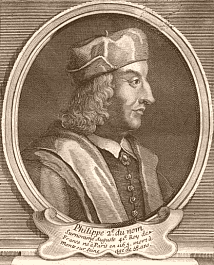
Author: Unknown, licensed public domain
Source: http://www.istockphoto.com/stock-photo-4783365-phillipe-auguste.php
This strategy boils down to the fact that it neither changed nor curtailed the local institutions but sent its own people-officials and occupied all the important provincial offices. In this way, the political and judicial system of Normandy has not changed, continuing to apply the prevailing law of Normandy until then, but the presidents and members of the courts were composed of officials of the French King coming from the His Royal Supreme Court.
In this way the King was fully controlling his annexed provinces-feuds and the local rulers continued to “appear” that they are launching developments in their provinces. In Fact, the King’s administrators were the link between the new provinces-feuds and the French kingdom and not the institutions that prevailed locally. Contrary to what was happening with England, where the institutions and laws were uniform throughout the territory.
This strategy functioned for many centuries preserving the territorial integrity of the French state. However, in this strategy the disadvantage was the suspicion and generally the antipathy that prevailed among the local rulers who for their subjects were the successors of local customs, institutions and privileges respectively and the servants of the Central the French King’s government. This undermining rivalry severely undermined the operation and effectiveness of local government and the implementation of central administration policies at local level.
Unlike England, the French King had defined as a rule that anyone who take an office in an area could not possess real estate in that region. While no one could take office in the area from which he originated.
Given these rules-laws, the administrative disadvantages as well as the rivalry among the administrative servants of the King and the local rulers, the King of France was forced to create and implement a labyrinthine administrative structure with various levels of power, which was based to a corresponding much-flat bureaucracy for the effective administration of the provinces-feuds and the implementation of central government policy throughout the realm of the kingdom.
The Disadvantages of this administration model
The various levels of power started from the lowest level that was the local administration and then gradually increased hierarchically for better control and reached the highest administrative level of authority that was the royal services of the Supreme Royal Court of Justice, Treasury and Chancellery, respectively, based in Paris.
For example, the mayor was controlled by the province governor, the province governor was controlled by the prefect, the prefect was controlled by councils and so on, that were based in the Chancellery in Paris. A similar administrative stratification was followed by the Court system where the board of the Supreme Royal Court was based in Paris.
The flow of orders and information from central authority to local authority and the flow of complaints, explanations and information from local authorities to central authority was complicated and ineffective making regime the mismanagement of human and physical/material resources of the Kingdom. But with the above described conditions it was the only system that could function adequately.
The downside of bureaucracy was that it needed a huge number of employees. The shared responsibility for the same issue by different agencies made it difficult to blame the real responsible when something was wrong. In this case a whole chain of officials had to move from its positions and replace them something that was not always easy.
In fact, the system of government was hiding behind bureaucracy and it often seemed that nothing was moving (such administrative problems are faced by many European States today who have adopted the French model of state and management equally).
However, the French model of state was a unified one consisting of provinces with divergent characteristics. Most European states that emerged in 18ο and 19ο century consisted of similar provinces annexed by France to its central administration. Mosaic states, such as France then, for this was a one-way street for them to adopt the French model of State and administration respectively.
The Institutions of the French State model
Despite these problems, the French King was the supreme secular ruler, he was the supreme arbiter of all the cases and the opposing parties in a local court if they believed that they were wronged could apply the appeal procedure and then the their cases could be avenged in the Royal Court. A tactic that over time was increasingly being applied.
Over time, the application of the measure of taxation by the King became increasingly acceptable based on the argument that the King knows and has the right to issue decrees and to impose taxation to defend the “common good”. Gradually the system of appeals and litigation in the Royal Court in conjunction with the French model of state began to bind morally and mentally the citizens-its nationals to their state and the King of France who was the sovereign of the State.
This process was accelerated by the fact that the King’s favored dignitaries began to idealize the state and its importance. They transmitted to the French people worship towards the King’s face as the sole successor of Charlemagne, brought from the Heavens. The worship of France was great considering that the French were the chosen people where three virtues, theoseveia, justice and knowledge, bloom in their society.
At the same time, the motto prevailing in French society was that protecting France meant serving God. This moral anchoring of the French people to their state was strongly demonstrated in the crisis that erupted between the King and the Pope, where the whole of the people sided to the King’s side.
references:
J.R. Strayer, The Administration of Normandy under St.Luis,
Holdsworth, History of English Law I,
T.F. Plucknett, A Concise History of the Common Law,
Thanos S. Chonthorgiannis
The law of Intellectual Property is Prohibited in any way unlawful use/appropriation of this article, with heavy civil and criminal penalties for the infringer.