Recently, the Greek Parliament voted to entitle the Greek government to start the process for the formal request from Germany to pay reparations for damages which took place in Greece due to the occupation of German troops during the Second World War (WWII).
The issue became widely known outside Greece when the descendants of the victims of the execution of 218 people from a unit of German troops, which was executed in June 1944 in the village of Distomo, brought the case to the European Court of Human Rights and the International Court of Justice in the Hague.
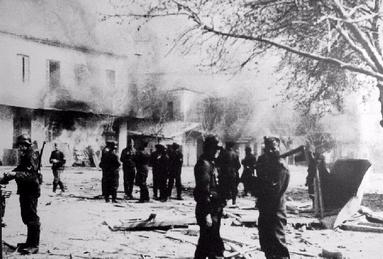
This photo by unknown Author, licensed fair use
Source: photo taken in 1944 by unknown photographer
https://en.wikipedia.org/wiki/File:Distomo_massacre_1944.jpg
The fact that International Law does not allow individuals to claim damages in such cases (only states can claim war reparations from other states) the courts have not justified them.
With the above resolution of the Greek Parliament, such claims for damages are raised by the Greek Government and are likely to end up in higher European courts.
According to the Treaty London Agreement on German External Debt (1953) Article 5, Paragraph 2 it is stipulated that the examination of claims for war reparations is postponed until a peace agreement with Germany is concluded.
Germany then tried to conclude bilateral agreements with the states concerned to close this issue by paying those states compensation. In a bilateral agreement of this type, Greece received $115m based on the contract-agreement made in 1960.
The German government considers that the issue of reparations for Nazi offences has been closed, citing this agreement of 1960 and Agreement 2 + 4 of 1990. The Treaty 2 + 4 was a peace agreement between the two Germanies (West and East) (2) and the winners of the WWII (USA, USSR, England, France) (4).
Greece, for its part, insists that with Treaty 2 + 4 of 1990 on German unification there is a peace agreement alone and the issue of reparations has not been closed but should be definitively clarified again. So, since Greece has requested in the most formal way from Germany these allowances, following the customary official refusal of Germany, Greece will bring the case to the competent international court outside Greece.
Proposal to resolve the problem
Our proposal is that the German state should find a way to compensate exclusively the relatives of the victims of the murder of Distomo and in such a way that he cannot “lay his hand” the Greek state in compensations of these people.
Since this tragedy is acceptable it is purely a moral issue to compensate the relatives of these victims because everything is created again except for human life which, if lost, is not restored. That is why this case should never have reached the highest courts in Europe.
In fact, and always according to our opinion, Germany should compensate the relatives of all those victims who have suffered the ‘Nazi injustice’ in Greece and always based on irrefutable evidence to prove that their relatives have fallen victim to “Nazi offences”.
Then there could be an acceptable agreed amount between the two countries for compensation to be paid by the German state to the Greek state, which would be able to satisfy Greece without compromising Germany’s economy, given that German economy is the “locomotive” of the Eurozone/EU economy.
This agreed amount for compensation could be attributed by Germany to Greece by funding research projects and projects in areas such as drugs, technology, artificial intelligence, projects in the digital world, infrastructure projects to local communities in Greece etc.
These projects could be undertaken by German companies in Greece and Greek companies. In this way, work will be given to Greeks stimulating parallel the Greek economy and projects will be undertaking by German companies.
The loan granted by Greece to Germany during the German occupation
During the WWII and more specifically during the German occupation in Greece, apart from covering all expenses for the living of German troops from Greece, the Nazis forced Greece to provide the Germans and the Italians a significant amount in the form of a loan. Part of this loan amount was used by the Nazis to finance the war in North Africa.
This loan was signed on March 14, 1942. Then the terms and amount of the loan was reformulated twice, and Nazi Germany had started repaying the loan by paying nineteen installments and until the end of the war, so since then and until now the loan has never been repaid. The amount of the loan was DM476m.
Therefore, Germany and Greece should jointly agree today on a mutually acceptable way of calculating interest rates, considering the level of inflation for the two countries since then to date and to bring an acceptable solution for both countries. The amount of the repayment of this loan is calculated using current prices and is of around €10-€11bn.
Germany could attribute this amount to the Bank of Greece without affecting the development of its economy.
It will not be any good for both countries sharing common values within the Eurozone/EU to be brought to the International Courts to resolve these issues.
Thanos S. Chonthrogiannis
The law of Intellectual Property is Prohibited in any way unlawful use/appropriation of this article, with heavy civil and criminal penalties for the infringer.