




In recent years, Taiwan has invested heavily in its new naval doctrine, “small displacement surface vessels with high firepower.” More specifically, these ships are of the “Tuo Chiang” class. In addition, the Scandinavian countries have invested in this naval doctrine with the respective class ships “Skjold” (Norway), “Visby” (Sweden) and “Hamina” (Finland). In this analysis we will refer to Taiwan and in our next analysis to the Nordic countries.
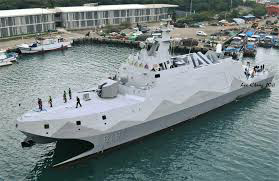
The Doctrine That Defined the Taiwan Strategy
In the late 1990s, Taiwan decided to change its naval doctrine, from sea control until then, to the sea denial. This was a forced decision because of the numbers in which China excelled everywhere. Surface vessels, submarines, aircraft, personnel, defense budget.
Given the overwhelming numbers in favor of China, Taiwan was forced to move away from the doctrine of quantity and turn to the doctrine of quality and the asymmetric approach. In other words choose to attack the enemy invading force when it is most vulnerable. According to Taiwan, a Chinese invading force has a high degree of vulnerability during its movement to Taiwan (mainly) and secondarily when it is on the coast and trying to build a bridge over the coast, securing its positions.
Taiwan’s adaptation to this threat has two parts:
• First, air battles and coastal combat within a 100-kilometer radius around Taiwan.
• Second, point battle, battle 40 km from the possible landing point.
The main means of battle for the first case are missiles, anti-aircraft and for ships, surface missiles. The main means of combat in the second case remain the missiles but also the naval mines, in deep and shallow waters.
The mines are expected to slow the movement of the Chinese amphibious force with missiles hitting it, with a focus on selecting targets from the largest to the smallest amphibious ships. Combined, these two approaches, together with US assistance, will increase the success of repelling any Chinese attack.

“Tuo Chiang” Class Surface Vessels
Based on this business doctrine, it was decided to build “Tuo Chiang” class ships as a complement and not as a replacement for large surface ships. The main characteristics of these ships should be:
- fast, 2. stealth, 3. High firepower, 4. high cruising stability (Catamaran design).
Τhe design of the ship is such that it does not have many large surface extensions, while the engine gases before being released are cooled, resulting in a significant reduction in their thermal trace, and of course the possibility of being detected by enemy radar. Taiwan calls them corvettes.
The ships are domestically built / designed by the NSCC (Naval shipbuilding Center), while they are very economical, 853.4m USD for the construction of 12 ships of this class (without support and weapons), ie 71.1 million US dollars (2011 prices).
The design of the ship is catamaran type with dimensions 60.4 meters by 14 meters by 2.3 meters (length, width, draft). Its displacement at full load is 685 tons.
Incorporates:
• one MTU 20V4000 M931 diesel engine with a maximum power of 5666 hp.
• Four MJP CSU850 water jets with a maximum power of 8046 hp each.
• It includes a helipad, but not a helicopter hangar.
Achieves / Requires:
• maximum speed 45+ knots at sea up to 7 Bοfor.
• range 2000 nautical miles at a speed of 22 23 knots
• crew 41 people.
Equipment:
• Shipping radar,
• sliding sonar,
• fire detection and control radar CS / MPQ-90 Sea Bee Eye technology AESA,
• fire control radar STIR 1.2 EO Mk.2,
•12 consumable launchers (6 in the bow and 6 in the stern),
• infrared and radio frequencies.

Armor:
• 16 steps against ships (8 Hsiung Feng-2 250km range and 8 Hsiung Feng-3 400km range),
• 16 TC-2N anti-aircraft missiles, maximum range 30km,
• 1 mm OTO Breda Super Rapid 76 mm main cannon (Leonardo),
• 2 M2HB Browning machine guns at 12.7mm
• 2 triple temporary torpedo tubes Mk.32
Protection:
• 1 Phalanx Close-In Weapon system (CIWS).
Ships in this category have a number of advantages: small displacement, high firepower, easy to use, due to their small size they can operate from small or large ports or hide on islands, islets and secluded coves, they are power multipliers with excellent cost. and performance, achieve high medium speeds with the ability to avoid torpedo attacks.


