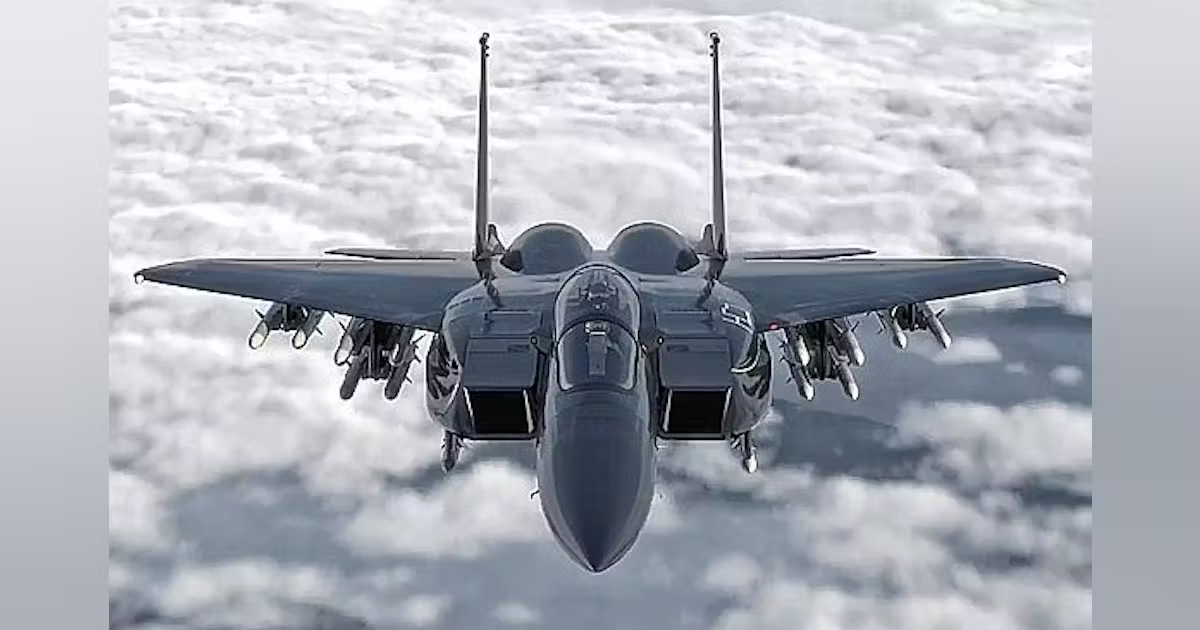
The F-15EX Eagle II is the latest evolution of the F-15 family of fighter aircraft, a design that first appeared in the 1970s and continues to occupy a central position in the United States Air Force. Its development is linked to the need of the United States Air Force (USAF) to replace the aging F-15C/D, which, after decades of service, were facing serious structural deterioration and technological lag. The F-15EX, which first flew in February 2021, combines the proven reliability of the platform with modern technologies, offering a cost-effective solution for air superiority, strike/deep penetration attacks, and cooperation with unmanned aircraft.
The history of the F-15EX begins with the F-15 Silent Eagle (F-15SE) program, a proposed evolution of the F-15E Strike Eagle presented by Boeing in 2009. The Silent Eagle was designed to meet the requirements of international customers, such as South Korea, Israel, Saudi Arabia, and Japan, who were looking for a fighter with a lower radar cross-section without the high cost of the F-35.
The F-15SE introduced innovations such as “conformal weapons bays” (CWB), which replaced the F-15E’s familiar conformal fuel tanks on the sides of the aircraft, allowing for the internal carriage of AIM-120 AMRAAM and AIM-9X Sidewinder missiles. In addition, the vertical tails were angled 15 degrees to reduce their radar signature, and special radar-absorbing materials (RAM) coatings were applied. The F-15E1 prototype, which flew in July 2010, demonstrated the ability to launch an AMRAAM missile from the CWB, confirming the system’s functionality.
Despite its capabilities, the Silent Eagle did not enter production. South Korea chose the F-35A, while Saudi Arabia preferred the F-15SA (Saudi Advanced), a version with less ambitious stealth improvements but significant upgrades to electronics and weapons. Israel and Japan, although expressing interest, did not place orders, with Israel focusing on customized versions of the F-15I Ra’am and Japan upgrading its F-15Js to a JSI configuration.
Although the Silent Eagle did not materialize, its technologies, such as digital flight control (fly-by-wire) and advanced avionics, formed the basis for the Advanced Eagle family, which includes the F-15SA, F-15QA (Qatar Advanced), and, eventually, the F-15EX.
Maintaining Boeing’s production line in St. Louis, Missouri, was critical to the development of the F-15EX. Orders from the Middle East, particularly Saudi Arabia and Qatar, played a key role. In 2010, Saudi Arabia signed a $29.4 billion contract for 84 new F-15SAs and the upgrade of 70 existing F-15Ss, with the first flight of the F-15SA scheduled for 2013.
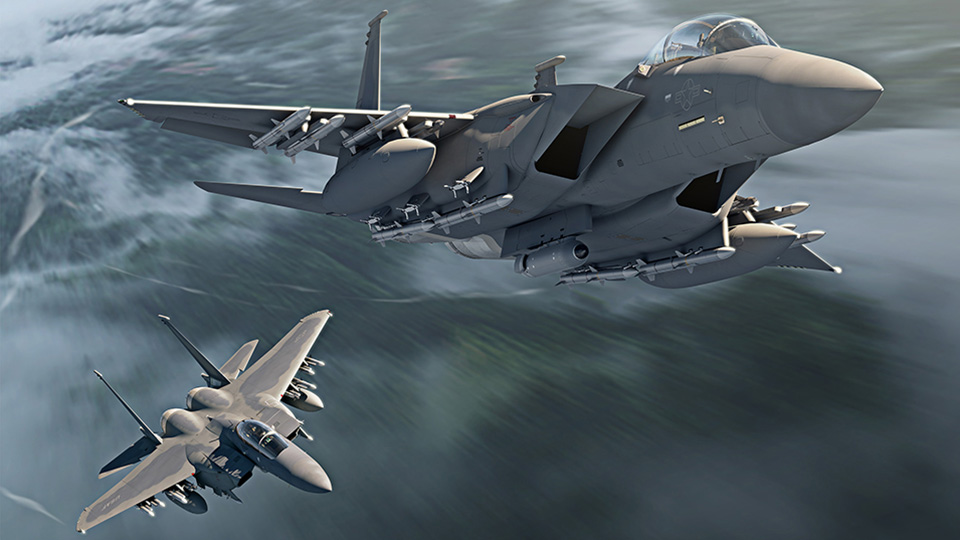
The F-15SA incorporated digital fly-by-wire, the AN/ALQ-239 DEWS electronic warfare system, and a revised wing structure for increased service life. In 2016, Qatar ordered 36 F-15QAs, with first flights scheduled for 2020, introducing further enhancements such as the ADCP II mission computer and large cockpit displays. These export orders kept the production line active, allowing Boeing to also offer the F-15EX.
The aircraft that Trump loved
The decision to acquire the F-15EX by the US was made in 2018, when the USAF recognized the need to quickly replace the F-15C/D, which had reached an average of 8,300 flight hours, exceeding the design life of 4,000 hours. The program was approved in 2019, with the first contract for eight aircraft to be signed in 2020, worth $1.2 billion. The first delivery took place in March 2021 at Eglin Air Force Base in Florida for testing. The F-15EX leveraged existing F-15 infrastructure, including ground equipment, simulators, and maintenance procedures, reducing integration costs.
The F-15EX’s connection to former President Donald Trump is significant. His administration supported the program as part of a broader strengthening of U.S. defense capabilities. And the same happened in his second term, that is, now, as the new American defense budget under consideration provides for an increase in the F-15EX fleet from 98 to 129 aircraft, with funding of $3 billion to accelerate production.
Radar – Electronic Warfare System
The F-15EX incorporates an advanced suite of electronics that enable it to face modern threats. The radar is the Raytheon AN/APG-82(V)1, an AESA technology that combines the AN/APG-63(V)3 antenna with the AN/APG-79 processor, used in the F/A-18E/F Super Hornet.
The AN/APG-82(V)1 offers superior detection and tracking capability for multiple targets, both airborne and surface, at ranges exceeding 200 kilometers for fighter-sized targets. AESA technology allows for rapid switching between modes, such as air-to-air and air-to-ground scanning, without mechanical antenna movement, while its resistance to electronic interference enhances survivability in high-threat environments.
The electronic warfare system is the AN/ALQ-250 Eagle Passive/Active Warning Survivability System (EPAWSS), developed by BAE Systems. EPAWSS replaces the older AN/ALQ-239 DEWS, used on the F-15SA and F-15QA, and offers advanced capabilities such as detection, identification, and jamming of radio frequency and infrared threats.
The system includes digital receivers and transmitters, which allow for simultaneous management of multiple threats, and is integrated with the AN/ALE-47 countermeasures distribution system, which uses chaff and flares. The EPAWSS completed its testing in April 2024, with the USAF approving full production through a $615.8 million contract to Boeing to install the system on all F-15EXs.
For passive detection, the F-15EX carries the Lockheed Martin Legion Pod with the AN/ASG-34(V)1 IRST21 (Infrared Search and Track) sensor, which replaces the older AN/AAS-42 “Tiger Eyes”. The IRST21 allows for the detection and tracking of low-observable targets, such as stealth fighters, through their infrared signature. The system provides a detection range of up to 100 kilometers for fighter aircraft and supports the launch of air-to-air missiles without the need to activate the radar, reducing the likelihood of detection of the F-15EX. In addition, the aircraft supports targeting pods such as the AN/AAQ-33 Sniper XR, which provide all-weather strike capabilities.
The Open Mission Systems (OMS) architecture is a critical element of the F-15EX. OMS allows for the rapid integration of new sensors, weapons, and software without the need for extensive modifications, ensuring long-term adaptability. The communications system includes the Multifunctional Information Distribution System (MIDS-JTRS), which supports secure data links, such as Link 16, for exchanging information with other platforms, including unmanned aerial vehicles and command and control systems. The avionics suite enables the F-15EX to function as a hub in network-centric battlefields, enhancing cooperation with other forces.
Engines – Performance
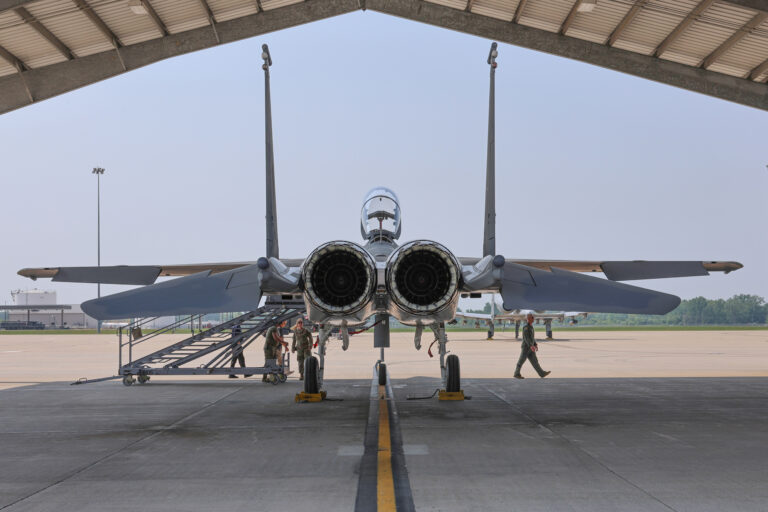
The F-15EX is powered by two General Electric F110-GE-129 engines, each producing 29,000 pounds of thrust (129 kN) with afterburning. These allow the aircraft to reach a maximum speed of Mach 2.5 (about 3,100 kilometers per hour), making it the fastest fighter in the USAF. The thrust-to-weight ratio is approximately 0.93 at full combat load, ensuring excellent maneuverability. The rate of climb exceeds 15,240 meters per minute, while the maximum flight altitude reaches 18,300 meters, allowing the F-15EX to operate at high altitudes for air superiority missions.
The F-15EX’s internal fuel capacity is 6,150 kg, which can be expanded to 16,100 kg using two conformal fuel tanks (CFT) and three external tanks. This configuration provides a combat range of 1,270 km without aerial refueling and a maximum range of over 3,900 km. The aerial refueling capability obviously remains.
The F-15EX’s structure is designed for a 20,000-hour service life, more than double that of the older F-15C/D, ensuring reliability until 2050. The reinforced wing structure, tested on the F-15SA and F-15QA, supports the transport of heavy weapons and additional pylons, increasing the total payload capacity, which is currently unrivaled internationally, at least among fighters.
Thus, the F-15EX can carry up to 13,400 kg of external load on 23 pylons, including 12 air-to-air missiles (AIM-120 AMRAAM, AIM-9X Sidewinder), precision bombs such as the GBU-39 Small Diameter Bomb and GBU-31 JDAM, and long-range missiles such as the AGM-158 JASSM. While the ability to carry large-sized weapons, such as the AGM-183A ARRW multisonic missiles under development, enhances its strategic value.
Advanced Two-Seat Cockpit
The F-15EX cockpit represents a significant advancement over previous F-15 models. It features two large 25×48 cm touchscreen displays, one for the pilot and one for the Weapon Systems Officer (WSO), supported by the Advanced Display Core Processor II (ADCP II) mission computer. These displays provide a comprehensive view of the battlefield, including data from radar, IRST, EPAWSS and communications systems. The human-machine interaction interface is designed to reduce crew workload, allowing for rapid decision-making on complex missions.
The Digital Joint Helmet Mounted Cueing System (D-JHMCS), a display of data and symbols on the pilots’ helmets, is a key component. The D-JHMCS allows the crew to launch weapons at high angles of attack from the forward quadrant, such as AIM-9X missiles, by tracking the pilot’s head movement.
The low-profile head-up display (HUD) supports the display of essential flight data, but reliance on it has been reduced as most data is displayed via the D-JHMCS and the large cockpit display. The two-seat configuration enhances the F-15EX’s versatility, allowing it to be operated with a single pilot for air superiority missions or with a WSO for complex missions such as ground strike and drone coordination.
XQ-58A Unmanned Teaming
The F-15EX is designed to act as a command and control hub for Manned-Unmanned Teaming (MUM-T) missions, with a focus on the XQ-58A Valkyrie.
Developed by Kratos Defense, the XQ-58A Valkyrie is a relatively low-cost aircraft with a range of 3,200 kilometers and a payload capacity of 550 kilograms. It is intended for roles such as reconnaissance, electronic warfare, weapons testing and, in some cases, suicide missions. It can also act as a forward sensor, detecting threats or providing targeting data while the F-15EX remains at a safe distance.
Tests conducted in 2023 by the Air Force Research Laboratory demonstrated the F-15EX’s ability to control two XQ-58As in dogfight scenarios, demonstrating its potential to function as a command platform.
A Career with a Future
The F-15EX is primarily intended to replace the F-15C/D, but is also being considered to gradually replace the older F-15E Strike Eagles, which will be nearing the end of their service lives in the 2030s.
Moreover, the transition from the F-15E to the F-15EX is seamless, as it uses similar infrastructure, ground equipment and training programs, reducing integration costs and time. While the F110-GE-129 engines, also used in the F-15E and F-16, offer a common maintenance infrastructure, reducing support costs.
Comparison with the F-35A
The F-15EX and F-35A represent different design philosophies, with each serving distinct roles in the USAF fleet. The F-35A, a fifth-generation fighter, focuses on low observability (stealth), sensor integration and mission flexibility. It features an advanced electronic warfare suite, network-centric warfare capability and internal weapons bays, which significantly reduce its radar footprint.
Thus, the F-35A excels in missions that require low observability and network-centric capabilities, such as penetrating hostile airspace and data management in complex battlefields. The F-15EX, on the other hand, is better suited for missions where stealth capability is not a primary need, such as airspace defense, enforcing no-fly zones, and carrying large weapons and heavy payloads.
Additionally, the F-15EX’s lower operating costs, estimated at $20,000+ per flight hour, and shared infrastructure with existing F-15s reduce transition costs compared to the F-35A, which requires extensive training and new infrastructure.
The F-15EX Eagle II demonstrates the resilience of the original design, which, five decades after its first flight in 1972, remains relevant in an ever-evolving and highly demanding battlefield.
Its ability to incorporate future upgrades ensures its long-term usefulness, so the “Eagle” continues to dominate the skies with a legacy that combines proven reliability and modern capabilities.