



The economist and former Finance Minister Luis Arce with his party ΜAS (Movement for Socialism) and his political alliances ISPS, received 54.5% in «Bolivia’s crucial presidential elections» of 18th October 2020 and was elected New President of Bolivia from the first round dominating the Bolivian political scene for years to come.
Luis Arce was the leader of economic policy implemented for fourteen years by former Bolivian President Evo Morales, who is self-exiled in Argentina. During its day, extreme poverty in the country halved, while the average growth rate reached 4.6% per annum and more than double GDP. It was the main contributor to the then nationalizations of large mineral wealth and energy mining companies.
by Thanos S. Chonthrogiannis
©The law of intellectual property is prohibited in any way unlawful use/appropriation of this article, with heavy civil and criminal penalties for the infringer.
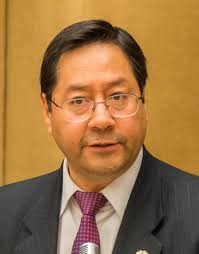
Photo by the website https://en.wikipedia.org
The economic policy pursued by Bolivia’s new president will not change as to what was implemented for days Evo Morales, but his retention in power will determine whether he will prove to be a good balancer in terms of the pressures he is about to receive internally from his party, which still has president in exile Evo Morales, and whether it will prove a real will to implement the US demands on Bolivia.
The main US interest in Bolivia rests on the control and exploitation of the giant stocks of lithium and other stocks of rare earths located in the Bolivian subsoil.
The usefulness of lithium mineral is of tremendous and strategic importance because it is used in battery manufacturing and is the main factor in the transition of the world’s economies to renewable energy sources (for more information about the usefulness of rare earths please read the analysis titled “Global Recession, Trade war and Rare Earths“).
The possession and exploitation of this mineral can determine which economy of the planet will become an economic superpower in the future.
The fact that China is the main producing and exporting country of 50% of rare earths worldwide, China’s demand, possession and exploitation of Bolivian lithium will make it a global superpower by judging global economic competition in its favour.
Bolivia’s former and self-exiled president Evo Morales and more generally MAS supporters of the now ruling MAS party believe that the former President’s downfall (or coup as his followers like to say please read the analysis titled «Bolivia: The Hybrid Coup and the Problems that require Urgent Solutions») is due to the fact that Evo Morales’ then government signed an agreement to exploit the giant lithium stockpile with China and Germany (EU) starting in 2020, leaving the US out.
This option alone predicted that in the future the comparative technological advantage would be given by China and Germany (EU) leaving behind the US which would be forced to depend on these two countries. This geopolitically and strategically could not be accepted by the US and especially by a country (Bolivia) located on the American continent.
The question now is whether Bolivia’s new President Luis Arce will be able to maintain proper balance with both the external and internal players. Unless it revises the agreements signed by Bolivia with China and Germany (EU) to exploit lithium while continuing to leave the US out, it will most likely follow Evo Morales’ path abroad.
If, on the other hand, it revises these agreements and also offers a significant share of lithium exploitation in the US, then it will come under intense pressure from Evo Morales supporters and from within the MAS party, who will be calling for his expulsion, leading to an internal parliamentary mutiny to fall from Bolivian executive power.
But Luis Arce’s tenure as former finance minister has shown that he has both the experience and the ability to make correct predictions-choices that give him the advantage of being able to choose the right balanced policy that will keep the majority of those concerned happy. We wish him well in his work.


