


Although the political history of the United States suggests that Americans traditionally “punish” the incumbent president during midterm elections, this time the result is overwhelming.
In fact, this marks only the fourth time since World War II that both the House and the Senate have simultaneously shifted partisan control during the same midterm elections—previous instances occurred in 1946, 1994, and 2006.
An initial assessment of what went wrong for the American president is of great interest. After all, the scale of the defeat is such that there is little room for misinterpretation.
A Shocking Defeat
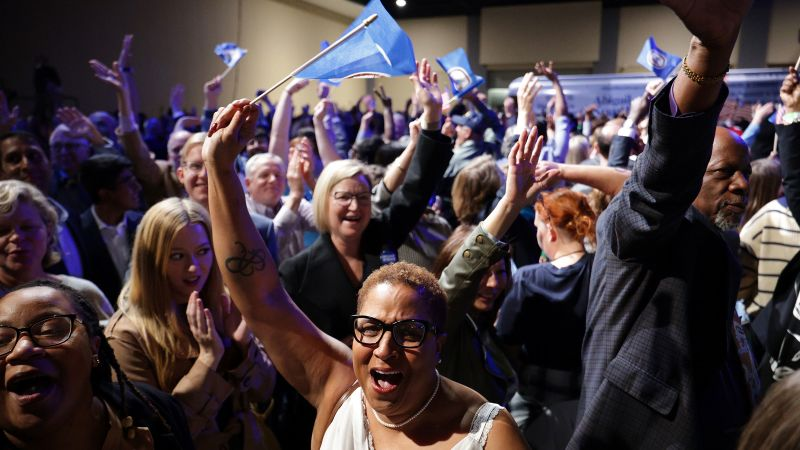
Indeed, the Democrats experienced a remarkable election night. The scope of their gains exceeded the projections of most analysts; their victory was not confined to traditional swing states but extended deep into areas dominated by Republicans.
- In Texas, James Talarico defeated Republican Ken Paxton by an overwhelming margin, becoming the first Democrat to be elected as a senator in the state in the last 38 years.
- The Democrats also made history by winning a Senate seat in South Carolina. The party had not won a U.S. Senate race in this state during the 21st century.
- Annie Andrews’ victory over Republican Senator Darline Graham was yet another one of the biggest surprises of election night—and perhaps the most painful blow for Trump, given that Darline Graham is the sister of the late Senator Lindsey Graham.
- In the Ohio Senate race—a state Trump had won three times—Democrat Sherrod Brown emerged victorious.
- In Kansas, Democrat Adam Hamilton comfortably defeated the incumbent Republican Senator, Roger Marshall. The last time Democrats had won a Senate seat from Kansas was in 1932, during the Great Depression.
- Democrats also made history in Georgia, where Keisha Lance Bottoms became the first Black woman ever elected governor in the history of the United States.
What led to the victory?
Election strategy consultants from both parties noted that the Democrats’ sweeping victories were driven by a high turnout of the party’s loyal base, as well as independent voters—who shifted toward the Democrats in both swing states and Republican strongholds.
The Democrats also adopted a strategy of fielding a candidate in every single race, even in contests where, just a few months earlier, the chances of winning had been considered slim.
This strategy paid off, especially as the Republicans put forward candidates who struggled to overcome Trump’s low approval ratings and voter anger over high prices.
Moving away from MAGA led to a crushing defeat
Trump asked voters to cast their ballots as if he himself were the candidate. They did—and the Republicans paid the price.
Early results and exit polls revealed a deeply dissatisfied electorate, which expressed strong disapproval of Trump and his political agenda; voters indicated they were particularly unhappy with high prices and the direction in which the country is heading.
Many reported that their financial situation is worse than it was two years ago, while nearly nine out of ten identified the cost of living as a decisive or very important factor in their vote.
These sentiments perfectly capture why Trump suffered such a crushing defeat: quite simply, he abandoned the MAGA doctrine.
Trump was elected on a promise to put America first, but—during his second term—he pursued policies that, according to his critics, strayed from that very promise. The war in Iran, the economic consequences of tariff policy, and persistent high prices offer an explanation for the Republicans’ electoral defeat: Trump’s political weakening is linked to the failure to meet the expectations he had cultivated among his own electoral base.
The Slogan… That Was Forgotten
The slogan “Make America Great Again” (MAGA) was not merely a communication tool. It encapsulated a specific political promise:
- less involvement in foreign wars,
- the protection of American manufacturing,
- addressing economic insecurity,
- curbing Washington’s interventions across the globe, and
- prioritizing the needs of American society.
In other words, Trump had promised that the resources and political power of the United States would be directed primarily toward restoring American prosperity.
However, the decision to launch a military strike against Iran on February 28, 2026, created a stark contradiction between his campaign rhetoric and his actions in government.
This military operation sparked backlash even within the MAGA movement—particularly among those who had believed that Trump’s return to power would mean avoiding new military entanglements.
Contradiction in the Economy, Too
The second major contradiction emerged in economic policy. Trump had promised the return of industrial production to the United States, the protection of American jobs, and the strengthening of citizens’ purchasing power.
The imposition of tariffs on imported goods was, from the outset, a core element of the “MAGA” brand of economic nationalism. Therefore, the tariffs themselves did not constitute an abandonment of that doctrine.
The contradiction lay, rather, between the stated goals of the policy and its actual consequences for American households.
Widespread tariffs, price increases, and the repercussions of war intensified economic pressures on a society that had expected the exact opposite: a reduction in the cost of living and an improvement in daily life.
A poll by the Associated Press-NORC, published before the election, is telling: only 17% of American adults approved of Trump’s handling of the cost of living, while 65% held his policies largely responsible for persistently high prices.
These figures point to a significant political shift. Trump, who had capitalized on Americans’ economic discontent to return to the White House, found himself confronted by that very same discontent.
An End to the “Romance” with Hispanic Voters
The period of political favor that Trump enjoyed among Latino voters may have come to an end. This is an unwelcome development for the Republicans, who were counting on this large group of swing voters to secure victories from California to Florida.
In Texas, where four out of every ten residents are of Latin American descent, the Democrats managed to wrest both the governorship and a Senate seat from the Republicans.
In southeastern Florida, home to a large Latino population, Democrat Pia Dandiya won the race for the 22nd Congressional District—even though the district’s boundaries had recently been redrawn in a way that favored the Republicans.
Latino voters had played a significant role in Trump’s 2024 victory, when he secured nearly half of the votes from Hispanic Americans, compared to about one-third in 2020.
Two years later, many of them had abandoned his party. Anger over the economic situation contributed to a decline in support for the Republicans among Hispanic voters.
According to exit polls, only one in three voters supported the Republicans on Tuesday, compared to 46% in 2024. The victories of Gina Hinojosa—who will become the first female governor of Hispanic descent in Texas—and Xavier Becerra—who will become the first elected governor of Hispanic descent in California—highlighted the significance of the Hispanic American vote.
Black voters and young people abandoned him
Trump had banked on his electoral base—comprising white working-class voters, as well as a larger-than-usual share of young people and voters from racial and ethnic minorities (who had contributed to his victory in the 2024 presidential election)—to save his Republican allies, provided they turned out to vote in large numbers. He was wrong.
In 2024, voters under the age of 30 were split almost evenly between Trump and Vice President Kamala Harris. In this year’s elections, however, about seven out of ten voters in the same age group stated that they supported the Democratic candidate for the House of Representatives in their district.
At the same time, Republicans appeared to lose ground among Black voters, particularly among Black men.
Nationwide, only one in ten Black male voters supported the Republican candidate for the House of Representatives in their local district.
This figure represents a significant decline compared to the approximately 25% who had supported Trump in the previous presidential election. About nine out of ten Black voters supported the Democratic candidate for the House, compared to about eight out of ten who had voted for Harris.
Americans Wanted Change
Voters across the country desired change, according to the AP Voter Poll, which found that approximately three-quarters of voters feel “angry” or “dissatisfied” with the direction of the country.
Among those who had Trump in mind when casting their ballots, about twice as many wanted to express their opposition to the Republican president as those who wished to support him.
Indeed, Trump’s political standing is at a new low, roughly two years before the end of his final term.
About 70% of voters want Congress to exercise stronger oversight of presidential power and serve as an institutional check. At the same time, roughly six in ten believe that Trump prioritizes his own personal interests over the interests of the country.

