

Poland’s geographical location is of vital importance to Germany. Poland shares borders with Belarus and the Russian exclave of Kaliningrad, lies adjacent to Ukraine, and serves as the primary land corridor for the transport of military equipment and Western aid to Kyiv.
Furthermore, it constitutes a critical link in NATO’s defensive posture in Eastern Europe. For Germany, strengthening Poland carries a twofold significance.
- First, it creates a more robust line of deterrence against Russia, limiting the risk of military expansion into Central Europe.
- Second, it enables Berlin to assume a greater role in shaping European defense policy by leveraging Poland’s strategic importance.
The crucial point is that Germany does not merely seek a strong Poland; it seeks a strong Poland integrated into a European defense system in which Berlin plays a central role.
The Germany-Poland Defence Agreement: A New Strategic Framework
The defence agreement signed by Germany and Poland on June 17, 2026, carries particular significance.
The agreement provides for a substantial deepening of military cooperation between the two nations, with a focus on:
- Baltic security.
- The development of joint defense capabilities.
- Cooperation between defense industries.
- Cybersecurity.
- Joint military exercises.
- Military mobility and infrastructure for the transport of forces.
- Countering hybrid threats.
The agreement was signed in Warsaw by German Defense Minister Boris Pistorius and Polish Defense Minister Władysław Kosiniak-Kamysz.
The German government presented the agreement as a key component of the new European security architecture, emphasizing that the defense policies of both countries must align with the frameworks of NATO and the European Union.
Of particular importance is the fact that this cooperation includes the strengthening of Poland’s defense infrastructure—most notably through the “Eastern Shield” initiative, which focuses on reinforcing the eastern border. The agreement does not constitute a mutual defense treaty comparable to the specific bilateral agreements Poland has concluded with France and Britain. It does, however, represent a significant step toward military and institutional integration.
In practical terms, Germany is investing in the creation of a robust defense framework in Eastern Europe, with Poland serving as the primary geographical and military pillar.
Donald Tusk as the Political Link Between Berlin and Warsaw
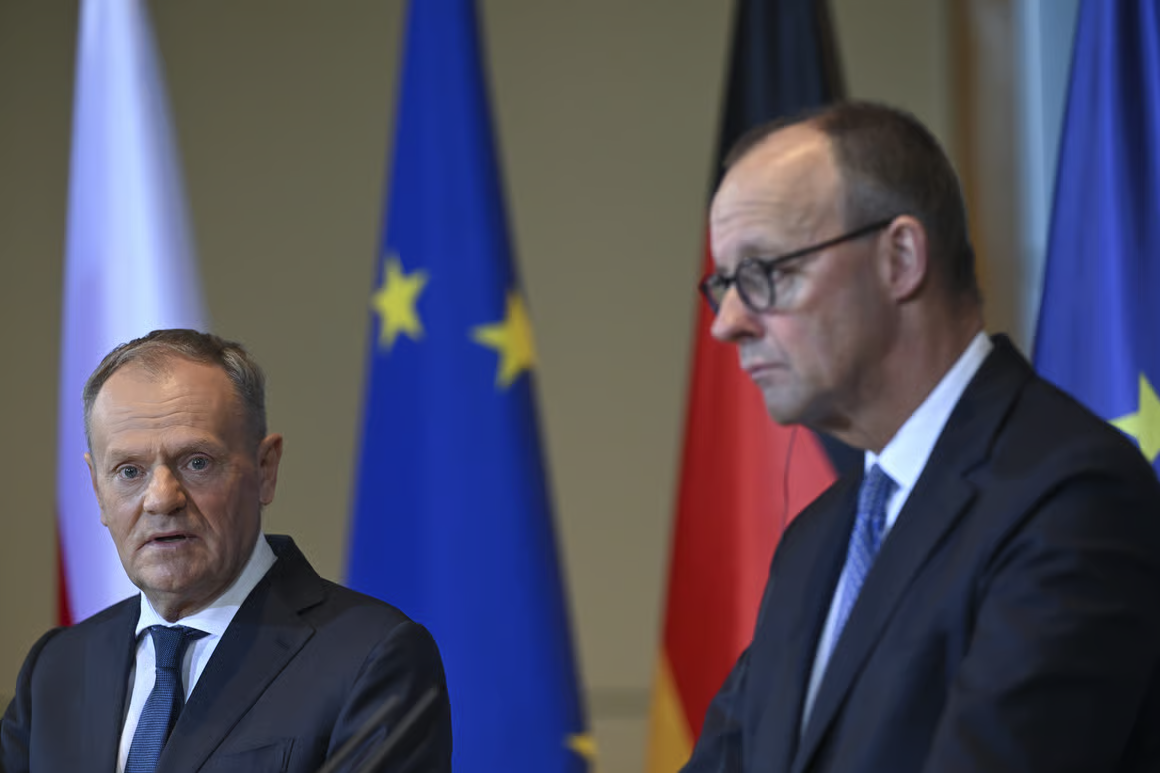
Donald Tusk’s political relationship with Germany is one of the most contentious issues in Poland. Tusk served as President of the European Council from 2014 to 2019, during which time he cultivated close political ties with the European center-right and key institutional figures within the EU.
At the same time, he has maintained particularly close relations with the German political leadership. His return to the Polish political scene and his electoral victory in 2023 coincided with Germany’s efforts to enhance its role in European security following the Russian invasion of Ukraine.
For the Law and Justice (PiS) party, Tusk’s political proximity to Berlin serves as proof that the current government is pursuing a policy more closely aligned with German objectives.
Jarosław Kaczyński’s party has repeatedly portrayed Tusk as a political representative of German interests in Poland.
This particular accusation, however, has also been used as a tool in domestic political confrontation. A study published in the European Journal of International Security (Cambridge University Press) notes that PiS had developed a systematic political narrative, portraying Tusk as an agent of Berlin and linking him to the alleged undermining of Polish interests.
The same study points out that state television broadcast a manipulated excerpt of a speech by Tusk more than 200 times, in order to reinforce the perception that he was serving Germany’s interests.
Consequently, the accusation that the Tusk government was under German control is deeply rooted in Polish political discourse, but it is not an established fact.
The American Dimension: Nawrocki as a Counterweight to German Influence
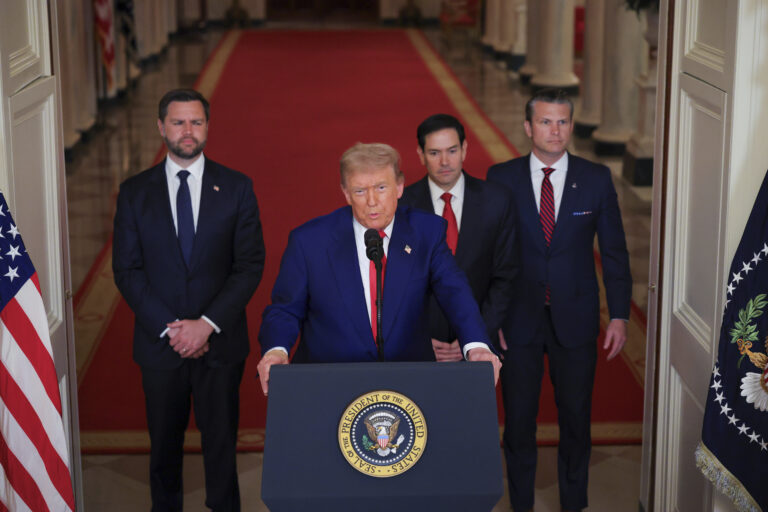
The other major factor in the Polish crisis is the United States. President Karol Nawrocki is an ardent supporter of Donald Trump and has received public political backing from the American president.
Trump notably stated that he supported Nawrocki, adding that the Polish president is doing an excellent job. Nawrocki has also proposed naming a new American military base in Poland “Fort Trump,” seeking to strengthen the strategic relationship with Washington.
His political stance creates a different balance within Polish foreign policy. On one hand, the Tusk government promotes closer cooperation with Brussels and Berlin.
On the other, Nawrocki seeks to maintain a strong American presence in Polish security. This does not mean that Nawrocki opposes the military strengthening of Poland or the countering of Russia.
On the contrary, both the government and the presidency recognize the Russian threat. The disagreement primarily concerns who should play the central role in shaping European and Polish defense policy. For Germany, strengthening European strategic autonomy is a key objective.
For Trump, maintaining American influence in Eastern Europe and ensuring European dependence on American military power are distinct components of his strategy. Thus, the conflict between Tusk and Nawrocki also takes on an American-German dimension.
The Constitutional Tribunal Crisis and the Question of External Influence
The current crisis creates a particularly complex environment. The Tusk government maintains that it is attempting to restore the functioning of institutions following interventions by PiS.
The opposition argues that the government is using the restoration of the rule of law as a pretext to gain control over the Constitutional Tribunal.
The European Commission has expressed the view that the Polish parliament should have the authority to appoint new judges—a stance that effectively bolsters the position of the Tusk government.
At the same time, the presence of thousands of protesters and the intervention by Nawrocki demonstrate that the crisis has taken on broader social and political dimensions. This confrontation is likely to have a decisive impact on the 2027 parliamentary elections.
This raises a significant geopolitical question: Could this internal institutional crisis lead to Poland becoming more dependent on its external allies?
The major geopolitical question: Should Poland exist as an independent power, or as a buffer against Russian might under German influence?
At the heart of the Polish crisis lies an attempt to forge a new balance of power in Europe. Germany seeks to bolster its own military and political role by leveraging cooperation with Poland—a move driven by the strategic necessity of containing Russia.
The Tusk government serves as Berlin’s primary political interlocutor in Warsaw, whereas a potential Nawrocki presidency would maintain close ties with Donald Trump and American conservative politics.
The notion that Germany is actively seeking to destabilize Poland in order to transform it into a controlled buffer against Russia remains a political interpretation that has yet to be substantiated.
Nevertheless, the substantive upgrading of German-Polish defense cooperation, the establishment of joint military structures, and the deepening of European defense integration clearly indicate that Berlin aims to exert greater strategic weight in Eastern Europe.
The critical question is whether this cooperation will be based on an equal partnership between two powerful European states, or whether it will create a new relationship of dependency—with Poland assuming the role of the front line vis-à-vis Russia, while Germany retains the central political and economic role.
In any case, Poland is not merely a country grappling with an internal constitutional crisis. It lies at the heart of a broader struggle over who will define Europe’s security, policy, and geopolitical direction in the years to come.
Should political polarization persist, both Germany and the United States will have an increased incentive to maintain a strong presence in the country’s political and defense-related affairs. This, however, does not prove that either of the two forces is causing or organizing the crisis.
