



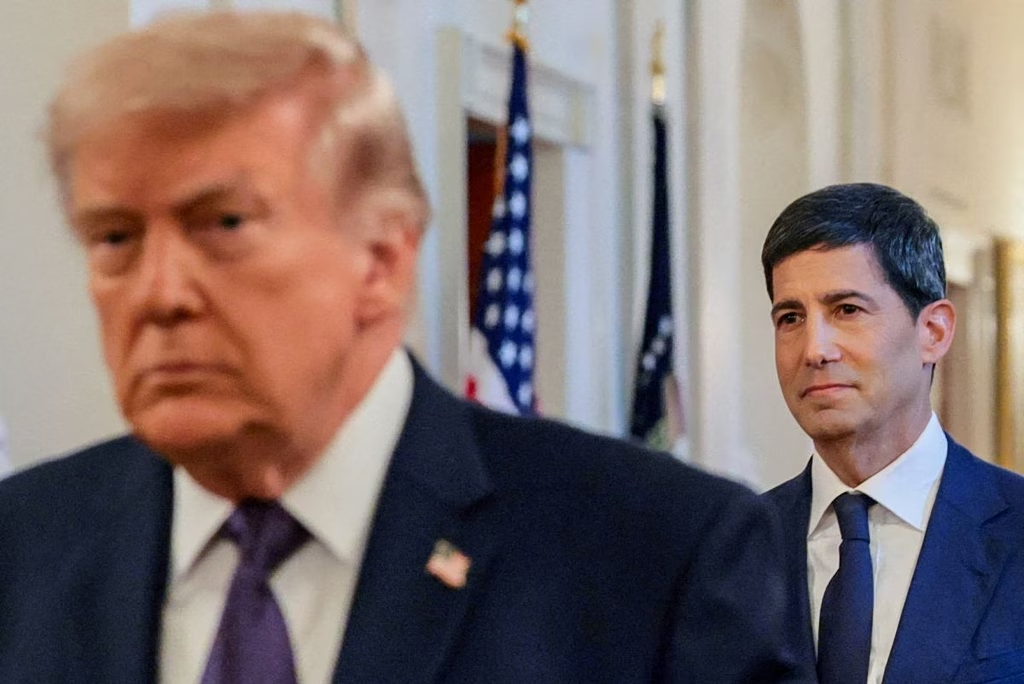
With the US midterm elections now about 40 days away and the campaign entering the home stretch, time appears to be running out on the era of President Donald Trump’s absolute dominance and omnipotence in American political life; the institutional checks and balances of the American democratic order are beginning—albeit belatedly and somewhat sluggishly—to function.
Defeat after defeat
While the 42nd US President managed, during his first two years in office, to impose his agenda and largely implement policies that were radically conservative, xenophobic, and corrosive to the rule of law, deep cracks have recently begun to appear in the image of absolute control over the country’s political life and direction—an image he and his team had carefully cultivated. A key piece of evidence for this shift is the Federal Reserve’s recent decision regarding lending rates.
This reality became starkly apparent this week: the clash with his own nominee for the Fed, Kevin Warsh, was preceded by a Supreme Court decision blocking Trump’s plan to restrict mail-in voting ahead of the midterm elections. The announcement of the decision sparked an angry outburst from Donald Trump; the former president lashed out at the justices he had appointed during his first term, describing the Supreme Court as an empty shell that bears no resemblance to what it once was.
Trump launched a scathing attack on Justices Brett Kavanaugh, Neil Gorsuch, and Amy Coney Barrett for siding with the majority that blocked his attempt to sow discord regarding mail-in ballots ahead of the midterm elections. “These are not the people I interviewed to serve on the Supreme Court,” Trump wrote on Truth Social.
Added to the above—and carrying a distinctly pre-election flavor—is the practical dismissal of Donald Trump’s promise to issue a $5,000 check to every American should the Republicans win in November.
The President’s idea was rejected both by officials within his own administration—notably Vice President JD Vance—and by Republicans on Capitol Hill, who immediately distanced themselves from Trump’s proposal.
Another humiliation—one that, this time, also reflects poorly on the Republicans themselves—is the decision by House Speaker Mike Johnson, a close Trump ally, to adjourn the House early (a day ahead of schedule) to avoid a vote on whether to initiate impeachment proceedings against Secretary of Defense Pete Hegseth.
The icing on the cake, of course, was Kevin Warsh’s decision to raise the Fed’s lending rates—for the first time since July 2023—rather than adopting a conciliatory stance toward the wishes of the man who effectively selected him for the role: Donald Trump.
For months—dating back to the time when Jerome Powell, the US President’s sworn enemy, was Chair of the Federal Reserve—Trump had been demanding significant cuts in borrowing costs, disregarding the risk of rising inflation—a risk exacerbated by his policy choices regarding the economy, foreign policy, and the war in Iran.
The worst is likely yet to come for Trump
All of this—combined with the recent double legal setback regarding the visa restrictions Trump sought to impose (on journalists and students) and the rules concerning benefits for green card applicants—demonstrates that the vital “space” President Trump had carved out for himself and his extreme policy choices ahead of the election has begun to shrink noticeably.
Analysts believe this situation could have a twofold impact: on the one hand, it may negatively affect his election outcome, while on the other, it will lay the groundwork for the net to tighten even further around Trump in the post-election period.
