

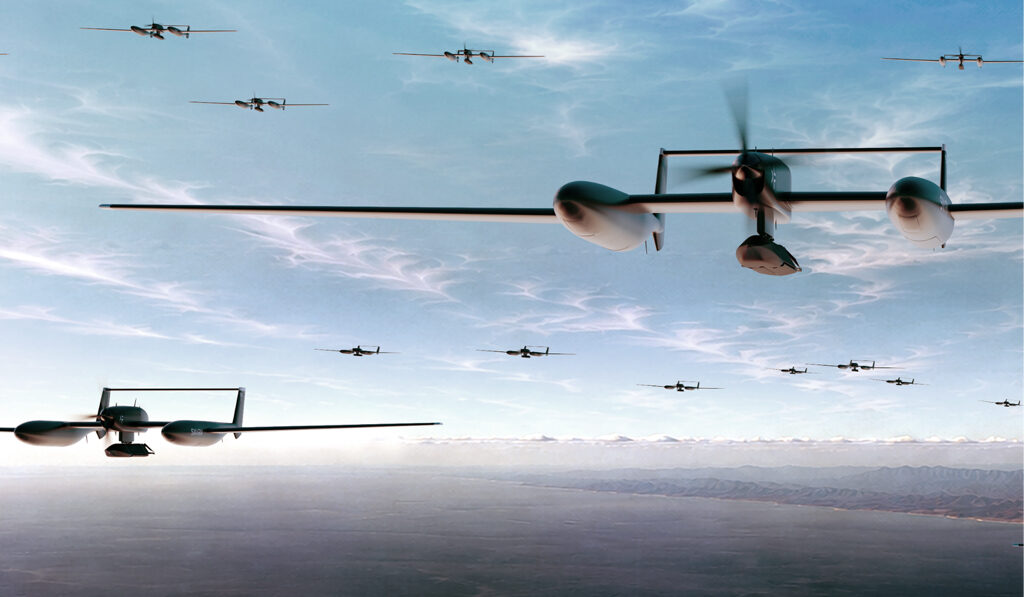
The American company Swarm Aero has unveiled Gamera, a new, large Group 5 UAV designed for ultra-long-range strike missions, capable of carrying heavy munitions such as the JASSM-ER and LRASM. The aircraft was revealed on September 14 at the Air, Space & Cyber Conference and is being proposed for the USAF’s Massed Modular Aircraft (MMA) program.
It is worth noting that Group 5 represents the highest category in the US Department of Defense’s official classification for unmanned aerial vehicles: these aircraft exceed 600 kg in weight and 18,000 feet in operating altitude, possess extended endurance and global or strategic range, and require specialized runways and ground control stations.
Named after the famous giant monster (kaiju) from Japanese cinema, Gamera features a wingspan of approximately 22 meters, a range exceeding 9,000 nautical miles (16,700 km) without refueling, and a payload capacity of over 1,270 kg distributed across seven hardpoints. It can carry air-to-ground and air-to-air weapons, as well as sensors, electronic warfare systems, or communications equipment.
Swarm Aero describes it as the first UAS designed from the ground up to carry “bomber-class” weapons, such as the AGM-158B JASSM-ER and AGM-158C LRASM. Furthermore—and most importantly—its design philosophy is not based on stealth doctrine, but rather on long range and the use of stand-off weapons, enabling it to engage targets without penetrating deep into hostile air defenses.
Gamera is designed for mass production and collaborative operations; utilizing the “Legion” autonomy system, a single operator will be able to control multiple aircraft acting as a team.
Particular emphasis is placed on cost. The company targets a price of approximately $10 million per aircraft—or lower with large-scale production—aiming for a significantly lower cost per mission compared to current large UAS.
Gamera is specifically tailored to the requirements of the Indo-Pacific region, where vast distances and the vulnerability of forward bases necessitate long-range aircraft capable of being deployed in large numbers. According to the company, the prototype could fly in 2027.