

The Christianization of the Franks (kerstening van de Franken) is undoubtedly one of the most pivotal events in European history. It not only altered the religious identity of the Germanic Frankish people but also laid the foundations for the alliance between Church and State in Western Europe. From the perspective of Dr. Los, this process is analyzed in terms of specific stages and characteristics, as follows:
1. The “Turning Point”: The Baptism of Clovis I
The Political Choice: In 496 AD (or 508 AD, according to more recent historical estimates), the Frankish King Clovis (“Renowned Warrior”) I embraced Christianity. Tradition holds that he vowed to convert if he won the Battle of Tolbiac (modern-day Zülpich) against the Alemanni, another Germanic tribe.
The Significance of Catholicism: Unlike other Germanic tribes (such as the Visigoths and the Vandals) that had adopted Arianism (a Christian heresy), Clovis turned directly to Catholic Christianity. This secured him the support of the Gallo-Roman population and the powerful Catholic Church.
2. The Nature of Frankish Christianization
“Top-down” approach: Christianization did not originate organically from the common people. When the king was baptized, the military aristocracy and his warriors (approximately 3,000 men) were compelled to follow his example.
Fusion of Paganism and Christianity: The early Franks did not immediately abandon their old customs. For a long time, Christian festivals replaced pagan ones (e.g., the “Yule” or Winter Solstice celebration became Christmas), while the veneration of saints took the place of ancient local deities.
Missionary Activity in the Low Countries: In the northern Frankish territories (present-day Netherlands and Belgium), Christianization was completed later—during the 7th and 8th centuries—through the efforts of prominent Anglo-Saxon and Frankish missionaries such as Saint Willibrord and Saint Boniface. 3. The Era of Charlemagne and Forced Christianization
As Los analyzes in his work, Christianization under the Carolingian dynasty took on a more aggressive and, at the same time, political character:
By the sword: During the “Saxon Wars,” Charlemagne imposed Christianity on neighboring pagan Germanic peoples (the Saxons) by force. Refusal to undergo baptism or the observance of pagan customs was punishable by death (the “Capitulatio de partibus Saxoniae”—or “Capitulation for the Saxon Territories”—was enforced through the use or threat of violence).
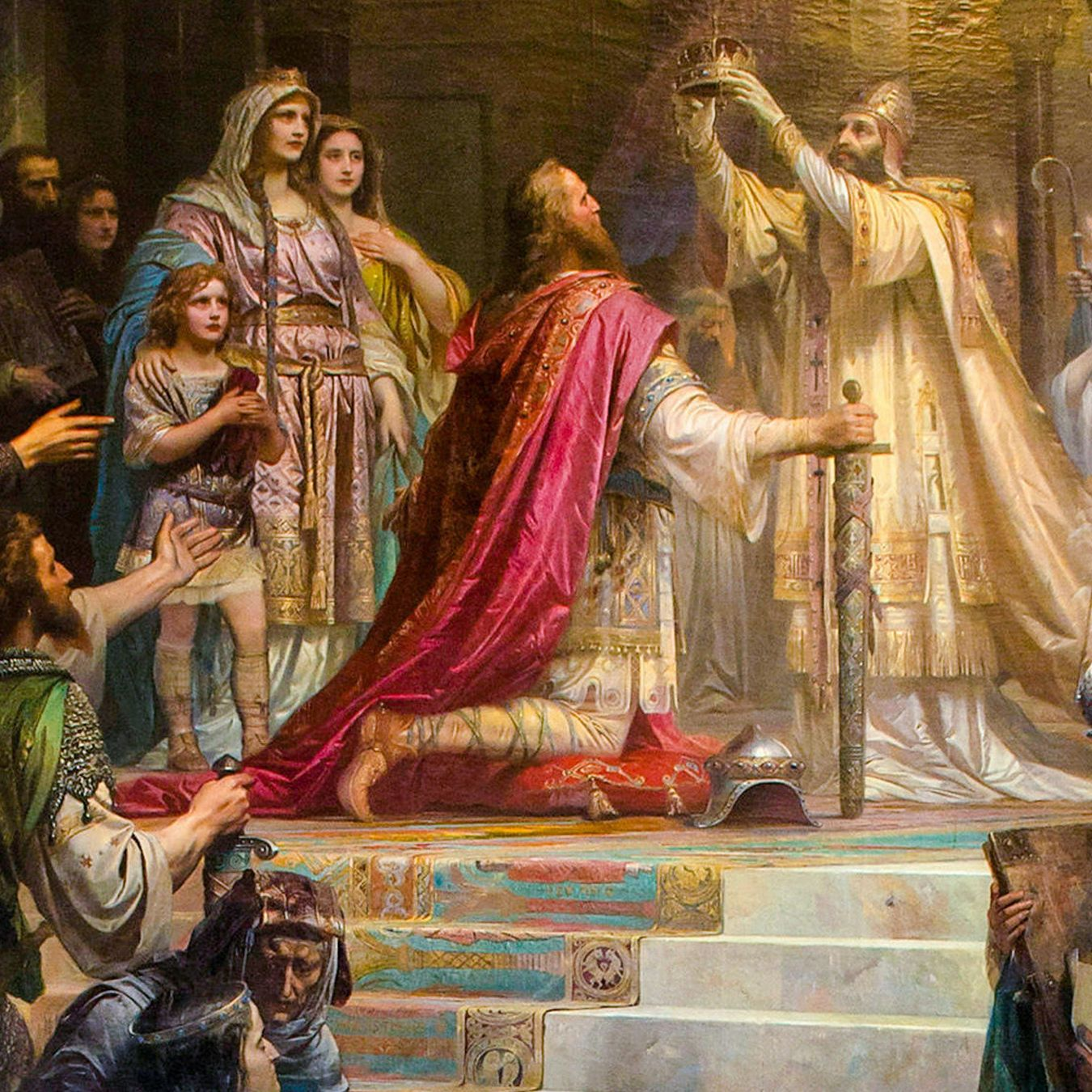
The Founding of the “Holy Roman Empire”: This politico-religious process culminated on Christmas Day, 800 AD, when Charlemagne was crowned Emperor by Pope Leo III, sealing the union of the Frankish sword with the divinely inspired spiritual authority of Rome.
In his work on the Christianization of the Franks by Charles (1940), Los develops a coherent theological and historical critique of the ruthless and violent methods Charlemagne employed to spread Christianity, particularly during the Saxon Wars.
As a theologian and pastor of the Dutch Reformed Church, Los examines the issue through the lens of the authenticity of faith and Christian ethics, focusing on the following key points:
1. Corruption of the Gospel through the use of force (“The Gospel of the Sword” – Het Evangelie van het Zwaard)
Los sharply criticizes the concept of “Christianization by the sword” (kerstening met het zwaard). From a theological perspective, he argues that the Gospel is grounded in free will, repentance, and the spiritual rebirth of the individual. When faith is imposed as a legal obligation—and specifically under penalty of death (as stipulated by Charlemagne’s notorious Capitulatio de partibus Saxoniae)—it ceases to be the Christian religion and transforms into an instrument of political coercion.
2. “False Conversion”
(Schijnbekering) A central theological argument advanced by Los is that the mass, forced baptism of entire populations resulted in a “superficial conversion” (oppervlakteconversie). Pagan Saxons and other Germanic tribes accepted baptism in Christ solely to save their lives. As a result, paganism was not truly eradicated but rather “disguised” in Christian garb. According to Los, this method undermined the spiritual depth of the Church for centuries, as it introduced numerous pagan elements and superstitions into worship.
3. The Political Instrumentalization of Religious Faith
Los analyzes how Charlemagne did not act solely out of religious zeal but used the Church as a tool to unify and control his empire. Imposing a common religion served as the ideal cohesive bond to keep conquered peoples in submission. For Los, this subordination of spiritual authority (the Church) to the exigencies of secular power (the State) represents a profoundly serious deviation from the Church’s mission.
4. Contrast with Early Missionaries
In his work, Los contrasts Charlemagne’s violent strategy with the efforts of early missionaries (such as Willibrord or Boniface in the Low Countries) and even with the counsel of the scholar Alcuin of York. [Alcuin of York was an Anglo-Saxon scholar, cleric, poet, and teacher from York in Northumbria, and is considered the most important intellectual figure of the Carolingian dynasty and the so-called Carolingian Renaissance.] As an advisor to Charlemagne himself, Alcuin had emphasized from a theological standpoint that “a man can be led to baptism, but not to faith!”
Dr. Los concurs with this view, stressing that Christian instruction (catechesis) must always precede the sacrament—a principle Charlemagne disregarded in the interest of rapid conquest. Consequently, the title of his book—posing the question of whether Charles was truly “Great” (Karel de Frank, de Groote?)—reflects precisely this challenge: Can a ruler be considered a “Great” Christian king when his methods for spreading the faith ran counter to the very spirit of Christianity?
While modern Dutch archaeology rejects the notion of total genocide or the forced, violent Christianization of the masses in the Low Countries, it confirms that the Franks strategically employed violence to subjugate the local elite. Once the leadership was subdued or co-opted, the common people underwent the process of “Frankification” gradually and peacefully, driven largely by the economic advantages offered by the new empire.
The pivotal issue—the backdrop to these historical events, as examined in Dr. Los’s work The Franks: Their History and Character (De Franken: Hun Geschiedenis en Karakter)—takes on a highly specific, radical, and ideologically charged dimension:
- In his aforementioned book Karel de Frank, de Groote? De Franken en de kerstening (published by the National Socialist publishing house Volk en Bodem), Los developed a theory attempting to redefine the “character” of the Franks in relation to neighboring Germanic tribes (such as the Saxons and Frisians). According to this school of thought, the analysis of the historical and racial character of the Franks is formulated as follows:
1. Historical Character: The “Roman Corruption”
In contrast to traditional historiography, which extols the Franks as the architects of modern Europe, Los and his contemporary nationalist writers (such as Taido Tjapkema) argued that the authentic character of the Franks was prematurely corrupted through:
Racial Mixing: It was argued that the Salian Franks, in migrating southward (to Gaul), came into contact with the local Gallo-Roman population. According to the racial theory of the time, this rendered them “mongrelized” (verbasterd) compared to the isolated Frisians or the unsubdued Saxons.
Political Subjugation to Rome: The character of the Frankish leadership (Merovingians and Carolingians) was criticized for abandoning the Teutonic customary law of freedom in favor of adopting the centralized, authoritarian Roman model of governance. 2. History: Charlemagne as an Anti-German Archetype
Los focused his historical research on the era of the Carolingian dynasty, challenging the myth of “Charles the Great”—or “Charlemagne”:
The Christian “Antidote”: According to Los, Charlemagne acted as an instrument of the Catholic Church, introducing an institution (Christianity) that eroded the authentic character of the Germanic tribes.
The Conflict with the Saxons: In the history of the Low Countries and Germany, Los did not view Charlemagne as a unifier, but rather as a Frankish ruler who forcibly destroyed the freedom of the Saxons (led by their indomitable chieftain Widukind), thereby betraying their shared Teutonic roots. 3. The Psychological Portrait of the “Frank” in Nationalist Historiography
Publications of the period (such as Laïki Froura—or Volkische Wacht—where Los wrote) attempted to contrast the character of the northern Germanic tribes with that of the Franks:
The Franks were portrayed as outwardly disciplined due to Roman law, yet inwardly “pliant” (buigzaam) and prone to political intrigue as a result of French influence.
The Frisians and Saxons were described as organized (ordelijk), tenacious (vasthoudend), and possessed of a deep spirit of independence—traits considered the foundations of the authentic Dutch character.
Dr. Los’s study of the history and character of the Franks is not merely a detailed historical account; it is also a characteristic example of the promotion of theories regarding racial purity and national identity in the Netherlands, illustrating the extensive use of medieval history for ideological and political purposes during the mid-20th century.
The portrayal of Charlemagne as a “genuine Teuton” (authentieke Teutoon) or “authentic German” (echte Germaan) represents a specific ideological and historiographical trend. This approach is directly linked to the spirit of writers such as Los, as well as to the broader German nationalist historiography of the 19th and early 20th centuries. This trend sought to “extract” Charlemagne from the French historical tradition—in which he was depicted as the French king Charlemagne—and restore him to his Germanic/Teutonic roots.
- The theory of Charlemagne as a “genuine Teuton” rests on four key pillars:
1. Racial and Linguistic Origins
Germanic Language: Proponents of this theory emphasize that Charlemagne’s native tongue was not early French (Romance) but a Frankish-Germanic dialect (Theodisce lingua—the language of the people). When scholars wished to indicate that something was spoken or written in the vernacular Germanic language, they used the term theodisce (vernacular/Teutonic).
Cultural Basis: The heart of his empire lay not in Paris but in the Rhineland regions of Austrasia. His palace at Aachen (Aquisgranum) was situated on distinctly Germanic soil.
Daily Habits: Historical sources from the era (such as his biographer, Einhard) record that Charles wore traditional Frankish attire, detested foreign (Roman) garments, and delighted in hunting and swimming in natural springs—traits considered typical of the Teutonic character.
2. Dr. Los’s Theological Perspective (The “Teutonic” Tragedy)
In his work, Los employs the concept of the “Teuton” in a more complex and critical manner, noting the following:
Conflict of Character: Los perceived an internal tragedy within Charlemagne. On one hand, there was the “Teutonic character” (independence, strength, a connection to nature). On the other, he adopted the despotic Roman-Catholic model of authority, which was alien to Germanic traditions.
Betrayal of the Teutonic Spirit: For Los, when Charlemagne slaughtered the Saxons (who were also a Germanic/Teutonic tribe) to force them to undergo baptism, he acted as an instrument of Rome and betrayed the authentic Teutonic spirit of Freedom.
3. Political Exploitation of the Theory (German National Socialism)
The concept of Charlemagne as a “genuine Teuton” took on extreme proportions in Germany during the 1930s and 1940s (the period when Los’s book was also published):
Initial Rejection: Initially, National Socialist ideologues (such as Alfred Rosenberg) labeled him the “Butcher of the Saxons” (Sachsenschlächter) because he had destroyed the pagan Germanic religion.
Re-evaluation of the Emperor as the German “Karl der Große” (Charles the Great): Later, the regime changed its stance and presented him as the first great unifier of the Teutonic and German lands—the man who established the First Reich. The French name “Charlemagne” was banned from official historiography and replaced exclusively by “Karl der Große.”
4. Contemporary Historical Reality
Modern historiography rejects these excessively ethnocentric, obsessive, and baseless nationalist distinctions: Charlemagne was neither “French” nor “German” in the modern sense of the terms. He was a Frankish ruler in an era when these two cultures were still united. The fact that his empire was later divided (by the Treaty of Verdun in 843 AD) gave rise to both France and Germany, making Charlemagne the “father” of both nations.
In the eyes of most historians—who portray Charlemagne “almost as the archetype of the ‘genuine’ Teuton” because they “begin with a vague and somewhat hazy notion of what they mean by the term ‘genuine Teuton'” and, by logical extension, because their own forma mentis prevents them from grasping what is typically Teutonic or, more broadly, Germanic…
[Forma mentis is a Latin phrase literally meaning “form of the mind.” It is used to describe the mindset, way of thinking, or thought structure of an individual or a group. It refers to the established set of perceptions and approaches—shaped by education, experience, or character—that influences how a person perceives and reacts to reality.]
…Charlemagne’s “unbridled sexual nature” and his capacity for true love are thus seen as indisputable signs of his “greatness”—or at least, that is the implication of these traits, whether stated directly or conveyed indirectly and by way of innuendo by the historians in question. Charlemagne’s renowned hospitality can be attributed to his adherence to a Germanic custom once deeply admired by Gaius Cornelius Tacitus in his work Germania (De Origine et situ Germanorum—”Germany: On the Origin and Situation of the Germans”), specifically in Chapter 21 (an ethnographic study of the Germanic tribes living beyond the Empire’s borders).
The Roman historian frequently used the Germans as the archetype of the “noble savage.” By showcasing their pure, selfless hospitality, he sought to indirectly criticize and shame the Roman society of his time—a society that had become materialistic, suspicious, calculating, and corrupt.
The sacred obligation never to deny shelter to a stranger was incorporated intact into medieval law. The Germanic custom of hospitality remained truly a “custom”—an ingrained habit of the soul and spirit—and never degenerated into a rationalized, intellectual, and socially oriented practice or a mere means of socializing, as happened later in Europe following Christianization. Nor did it transform into the observance and practice of a Christian virtue closely linked to the humanitarian ideal of mercy (misericordia) and compassion (caritas), driven by the theological imperative to invite the poor, the needy, and the outcasts. Consequently, it did not strictly follow Chrysostom’s view of hospitality as a means of fostering a Christian, cosmopolitan humanity.
When Charlemagne acted as a benevolent “Teuton,” he upheld the laws of absolute hospitality described by Tacitus. Yet, when he had to act as a Roman-style state organizer, he curbed the abuses committed by Irish and English pilgrims. Precisely because he combined the Teutonic tradition with Roman administration, he succeeded in transforming the ancient custom of hospitality into a functional, socially beneficial, organized, and regulated state network, putting a stop to its exploitation by “professional” travelers.
The aforementioned letter fully confirms the impression conveyed by the text you have just read: the institutionalized Christian charity of Charlemagne’s Frankish Empire had fallen prey to resourceful and deceitful British travelers who had discovered how to travel across Europe for free at the expense of the Frankish state.