The accumulation of more than 100,000 men of the Russian Armed Forces on the border with Ukraine, and in fact heavy, armored, artillery, select regiments of the “Guard”, paratroopers, from all possible directions, south of Crimea, north-north, north-north and north , even through neighboring Belarus, and of course with the mobilization of the Black Sea Fleet and the surrounding air units, as well as the continuous conduct of exercises with real fire, is the great crisis of 2021 that continues in 2022.
Russia declares in all tones that “we have no intention of invading” but does not explain the mobilization and the constant movement to the border zone, with large stockpiles of ammunition, that is, with purely war preparations. On the other hand, the US and Europe respond that they will “defend the integrity of Ukraine”, but not with the army, but mainly with sending military supplies, training, accounting support, providing information, etc. Russia no longer has the military advantage to make such an invasion. Attention, we always refer to the military part.

1. Russia did not have the element of surprise.
The area of potential operations is monitored on a 24th basis by every western medium: by NATO E-3 AWACS, but also by US electronic surveillance RC-135 Rivet Joint of the 95th USAF Reconnaissance Squadron, based in Britain, at the RAF Mildenhall base. Almost every day we have unmanned RQ-4 Global Hawk flights from the Sigonela base in Italy, as well as EP-3E electronic surveillance from Souda, as well as E-8C Joint STARS battle management. The American Artemis, another ISTAR (Intelligence, Surveillance, Target Acquisition, Reconnaissance) aircraft based on the Bombardier Challenger civilian jet, has also appeared in the area.
Definitely, we have the presence of several more European aircraft, such as the Swedish S102B Korpen (intelligence collection) and the British RC-135. To these we add the Ukrainian media, from Turkish-made unmanned Bayraktar to small American Raven for local surveillance, plus a sperm of commercial UAVs used on every corner of the Russian-Ukrainian border.
Satellite surveillance has been intensified by both military and civilian satellites. With their own information about the mass arrival and camping of Russian troops to be made public in order to secure the relevant Western accusations.
2. At the level of Ukraine.
The Ukrainian armed forces in the almost three months that the Russian mobilization lasts (essentially 10 months, because in March-April 2021 a similar crisis took place again) had plenty of time to organize, mobilize, fortify, open trenches, anti-tank trenches, to be trained, to repair each of their vehicles. Also to be informed by western sources about what they are facing, to order their forces accordingly, to review plans, to order reserves, to create stocks and multiple lines of defense.
3. Ukraine is receiving ample military equipment from the West.
Although this is not a heavyweight, as it focuses mainly on anti-tank missiles, atomic weapons, telecommunications and ammunition, it has clearly been strengthened. A full account of what was sent is not possible as it remains secret, but various sources say more than 2,000 NLAWs from Britain, hundreds of US Javelin anti-tankers, and last year the US alone transported $650 million worth of military equipment to Ukraine. and this year new material worth $200 million, which they describe as “lethal” without announcing what exactly it is.
Countries such as Estonia and Lithuania have pledged to provide military equipment to Ukraine, whether modern or Western (already licensed by the United States) and older, such as 122mm artillery shells and ammunition.
4. Various groups of “military advisers” have already arrived in Ukraine.
These “military advisers” have arrived either formally, to train local troops, or informally, as small mercenary units. The latter is a dark spot as Russia and Ukraine blame each other for hiring mercenaries in the region: for special operations, for provocations, but also for exploiting “chemical elements”. That troops on either side can theoretically not use. Rumors are already circulating about the arrival in Ukraine (for a fee) of Azeri and Syrian mercenaries, with Turkish facilities in fact.
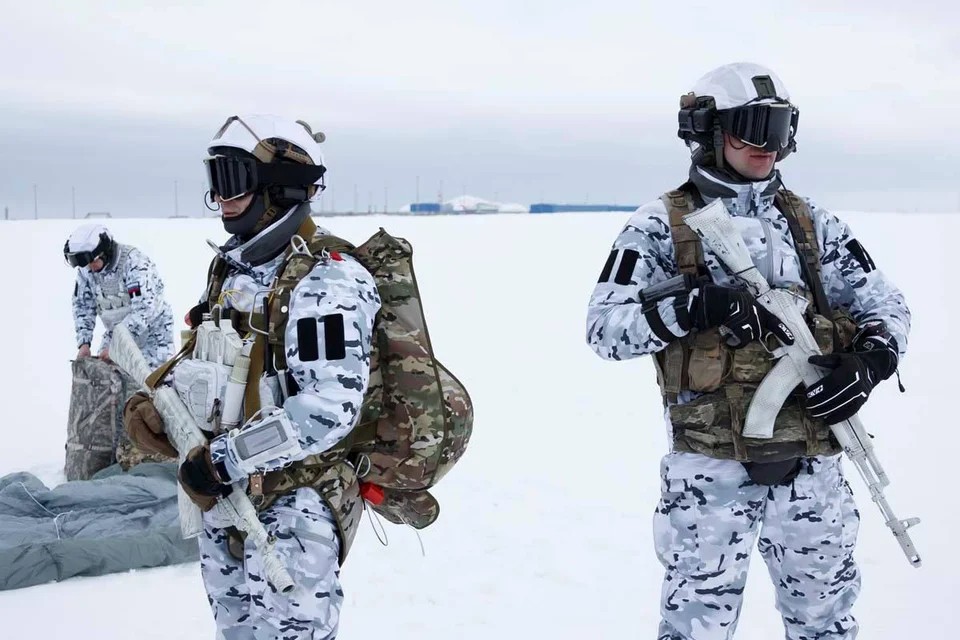
5. In the event of an invasion,
Ukraine will order its entire Armed Forces, estimated at about 400,000 personnel, and with full mobilization could go up a lot, while Russia can not put forward all its own forces, thus stripping any other sector its defense. At the same time, it is too much to assume that even if Russia invades, it will do so on a large front using all the local forces (of the approximately 100,000-150,000 it has around). As military tactics require some of them to be supportive and reserve. So at a one-to-one level, Ukraine maintains a local advantage in land units at least.
In the aviation sector, however, Ukraine lags far behind as it has a mix of old fighters, about 40 operational MiG-29s, and some 25+ Su-27s (the numbers are more but some are now only for educational use), while there are about 30+ Su -24M / Su-25 for air-to-ground operations. Against them, however, is a much stronger Russian force. Near the northern border with Ukraine are the 6th Air Force and the 14th, with plenty of MiG-31, Su-35S, Su-34, Su-30, many of them newly built, while the anti-aircraft network is very dense, since just 600 km north is Moscow. In the south, in the region of Crimea, is the headquarters of the 4th Russian Air Force (in Rostov on the Don River), with combat experience as it had participated in the brief war in Ossetia and Chechnya in the past.
Russia has the ultimate advantage in naval forces, as the Ukrainian navy has only one old Krivak III class frigate along with some patrols, against a serious fleet of Admiral Grigorovich class missile frigates, Kilo submarines, dockers, etc.
Our Conclusions
If the Russian forces invade, they will be under full surveillance from the first moment, without the possibility of cover or surprise. They will find against them an enemy now well prepared and fully manned, fortified and, above all, fighting defensively and “for altars and hearths”, that is, desperately. They will meet another Ukraine that will constantly receive help, perhaps not directly war but accounting and support that will relieve it. At the same time, it is a given that in the event of a conflict, NATO will intensify its mobilization in the wider region, something that Russia can not ignore, so it will employ several of its forces for precaution and self-defense. While near which Ukrainian front will receive serious electronic harassment from Western systems.
Ukraine will have to confront a large area of high-mobility winter operations with the massive use of anti-tank missiles, that is, a more modern doctrine that we have seen work, e.g. in Syria (that is, where Turkey “lived” with great losses, in its own chariot raids).

Russia will have restrictions – for geopolitical reasons and for reasons of prestige – on using its full military potential. E.g. it will be difficult to bomb critical political installations, urban areas, or areas with a majority Russian-speaking population. While the whole -always hypothetical- operation can not have much depth as it is in Russia’s interest to quickly disengage from such a move, to achieve as much as possible in a few days and then to claim politically what has been accomplished. That is, exactly what happened with the occupation of Crimea, where there was no substantial Ukrainian reaction.
In a full-blown Russia-Ukraine conflict, the balance of power, experience and structures is clearly in Russia’s favor. But only in a “total” war that neither side wants. And if that happens, the chances of the conflict escalating geographically are very high, rapidly changing any calculation of “victory”.
As time goes on, the chances of even a somewhat successful Russian invasion diminish. As Ukraine, which in the face of Russian danger has rallied and fanatized, will fight, at least enough to make a Russian invasion difficult.