



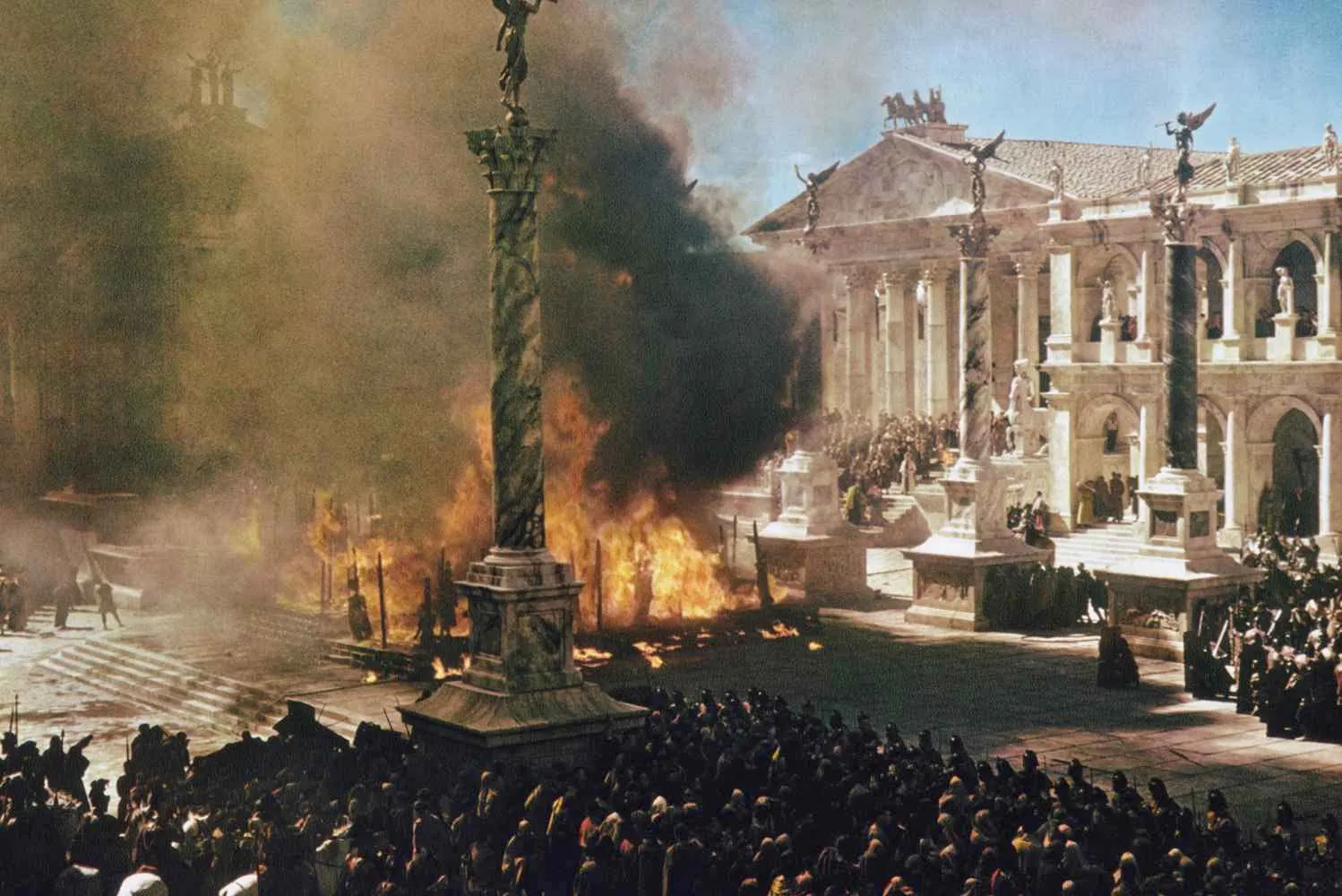
The atheistic English historian and essayist, a follower of the Enlightenment, Edward Gibbon (1737-1794) wrote his great work “The History of the Decline and Fall of the Roman Empire” as if he were building an impressive mausoleum of golden bones and dead gods. His complex, torrential, poisonous and sometimes refined prose is a magnificent and labyrinthine palace full of ashes. You walk through corridors of decline and triumph, you smell the burnt books of Alexandria and the songs of the eunuchs of Byzantium. The multi-layered work is a …. pornographic hymn to loss.
Gibbon dissects and analyzes the Empire as it dies, recording every “natural” or “unnatural” orgasm of decline, every spasm of the soul of the West as the West steadily turns to dust. I read him with eyes brimming with bloody tears, yet with a broad smile. I think: This is it. This is how you kill something by loving it too much! He passionately accuses Christianity, he accuses the simple and naive softness of social relations, he accuses the loss of political virtue.
But in reality what he is saying is that all Empires rot from within, from within, at the moment of their heyday, at the moment of their absolute power – at the moment they possess the world, the morbid decaying worms are already in the skin of their bodies and multiply rapidly.
Of course, after the time of Gibbon, historical material is much more abundant, historical problems have changed, the examination of sources has become more critical, the internal relationship of sources is much clearer, and new sciences, such as numismatics, epigraphy, sealology, and papyrology, contribute substantially to historical research. Moreover, Gibbon, a very educated man, had not been at all versed in Greek.
The English historian Edward Augustus Freeman (1823-1892) aptly writes in this regard that: “Despite the wonderful art of Gibbon, his style is certainly not that which is needed to arouse respect for the persons or the period with which he deals, or to lead to a more detailed study of them. His unparalleled sarcasm and his underestimation are constantly at work, so he is incapable of admiring things or people with real enthusiasm.
Almost every History, when handled in this way, lets its contemptible side dominate the reader’s thought. Perhaps no history would remain unstigmatized by such a handling”. Byzantine History in particular, so cruelly mistreated, is presented by the great author particularly badly. The personal Histories and affairs of all the Emperors, from the son of Heraclius, Neo Heraclius-Constantine III to Isaac Angelos Komnenos, are compressed into one chapter!
Gibbon’s six-volume work, “The Decline and Fall of the Roman Empire (1776-88),” is widely considered the most definitive and ambitious account of ancient European civilization.
Upon the publication of Volume 3, Gibbon was fiercely attacked by some as a “pagan” for arguing that Christianity (or at least its abuse by some of its clergy and followers) had clearly hastened the fall of the Roman Empire.
What Gibbon did not, at least apparently, know — but perhaps he did know, perhaps he knew it too well and could not write about it because English constraints bound him like a … mummy — is that the fall of an Empire is not a unique event. It is a terrifying repetition, a hellish ritual, a curse.
Civilizations are organisms! They are born, they grow, they flourish, they die!
The German historical philosopher Oswald Spengler (1880-1936), another idiosyncratic and brilliant “lover of ancient ruins,” came along later and said it out loud: Civilizations are organisms! They are born, they grow, they flourish, they die!
Today the West is a corpse that has not stopped twitching, trembling. It thinks it is alive because it has Netflix and missiles and teaches “gender theory” in every class in its high schools and universities, but this is certainly not life! This is terminal delirium.
Spengler’s brilliant and expansive “Decline of the West” is a terrifying cry in a sterile intensive care unit room, a terrible prophecy that tells us: We are not special. We are not eternal. We are Rome, over and over and over again. Gibbon was the chronicler of a death. By analogy, Spengler is the funeral director of all future developments.
The subtitle “Morphology of World History” in the monumental work “The Decline of the West”, by the great Spengler, is essentially the central idea of the Decline of the West, an idea that goes back to Goethe and Nietzsche. World History is the history of its carriers, that is, the history of great civilizations, which are considered by the keen “anatomist” scholar Spengler as great biological organisms that are born, mature, flourish and die.
Although they are independent of each other, they are nevertheless governed by a common necessary, characteristic, in a way organic law, which constitutes their destiny. The similarity of the late Roman era with the present, which had been pointed out by several historians and also by other thinkers, is a special case of this general law of living Becoming.
Such great civilizations or related “mega-organisms” of world history, examined morphologically in the organic phases of their genesis, flourishing and decline, are the Egyptian (to which the Creto-Minoan also belongs), the Babylonian, the Indian, the Chinese, the classical Greco-Roman, the Arabic (of which the early Christian-Byzantine is a part), the Western and the Mexican-pre-Columbian civilizations.
In the constantly and deeply stirring, but not sufficiently substantiated comparison of the ancient Greek spirit, (of course related ethno-ethnically) with the West, the Teutonic Spengler, probably reveals a “drip” contempt for the former – or rather something more unfavorable – for the former.
As a declared German Nationalist, who intuitively and intellectually considers his nation as the “Archetype of the West” (a position with which we probably cannot disagree), he simultaneously expresses a strong disappointment for the fact that the West did not abandon its ties with the ancient classical Greco-Roman world, so that they represent unshakable, capable and deep morphological bonds.
These, according to the great thinker, function as a powerful brake, practically incapable of touching the deepest Faustian essence of the Western soul (which knows no measure and no hesitations of limits).
The “Renaissance” had nothing ancient Greek in it, it was simply a transitional cautious phase of a few decades, in the form of a reaction against Gothic austerity. In fact, Spengler is indignant at the fact that the West, after its reserves of genuine artistic expression had dried up, resorted to “neoclassicism”, as an adulterated external imitation of ancient forms.
He also considers the identification of money with coins like the ancient ones as such an imitation, but he also prophesies the development of a truly Western economy, in whose descent these will evaporate into intangible values, dependent on abstract credit figures and stock market correlations.
The Faustian and Apollonian soul respectively
Spengler perceives the achievements of each civilization as “symbols” of its psyche, as projections of its psychic peculiarity at each stage of its evolution, as realizations of this psyche (soul). The “Faustian” people of Western civilization build ships and boldly set out into vast unknown seas like the Vikings, erect sky-high and pointed Gothic temples as symbols of infinity, discover the dimension of depth in oil painting and polyphonic music, develop their own mathematics.
The above and many other material, artistic and spiritual achievements exceed the limited space of Euclidean geometry, (which represents an expression of Apollonian psyche (soul)). They exceed it by tending towards the space where we traveled with non-Euclidean geometries! The “Apollonian” Euclidean man is limited to the “here and now”, to the city-state, to the concise body, while the “Faustian” ideal is televisual, intersubjective, cosmic, infinite. However, both of these human types share the admirable “Promethean” character, of frenzied boldness, of assuming responsibility and of obsession with the great noble purpose set at each time.
Spengler believed that the cycle of birth, growth, and decline was universal to all civilizations, and he drew parallels between the fall of the Roman Republic and the rise of the Roman Empire with what he saw happening in the 20th-century West. He applied this model to other civilizations, including the Qin dynasty in China and the Aztecs in Central America.
Spengler viewed empires as the final stage, the “material civilization,” of a civilization’s life cycle, characterized by the hardening of its institutions and the rise of authoritarianism. He argued that civilizations go through cycles of birth, youth, maturity, and decline, and that the transition to empire (like Rome) or “Caesarism” occurs when a civilization’s internal tensions lead to a strong, charismatic leader who imposes order from without, often from the margins of the original civilization.
He saw the rise of the imperial personality as inevitable in this final phase, a process he called “Caesarism”, after the Caesars – Emperors. This occurs after internal conflicts and the breakdown of democratic institutions.
For Spengler, the formation of an empire was not a sign of the strength of a civilization, but a symptom of its decline, a phase he called “material civilization” (Zivilisation). Spengler distinguished between “ethico-pneumatic civilization” (Kultur), which is dynamic and creative, and “material civilization”, which is the final, static and materialistic phase.
Spengler, a polyhistorian, a polymath and intensely, obsessively “Faustian”, in his much-fabled work on civilization and its inevitable decline, tames and metabolizes enormous masses of cultural material, searching with his “physiognomistic” but also penetrating gaze for similarities and analogies between the morphologically related phases of the eight civilizations that he analyzes and discusses:
Similarities and analogies between the stages and periods of development of civilizations, which emerge as morphologically “simultaneous”, as all great creations, all individual forms of religion, art, politics, society, science and economy are born, develop, are completed and fade away “simultaneously”, regardless of their respective historical calendar time. Typical phenomena of such “simultaneity” include Buddhism, Stoicism and socialism, three ways of “mental decline” of three different cultures.
The West is today a grotesque Byzantium with ….TikTok. We export deconstruction, decay, rot. Our values are a sad entropy, disguised as justice, useless, made up of humanity. A thanklessly dispersed energy, which cannot produce any substantial work in the prevailing socio-political system, as it evolves towards a state of general dysfunction and disorder.
Gibbon wrote about insignificant Emperors, too weak to rule, carried away by perversions, gold, religious conversions, gods and gladiators. Now we have presidents who are … simulations of rulers, bureaucrats with plastic souls, pseudo-emperors in drag, “personas” financed by NGOs. We lecture the world about human rights, while we bomb interfaith weddings with deadly drones and mindlessly poison the minds of the masses with algorithms.


