

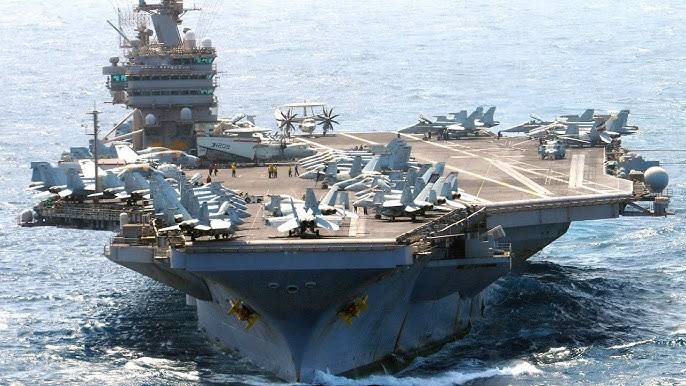
While much, much of it inaccurate, has been written about the current 266-day deployment of the aircraft carrier USS Abraham Lincoln (CVN-72), it is not the longest total deployment of an aircraft carrier in modern U.S. Navy history.
It did, however, set a record for the most consecutive days a ship has spent at sea without a major port call. USS Abraham Lincoln remained at sea for a record number of consecutive days, with only one brief, one-day stop in Guam, breaking the previous record set by USS Dwight D. Eisenhower in 2020 during the COVID-19 pandemic.
At 266 days (about 9 months) today, the USS Abraham Lincoln’s mission is one of the longest in recent years, but falls short of the USS Gerald R. Ford, which recently completed a 326-day mission, as well as the historic milestone set by the USS Midway of 332 days during the Vietnam War.
The deployment of the USS Abraham Lincoln to the Middle East reveals a problem far greater than crew fatigue or the strain on an aircraft carrier: the vulnerability of the supply chain that supports a U.S. naval force far from its main bases.
The Lincoln has been at sea since November 21, 2025, when it sailed from San Diego, on the U.S. West Coast. It was originally scheduled for the Indo-Pacific, but the escalation of the crisis with Iran led to its diversion to the Middle East. In January, it was transferred to the CENTCOM area of responsibility and has been participating in US operations since then.
This deployment, with more than 200 days without any significant docking. This is an extremely long period for a crew of about 5,000 people and has already caused reports of problems with supplies, repairs, but most importantly, the psychological burden on the crews.
Behind the crew problem lies a deeper operational issue
The Iranian attacks on US facilities in the Gulf also hit NSA Bahrain (Naval Support Activity), home to US Naval Forces Central Command and the 5th Fleet. The attacks damaged facilities, warehouses and other infrastructure at the base (for more analysis on this issue please read the article titled “Pirates Always Lose to Organized State – 16 US Bases in 8 Gulf States & Middle East Destroyed“).
The importance of NSA Bahrain, however, lies not only in the facilities that were destroyed. A forward naval base is a critical hub for supporting ships operating in the region. If the ability to support from the Gulf is limited, the problem automatically transfers and even escalates to ships at sea.
The alternative is support from much greater distances, which is precisely the problem highlighted by the Lincoln case: an aircraft carrier may have a practically unlimited range thanks to its nuclear propulsion, but the same is not true for its supply chain.
Aircraft fuel, spare parts, food, ammunition, mail, personnel, and specialized equipment must be constantly transported. The aircraft carrier can be refueled at sea and receive emergency cargo by aircraft, but the further it is from available support hubs, the more complex, time-consuming, and costly each mission becomes. The Navy itself recognizes that even a nuclear-powered aircraft carrier depends on UR (underway replenishment) and COD (carrier onboard delivery) to maintain its operational capability.
Diego Garcia also targeted
The situation became even more complicated when Diego Garcia, one of the most important American and British military hubs in the Indian Ocean, came under Iranian fire.
On March 20, Iran launched two ballistic missiles towards Diego Garcia. One failed in flight, while the second was intercepted by a US warship with an SM-3 missile. Neither of them hit the base.
The incident was particularly significant not because it caused damage, but because it demonstrated that Iran was seeking strikes against a hub located some 2,500 miles away from Iran.
This creates a strategic paradox: the United States has an enormous power projection capability, but the facilities that enable this projection can now become targets in their own right and are vulnerable.
The Carrier Is No Longer the Only Center of Gravity
This development also changes the way in which the survivability of a Carrier Strike Group should be assessed.
For decades, the classic question was whether the adversary could locate and strike the carrier itself. But today another question is becoming equally important: can the adversary disrupt the chain that keeps the carrier operational?
The answer is that it does not necessarily require a strike on the ship. Disrupting the ports, depots, airfields, supply ships, transportation networks, and maintenance bases is sufficient. The more of these nodes a force has to use, the more points there are on which pressure can be exerted. Logistical support thus becomes an operational objective.
USS George Washington Solves Only the Immediate Problem
The deployment of USS George Washington (CVN-73) to the Middle East is an immediate response to the need to replace Lincoln. The carrier, previously the centerpiece of the US presence in the western Pacific, is now moving to the CENTCOM area, which will allow Lincoln to be freed up. But it does not solve the logistics problem.
If forward bases remain vulnerable and alternative hubs are thousands of miles away, then replacing one carrier with another simply moves the problem to the next deployment cycle.
And therein lies perhaps the most important lesson from the deployment of Abraham Lincoln: the true resilience of a naval force is determined not just by how many aircraft carriers it has, but by how quickly it can refuel, repair, and rest their crews when bases closer to the theater of operations themselves become targets.
The Lincoln case shows that in long-range warfare, “forward deployed” can very easily become “overextended,” a challenge that is not met with another aircraft carrier, but with a much more resilient, dispersed, and protected supply chain architecture.