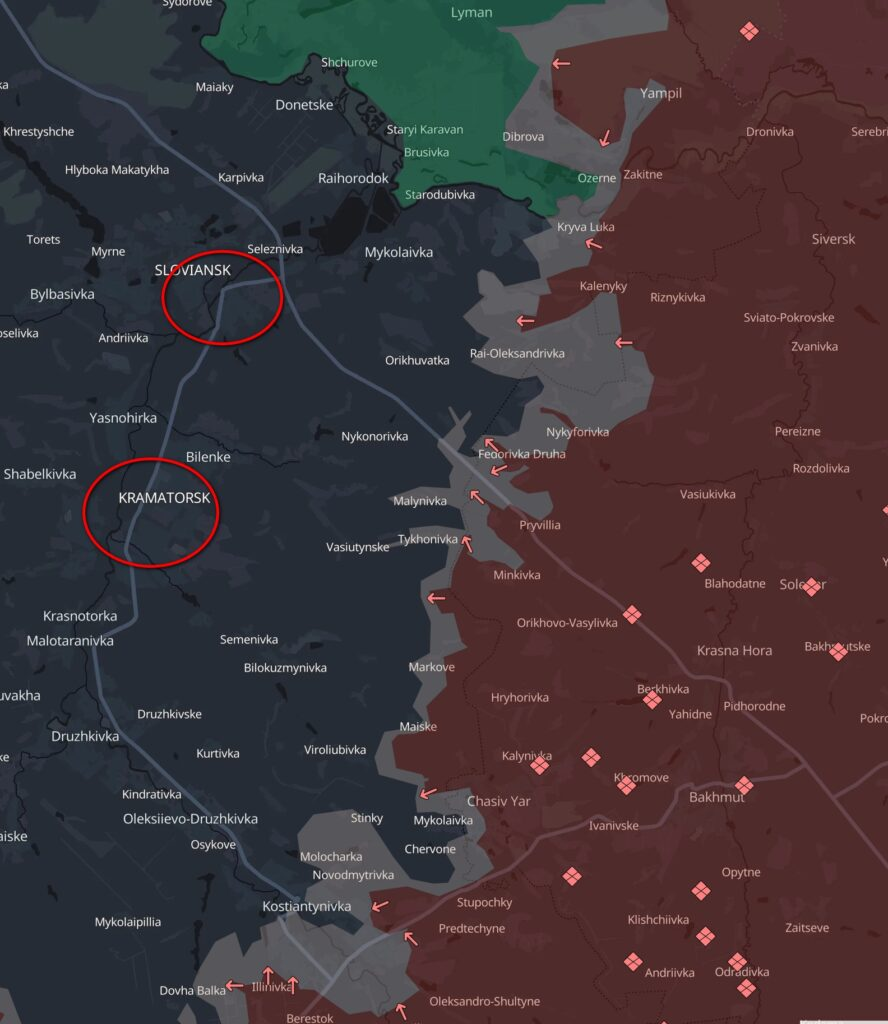
Russian forces continue offensive operations on the Siversk-Slovyansk and Bakhmut-Slovyansk axes in Ukraine, trying to approach the eastern and southeastern outskirts of Sloviansk and the eastern suburbs of Kramatorsk. These cities, which have been fortified by the Ukrainians, are considered the “keys” for capturing the rest of the Donetsk region, one of Moscow’s strategic goals.
According to Ukrainian military analyst Konstantin Masovets, although the pace of the Russian advance has slowed down significantly, Moscow’s forces have achieved some tactical gains in several parts of the front. Russian assault groups have been recorded about 7.7 kilometers from Kramatorsk, in the Vasyutinsk area, and about 12 kilometers from Sloviansk, from the most advanced Russian positions near Yurkovka and northwest of Rai-Olexandrovka.
Large concentration of Russian forces
The Russian 3rd Combined Arms Army has concentrated almost all of its strength in this sector, with the exception of one brigade. This allows the Russian command to significantly increase the density of its forces and continue attacks for a long time, despite losses. The main efforts are currently concentrated on the two ends of the Russian formation: along the southern bank of the Seversky Donets River and on both sides of the E-40 highway, on the Sloviansk-Bakhmut axis. The main goal seems to be the approach to Mykolaivka, one of the most important nodes of the Ukrainian defense in the region.
Just two kilometers from Mykolaivka
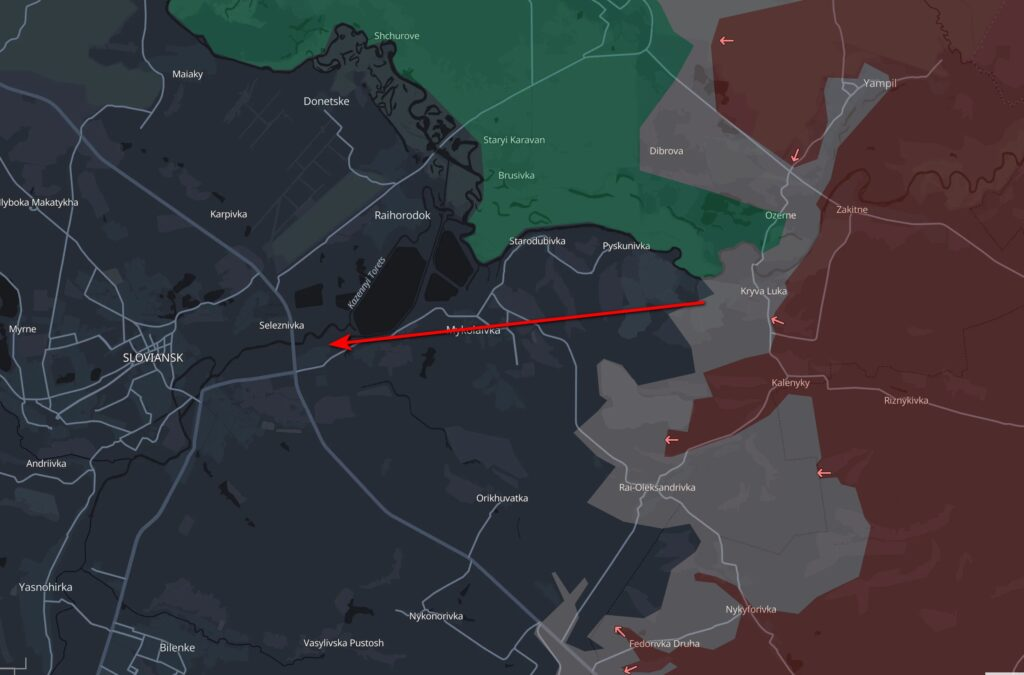
During June and July, small Russian infantry groups managed to penetrate forest areas north of Rai-Oleksandrovka and get significantly closer to Mykolaivka. From some advanced positions, the distance to the southeastern outskirts of the city no longer exceeds two kilometers. In another place, south of Kriva Luka, Russian positions are just over four kilometers away.
Russian assault groups have also advanced along the Seversky Donets–Donbass canal. In some places they have managed to pass further north than the canal’s junction with the E-40 highway, while fighting is now also taking place near Yurkovka. At the same time, Russian groups have reached the eastern outskirts of Vasyutinske, advancing about 4.5 to 5 kilometers from the canal. This shows that the 3rd Army is not only moving towards Sloviansk, but is also beginning to divert some of its forces towards Kramatorsk.
The advance continues, but much more slowly
The pace of the Russian advance is not great. On average, Russian forces have advanced about 4–5 kilometers in two months, while in some sections the progress has reached 6–8 kilometers. However, the crucial element is that in the sector between Rai-Oleksandrovka and Vasyutinske the Ukrainian forces have not yet managed to completely stop the pressure.
This particular area is of particular importance, because in the event of a new Russian advance the shortest routes to Sloviansk and Kramatorsk are open.
Why have the Russians slowed down?
The slowdown is not accidental. Russian units are showing signs of significant wear and tear from continuous attacks and high personnel consumption. The Russian command is still using the same tactics: small groups of infantry are trying to penetrate Ukrainian positions, find weak points and create small bridgeheads. However, the frequency of these attacks seems to have decreased, which may mean that reinforcements are needed. It is noteworthy that the battles for Rai-Olexandrovka have been going on for over a month, without the Russian forces having managed to gain full control of the village.
The big question for August
In August, the 3rd Army will probably be reinforced with new forces from Russian strategic reserves. The reason is simple: of all the Russian formations operating in the region, this is the one that has come closest to the wider Sloviansk-Kramatorsk urban area, which is considered one of the main objectives of the Russian summer campaign.
Nevertheless, the Russian command is faced with a difficult dilemma. It will have to decide whether to concentrate all available forces in an immediate attempt to break through to Sloviansk and Kramatorsk, or whether to continue to divide its forces to simultaneously support operations towards Liman, Kostyantynivka and Druzhkivka.
In any case, the pressure in the wider area is increasing and the coming weeks are considered very critical for the defense of the two most important cities that remain under Ukrainian control in the northern part of the Donetsk region.