More and more, young people limit their ideals to dubious and degrading pleasures. This deviation is clearly illustrated in the Homeric writings. Doesn’t the first verse of the Iliad begin with the word “rage”? Homer was a witness to the weaknesses of people. By keeping his work alive, we also understand how to defend the values of our own culture.
15,693 verses + 12,110 verses: the Iliad and the Odyssey respectively. More than a masterpiece. One of the oldest monuments of Western literature. Not a legend, but a myth embroidered on a reality. No writer since Antiquity has ever questioned the reality of the Trojan War. Plato himself, who rejected Homer’s “ethics”, does not dispute the fact itself. “The very fact,” notes Jean Bérard 1 in his preface to the edition Pleiade (published by Gallimard, 1961), “that in the Iliad and the Odyssey, the unusual episodes of the two poems are mentioned by mere allusions is significant: it implies that this legend was known both to the poet and to all those to whom he himself addressed himself.”
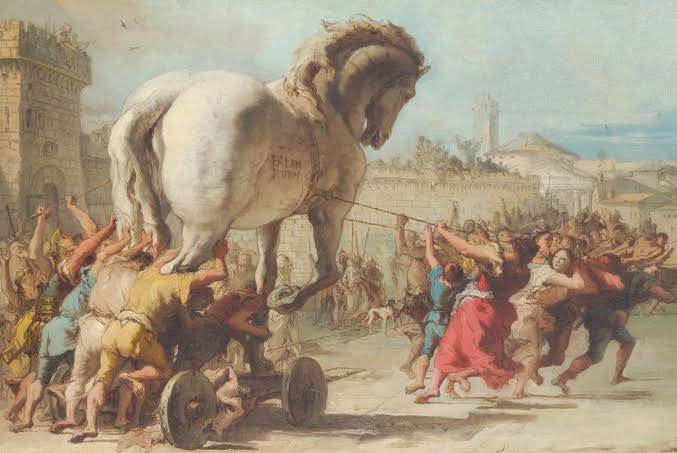
The date of the invasion and burning of Troy is still uncertain. It is generally dated to −1270, the thirteenth century BC. In 1870, in the tomb of Hisarlik (Anatolia), the German archaeologist Schliemann found the ruins of the city of King Priam. Homer’s world is the Mycenaean world that scholars have restored to us. The Atreides and the Golden Fleece. The founding of Rhodes and the destruction of Thebes. Achilles and Patroclus, Helen and Paris. The crime of Aegisthus and Clytemnestra. This universe was destroyed around 1200 BC. After the Trojan War, Homer tells us, the descendants of Heracles, led by the Dorians, settled in the Peloponnese. Thus, with the “return of the Heraclides”, the era of ancient heroes came to an end.
Due to essentially ideological motives, some authors tried to deny the identity of the Homeric world and the Mycenaean civilization. Moses Israel Finley2, followed by Pierre Vidal – Naquet3, never failed to place the name of Homer in quotation marks and to ensure that ancient Greek society “indisputably recalls the other societies of the same era from the Near East” (“Le monde d’Ulysse”, Maspéro editions, 1969). Jean Bérard replies: “It can no longer be doubted that the Age of Heroes, to which the epic legends of Greece refer, responds to the archaeological realities of the Mycenaean era revealed to us by excavations”.
The Sacred Books of Ancient Greece
From the Trojan War, which lasted ten years, Homer preserves only two short episodes: the dispute between Achilles and Agamemnon and what follows. And the long wandering of the cunning Odysseus after the plunder of Ilium. Exemplary destinies. Odysseus lives to a ripe old age and reaches his end after a long journey. Achilles has the short existence of heroes. (No one can have, at the same time, both endurance and intensity). For one, adventure and love. For the other, war and friendship. The fox and the lion.
The technique of composition is ultramodern. The first song of the Iliad begins when the war reaches its end. The Odyssey takes Odysseus from his departure from Calypso, where he stayed for seven years. Only in a minor episode is the reader called upon to “return.” Homer invents flashback.
The poet sings of exploits, and above all of exploits of war. But the clash of arms does not exclude psychological analysis, nor emotional heights. The harshest customs are also the least crude. “The Achaean society of the heroic age, however much it may seem to our modern eyes, is by no means a primitive society. The splendor of material culture and art, as the carved gold cups from Vapheion or Dendra remarkably testify, are already associated with a great moral perfection.” (Jean Bérard).
A multitude of images: “In the heart of the countryside, where one is without neighbors, the firebrand is hidden under ashes and embers to preserve the seed of fire, so that one need not seek it elsewhere: thus was Odysseus hidden under its leaves.” Some constants appear in the Iliad: the sense of honor, the joy of life, the taste for affirmation, masculine values, the love of friendship. The society of the gods mirrors that of men, with the same qualities and shortcomings.
Homer, who conceived them according to his image, depicts them with an “indifference” that would have scandalized Plato. “Homer’s gods are not pure spirits,” writes Professor Albert Severyns4 from the University of Liège. “Given a rational form comparable to that of man, they behave like mortals in an earthly society” (“Les dieux d’Homère”. “Presses Universitaires de France” – PUF, 1966). These are not jealous or stern gods. They are gods who laugh.
Perhaps this is why the Iliad and the Odyssey were truly, in Flacelière’s terms, the “sacred books of Greece.” For the Greeks of antiquity, Homer was “the Poet.” He was unique. But he was also something more: a source of knowledge of the ancient Greek spirit in its purity, a master of all wisdom, a guardian of traditions. In Athens, Solon and Peisistratus made his work a liturgy and a school textbook. Every four years, on the occasion of the Great Panathenaea, the two poems were read from cover to cover. “Perhaps we forget,” writes Flacelière, “that the capacity of the ancient public was much stronger than ours.
In the dramatic games of the Great Dionysia alone, which took place in Athens, the spectators probably heard around eighteen thousand verses in three consecutive days. The twenty-eight thousand verses of the Iliad and the Odyssey, without lyrical division or choral developments, could be recited at this rate in four days.”
After the Homeric period, the bards dispersed to the islands and the coasts of Ionia, ensured the dissemination of the Iliad and the Odyssey and composed new poems. These are the Homerics. To them we owe a series of accounts that make up the Epic Cycle. In the Greek world they provided not only the texts, but also the rhapsodists or reciters.
In the first centuries of our era, the decline of ancient civilization led to the eclipse of Homeric studies. These would only be revived in the tenth century, in Constantinople. In the fourteenth century, they flourished again in Europe.
The first printed “Homer” appeared in Florence in 1488. The Renaissance, and then the Enlightenment, were each inspired in turn. Explanations and criticisms multiplied. In the twentieth century, Anglo-Saxon and German universities competed on the subject in knowledge and skill.
Almost as many books have been published on Homer as on Goethe and Shakespeare, Atlantis and the pyramids of Egypt. In France, Victor Bérard 5 has attempted to recover the geography of the Achaeans (“Les navigations d’Ulysse”, 1927–30). Emile Mireaux 6 («Les poèmes homériques et l’histoire grecque»). Albin Michel 7, (1948–49) has sought the secret of Homer in «colonial rivalries» and in the tin trade. Charles Autran 8 («Homère et les origines sacerdotales de l’épopée grecque», Denoël editions, 1939–43), who depicts the mysterious castes of the Greek priests, has seen in the Trojan War an «act of purification» intended to eliminate a «hateful impiety».
All of Antiquity attributed the Iliad and the Odyssey to the same author. The “analysts” were more skeptical. They have given us ingenious theories that sketch the uncertain outlines of a “Homer in the plural.” But most of the Homerists have returned to the hypercriticism that was popular in the last century among the Anglo-Saxons and Germans.
As early as 1930, Victor Bérard wrote: “Today one is considered the last of the ignorant if he dares to question the idea that the Iliad and the Odyssey, from their first verse to their last, were composed by the blind poet” (“La resurrection d’Homère.” Grasset, 1930).
Perhaps Homer was not blind. According to the Ancients, “material” blindness was often associated with “spiritual” clairvoyance, with the gift of prophecy and with divination. In the myth, Oedipus acquired the gift of prophecy at the moment he pierced his eyes. Georges Dumézil has noted other examples of “preliminary mutilations”: Odin 9 and Horatius Cocles 10, Tyr 11 and Mucius Scaevola 12, etc. “The greatest of poets must therefore have been blind,” writes Robert Flacelière 13, “but in reality, we do not know whether he was.”
If we are to believe Herodotus, Homer lived around 850 BC. He probably composed other, secondary works, such as the Hymn to Apollo mentioned by Thucydides.
Seven cities claim the honor of having given birth to the poet. The island of Chios, in Ionia, mentioned by Pindar and Simonides of Amorgos, seems to be the best “placed” for this honor. The place is famous for its landscape and beauty. It owes its name to Chioni, daughter of one of the first kings who pledged to marry Orion as soon as he had driven the snakes that were infesting the country from the land.
Homer, said Herodotus, lived in the village of Pytis, which is today called Pitios. There a body of Homeric poets (the most famous being Kynethos of Chios) worked for a long time. Here we see the “olives of the Lord” and drink an age-old wine, the “nectar of Homer”! In the Museum of Chios one finds the head of Homer discovered by archaeologist Anderson14, the Homeric epitaph discovered by Professor Kontoleon15 as well as various other remains from Antiquity.
Notes
1. Jean Bérard. (Jean Bérard) Born in 1908 and died in 1957, he was a French historian, Hellenist and archaeologist. The son of the Hellenist Victor Bérard and brother of Armand Bérard, he studied at the renowned École Normale Supérieure and obtained a doctorate in philology. A member of the French School in Rome from 1933 to 1936 and then from 1939 to 1940, he visited the sites of Magna Graecia and North Africa. His thesis on the Greek colonization of Italy and Sicily in Antiquity revived research on Magna Graecia, which gradually confirmed his views.
Upon his return to France, he was appointed to the Faculty of Letters in Nancy and then Associate Professor at the Sorbonne. He then worked on the dating of the Trojan War, applying a more satisfactory chronological framework. From 1952 to 1955, he directed excavations on the island of Cyprus, in Nea Paphos and Ktima, where he discovered many tombs in the necropolis of “Iskentar” [on the southwest coast of Cyprus, in the city of Paphos. Specifically, the area of funerary monuments extends between the old center (Ktima / Mouttalos district) and the area of Kato Paphos.] from the 2nd millennium to the 2nd century BC. He died in a car accident in July 1957. In 1966, a research center for southern Italy was created in Naples that bears his name.
2. Moses Israel Finley. Sir Moses Israel Finley – Fellow of the British Academy, (née Finkelstein, 1912–1986) was an American-British academic and classical scholar of Jewish origin. His prosecution for communist-subversive activity by the United States Senate Subcommittee on Internal Security in the 1950s resulted in his relocation to England, where he became an English citizen, a classical scholar, and eventually a tutor at Darwin College, Cambridge. His most notable publication is Ancient Economy (1973), in which he argued that the economy in antiquity was governed more by regime and political ideology than by rational economic motives.
3. Pierre Emmanuel Vidal-Naquet. Pierre-Emmanuel Vidal-Naquet (1930–2006) was a French historian of Sephardic origin who began teaching at the École des hautes études en sciences sociale (EHESS) in 1969. Vidal-Naquet was a specialist in the study of Ancient Greece, but he also dealt with the history of war, especially the Algerian War (1954–62), during which he opposed the use of torture by the French Army, and Jewish history. In February 1971, he participated with Michel Foucault and Jean-Marie Domenach in the founding of the Groupe d’Information sur les Prisons (GIP), one of the first French new social solidarity movements. He participated in many debates on historiography in which he criticized denialism (especially of the Holocaust) and was a supporter of peace efforts in the Middle East. Until the end of his life, Vidal-Naquet never abandoned his devotion to antiquity.
4. Albert Severyns. He was (1894–1964) a distinguished Belgian classical philologist, paleographer, and university professor, known worldwide for his monumental work on Homer and the Epic Cycle. He served as a professor at the University of Liège (Université de Liège) in Belgium, dedicating his career to the decipherment and analysis of ancient Greek literature. His most important work was the multi-year and extremely detailed research entitled “Recherches sur la Chrestomathie de Proclos”. “Researches on the Chrestomathie of Proclus”. The Chrestomathie of Proclus is the main source of information that survives on the lost epics of the Trojan Cycle (such as the Cyprian, the Aethiopis, and the Ilios Persis). In 1928 he published his doctoral thesis: “Le Cycle Épique dans l’École d’Aristarque”, examining how Alexandrian scholars (such as Aristarchus of Samothrace) approached the epic cycle. For his pioneering work on the Epic Cycle, he was awarded the first Théodore Reinach Prize in 1929 by the French “Union of Hellenic Studies”. However, beyond literary texts, he dealt with the historical and geographical reality of the Bronze Age, publishing the work “Grèce et Proche-Orient avant Homère” – “Greece and the Middle East before Homer” (1960).
5. Victor Bérard. Born in 1864 and died in 1931, he was a French Hellenist, diplomat and politician. He is best known for his translation of Homer’s Odyssey, as well as his attempts to recreate the voyages of Odysseus.
6. Émile Mireaux. Born in 1885 and died in 1969, he was a French intellectual, journalist, and politician. He entered the École Normale Supérieure. He earned his doctorate in history and geography in 1910.
7. Albin-Jules Michel. (1873–1943) was a prominent French publisher who founded Éditions Albin Michel in Paris in 1902. Born in Bourmont, his early life was shaped by family ties to the famous publisher Ernest Flammarion. Michel built one of France’s leading independent publishing empires, which remains a major cultural institution to this day.
8. Charles Autran. (1879–1952) was a distinguished French linguist, orientalist, and historian of ancient religions, known for his unconventional and particularly bold theories on the interconnections of ancient civilizations. After completing his studies in Paris, at the École Pratique des Hautes Études (É.P.H.E.), he served as a research fellow at the “French Institute of Oriental Archaeology in Cairo” (IFAO), a fact that determined his path in archaeology and the study of the cultures of the Near and Middle East. In the early 1920s he worked as a Professor at the Faculty of Letters of the University of Aix-en-Provence. Later, from 1926 onwards, he settled and worked in Paris. He devoted his entire life to understanding the interactions between the peoples of antiquity. He specialized in comparing languages and religious traditions, attempting to connect the Greek, Semitic, Indian and Mesopotamian worlds. He died in 1952 in Bois-Colombes, near Paris.
Autran provoked heated debates and was often criticized by his contemporaries for his tendency to seek distant cultural connections, such as Phoenicians and Dravidians: where he supported the groundbreaking theory that the Phoenicians were not of Semitic origin, but had Dravidian roots and had migrated to the Mediterranean from Kerala, India. – Indian roots in Greece: He tried to interpret many ancient Greek place names (such as Astypalaia) and names through Indian languages. – Persian roots of Christianity: One of his most discussed studies concerned the influence of ancient Persian religious cults (such as Mithraism and Zoroastrianism) on the formation of early Western Christianity.
His most important works: “Phéniciens” (1920) – Essay on the ancient history of the Mediterranean. – “La Grèce et l’Orient ancien” (1924) – A study of the relations of Greece with the Ancient East.-“Sumérien et Indo-Européen” (1925) – A linguistic comparison of Sumerian with the Indo-European languages.-“L’Épopée indoue” (1946) – A study of the ethnographic and religious background of the Indian epics.-“Homère et les origines sacerdotales de l’épopée grecque” (1938–1943) – His three-volume work on the priestly origins of the Homeric epics, “O méros kai oi hieratiques aparches tou élénicos épous” is a multi-volume, specialized scientific work published in Paris by the publishing house Les Éditions Denoël between 1938 and 1943. This work was published in three volumes and its production was interrupted during World War II. World War: Volume I (1938): Introduction to the theory of priestly origins (168 pages)-Volume II (1939): Analysis of religious structures and Homeric texts (317 pages).-Volume III (1943): Completion of the research on the influences of the Near East (378 pages).In this book, Autran develops a groundbreaking theory for its time regarding the birth of Homeric poetry.
He argues that the Greek heroic epic (Iliad and Odyssey) was not born exclusively from popular troubadours (aoids) or secular court traditions, but has its roots in sacred texts and liturgical rituals of ancient priesthoods. He connected early Greek religion and mythology with the cultures of Asia Minor, Mesopotamia, and the Hittites, examining how the old religious traditions and temple hymns gradually transformed into secular, heroic poetry.
9. Odin is considered the supreme god in Scandinavian and Teutonic religion and mythology. He is the son of the giantess Bestla and the god Borr, the supreme god of the Æsir, the most important branch of the northern pantheon. He was the father of several of them and the creator of the first pair of the current generation of humans (Ask and Ebla), the shaper of the Nine Worlds of the Teutonic tradition from the remains of the giant Ymir. He sacrificed one of his eyes to gain the gift of prophecy and – according to the Icelandic epic Hávamál – he hung himself on the “Tree of Life” the sacred mead Yggdrasil and pierced his side with a spear to gain in return on behalf of the Gods and men the knowledge of the runes and the power to prophesy the future. In detail: When the world and he were young, and while the Aesir were still fighting with the Vanir, Odin sought power. So he offered to sacrifice his right eye to the Dragon, guardian of the gushing Spring of Mimir (Mímisbrunnr), so that he could drink from the spring. Since then, he has remained one-eyed but omniscient, while the power of the Spring grants him powerful vision in his single eye. Another, similar but more painful sacrifice he made was to hang himself from a branch of the World Tree. For nine days and nine nights he was tormented by terrible pain, until with a tremendous effort of will he managed to read the magic runes he had carved on his staff and which he had left at the base of the Tree (the runic sounds were considered to have supernatural and magical powers). Thus he was reborn immortal and – having also drunk from Mímisbrunnr – became the leader of all the gods, bringing peace to Asgard, as well as becoming the eternal cosmic lord of war, poetry, magic and wisdom.
10. Horatio Cocles – In Roman mythology, a legendary hero of the “Horatian Generation” is known by the name Publius Horatio Cocles (PUBLIUS HORATIUS · COCLES). He was a Roman warrior of the 6th century BC, who single-handedly defended access to the Sublicae Bridge on the Tiber against Porsenna (Etruscan king of the city of Clisio – Clusium – Cusi), until his men finally destroyed the bridge. According to Titus Livius, initially two more men stayed with him when the others panicked and fled, Titus Herminius and Spurius Lartius, but eventually they also left after Horace’s request.)
During this battle, Horace lost one of his eyes, which is why he was nicknamed “Cocles”, meaning “one-eyed”. After the bridge was destroyed, Horace either managed to swim across the river to the safe other side (as Livy writes), or he failed and drowned in the Tiber (according to Polybius). A statue of Horace Cocles was erected in the temple of the god Vulcan-the Latin Hephaestus in Rome, while he himself was rewarded with as much land as he could plow with his plow in one day.
The story is influenced by the one-eyed Cyclopes of Greek mythology, hence the connection with the god Hephaestus-Vulcan. The Latin word Cocles itself is etymologically derived from the Greek “cyclops”. Cocles is essentially an “anthropomorphized” Cyclops, assistant to the blacksmith god.
11. Tyr (Týr) is the god of war and battle in Norse and Teutonic mythology, depicted as one-armed. He was the son of Odin. His name meant “god” and comes from the Proto-Germanic Tiwaz, which continues the Proto-Indo-European Dyeus, (the original chief cosmocratic Indo-European god), from which also comes Zeus of the Greek religion and Dyaus Pitar of the Vedic religion. According to the Edda (Poetic and Prose), at one point the gods decided to chain the wolf Fenrisulfr (or Fenris), but the beast broke any chain they put on it. Finally, the great dwarven craftsmen made a magical strap, Gleipnir (the “Open”), from materials such as “woman’s beard and mountain roots.” However, Fenrir suspected the gods of deception and refused to be bound unless one of them placed his right hand in his mouth. Tyr, known for his great courage, agreed and the other gods bound the wolf. Fenrir realized that he had been deceived and cut off the god’s hand with his teeth. Fenrir will remain bound until the day of the Twilight of the Gods – Ragnarok. During the final battle of Ragnarok, Tyr will kill and be killed by Garm, the guard dog of Hades–Helheim.
12. Gaius Mucius Cordus, better known by his later cognomen Scaevola, was a Roman youth, possibly mythical, famous for his bravery.
In 508 BC, during the war between Rome and Clusium, the Etruscan king of Clusium Lars Porsenna besieged Rome. Gaius Mucius Cordus, with the approval of the Roman Senate, secretly entered the Etruscan camp, intending to assassinate Porsenna. Since it was the day of the soldiers’ pay, there were two similarly dressed men, one of whom was the king, on a raised platform, addressing the soldiers. This caused Mucius to misidentify his target, and he accidentally killed Porsenna’s scribe. After being captured, he declared to Porsenna: “I am a Roman citizen, men call me Gaius Mucius. I have come here as an enemy, to kill my enemy, and I am ready to die, however much I may kill. We Romans act bravely, and when adversity strikes, we suffer bravely.” He also stated that he was the first of the 300 Roman youths who volunteered for the task of assassinating Porsenna, at the risk of losing their lives.
He is said to have declared to the Etruscans: “Beware, that you may know how cheap the body is, to men who have their eye on great glory” and placed his right hand in a fire that had been lit for sacrifice, where he held it there without showing any sign of pain, thus earning for himself and his descendants the surname (cognomen) “Scaevola”, which means “left-handed”. Porsenna, amazed by the indescribable bravery of the young Roman, dismissed him from the Etruscan camp free to return to Rome, saying “Go back, since you are doing more harm to yourself than to me”. At the same time, the Etruscan king also sent ambassadors to Rome, to offer peace.
Mucius was granted agricultural land on the right bank of the Tiber, which later became known as “Mucia Prata” (Meadows of Mucius).
13. Robert Flacelière (1904–1982) was a scholar of classical Greek. From 1925 to 1930 he was a member of the French School of Athens and from 1932-1948 Professor of the “School of Letters” (Philology) at the University of Lyon. He was then appointed to the Chair of Greek Language and Literature at the University of Paris, a position he held until 1963 when he was appointed Director of the “École Normale Supérieure”. During the student uprising of May 1968, Flacelière organized a petition of faculty members against the rebellious students and found himself at the center of a heated controversy, being met with choleric hostility by Anarchist and Leftist circles.
14. John Kinloch Anderson (1924–2015) was a Scottish classicist, archaeologist and author. He wrote many books on ancient Greek warfare, with wide influence, on ancient Greek art and the practice of horsemanship and hunting in the ancient world. He also published dozens of articles and book chapters on ancient history, philology and archaeology.
The famous, traditional “Homeric epitaph” —which contains verses describing Homer’s death, as well as his grave— is associated with the island of Ios and not with Chios. According to ancient texts such as “The Contest of Homer and Hesiod”, the poet is said to have died on Ios and was commemorated with this very poem.
15. Nikolaos Kontoleon was born in 1910 in Chios. Thanks to the bequest of Stamatis Proios, he studied philology at the University of Athens. In 1932 he graduated with honors and in 1933 he was admitted after exams to the archaeological service. Until 1938 he served in the Cyclades, when he received a scholarship from the German state and studied in Cologne and Munich. As a curator and superintendent of archives in the Cyclades and the Eastern Aegean, he contributed to the organization of archaeological museums, such as in Tinos and Naxos. In 1953 he was elected a regular partner of the German Archaeological Institute, in 1956 a regular professor of the Chair of Archaeology B and twice dean (1964-1965 and 1974-1975). In 1967, he was awarded an honorary doctorate from the Faculty of Philosophy of Montpellier.