


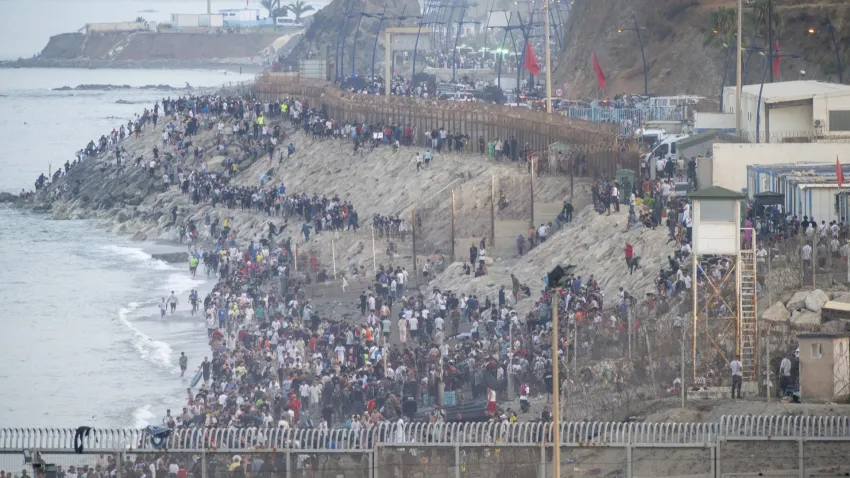
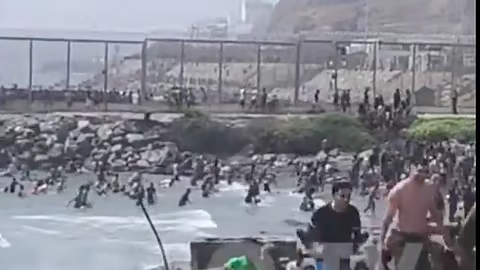
Within 24 hours, Ceuta, a Spanish possession in Africa opposite Gibraltar, was confronted with one of the largest mass entries ever recorded at an external border of the European Union. More than 49,000 people have been displaced from Morocco, more than half of the city’s population, and at least 19 have died. The final counting will take time, but the actual scale is already clear. Thousands passed by land and sea, local authorities were flooded, minors were left on roads and parks, and the army was deployed to restore rudimentary control.
Ceuta has about 85,000 inhabitants. The entry of tens of thousands of people in a few hours is not a manageable migration flow. It is a collapse of the EU’s external border. France then stepped up border controls with Spain, while Italy threatened emergency measures against Madrid. This is the sequence that can break the Schengen agreement on common internal borders of the EU. A state loses control of its external “gateway” and its partners begin to build internal borders.
Spain opened a programme for 500,000 and received 1,174,978 applications
In January 2026, the government of Pedro Sanchez announced the legalisation of some 500,000 irregularly staying migrants and asylum seekers. In April it still estimated that the potential beneficiaries would be around half a million, having foreseen an administrative capacity to process up to 752,250 files.
By June 30, when the process was closed, 1,174,978 applications had been filed, more than double the initial government forecast. By 2 July, 609 737 files had been processed and 159,097 applicants had been registered with the Spanish Social Security Agency. Hundreds of thousands were granted temporary work until their application was finalised, while residence and work permits have an initial duration of one year.
The people who pass through Ceuta today are certainly not subject to this regulation. The Spanish decree requires a presence in the country before 1 January 2026, for at least five months continuously and without a criminal record. The issue is that when a government makes a massive legalization of immigrants (with any reason for entry), this is interpreted as an “invitation” in the hope of a similar settlement in the future.
The Spanish residence permit has a European scope
Madrid presents the regulation as relating exclusively to the Spanish economy and society. This position overlooks the way Schengen works. The holder of a Spanish residence permit can travel and stay in the other Schengen States for up to 90 days in each 180-day period, without the need for a new visa.
Leave does not automatically offer a permanent right to work in every European country. This legal limitation does not change the substance. It offers real, legal mobility in an area where, under normal circumstances, systematic internal border controls are not carried out.
Therefore, the Spanish document does not reside in Spain. It allows its holder to move to France, Germany, Italy, Belgium or the Netherlands. Madrid’s immigration policy automatically has European consequences, even when the other governments were not consulted and did not agree.
This is the structural problem of Schengen. Freedom of movement is based on the premise that each State responsibly controls the common external border and issues residence permits with an awareness of the consequences for all.
The Sanchez government claims national autonomy in legitimacy and European solidarity in managing the consequences. The two cannot coexist indefinitely.
Ageing is tackled by legal migration
The Spanish government’s main justification is well known. The country is ageing, the economy needs workers, and the insurance system needs young people to provide resources. Even if we accept this diagnosis in full, it does not appear that the solution is to legitimise irregular stay a posteriori.
The European Union has the EU Blue Card for skilled workers, the single residence and work permit, frameworks for seasonal work and organised recruitment from third countries.
In 2024, EU states issued around 3.5 million first residence permits, of which 1.1 million were in employment. Spain itself issued 561,640 first permits, most in the EU, with 95,735 directly for work reasons. So the country has a mechanism, administrative experience and sufficient scale to attract a legal workforce.
There is also the Spanish GECCO programme, through which companies hire workers while they are still in their countries of origin. The state knows in advance who is coming, for which job, with which employer, for how long and under what conditions of return.
In 2025, through GECCO, 25,767 people from 17 countries worked legally in Spain, a 25% increase over 2024.
The new GECCO arrangement for 2026 provides for multi-annual leave, work for up to nine months each year and a mandatory return to the country of origin after the end of seasonal employment. This is legal and controlled immigration. The difference is fundamental. Legal migration selects workers based on the real needs of the economy. Mass legalisation is called upon to deal retrospectively with those who have managed to enter, remain and join the informal economy.
So the demographic crisis is a reason for more legal recruitment and movement of citizens from other countries, but there can be no blank cheque to turn irregular stay into a substitute for immigration policy.
Dependence on Morocco
Official data also reveals an impressive geographical one-sidedness. Although 17 countries participated in GECCO, 81% of the workers recruited in 2025 in Spain came from Morocco. 92% of them were women, mainly for seasonal agricultural work. Colombia followed with just 13% and Honduras with 4%.
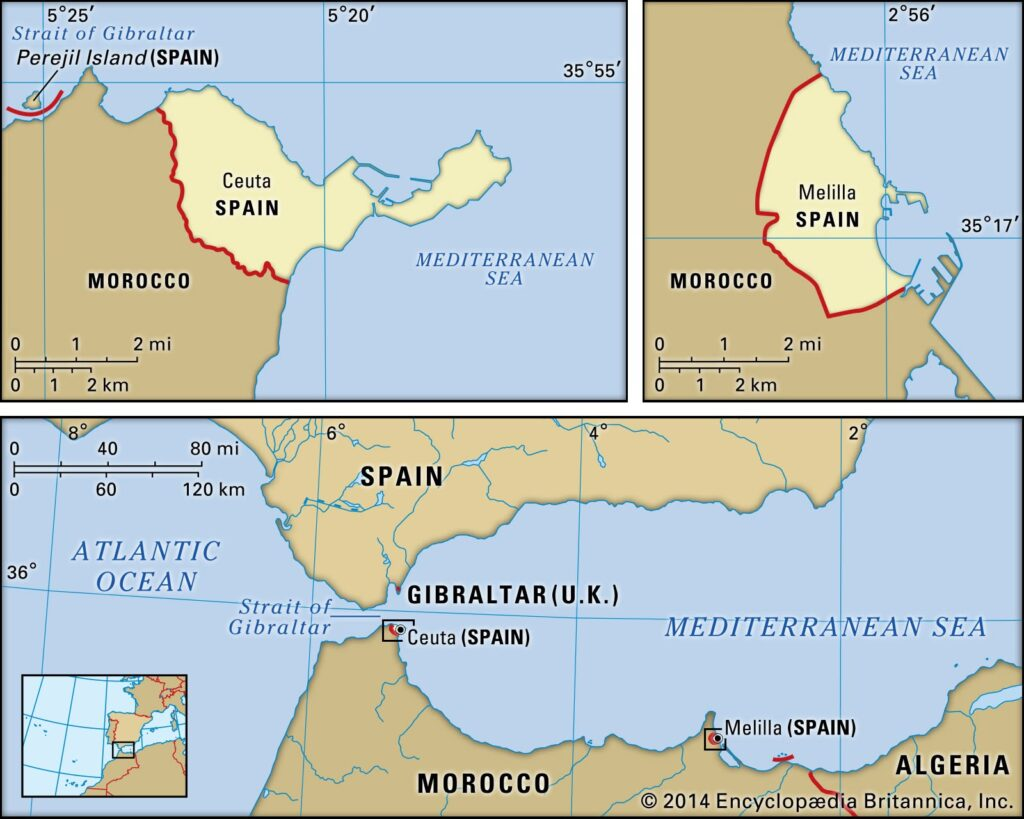
Spain could expand legal recruitment to Latin America, sub-Saharan Africa, Asia and other countries with which it can conclude bilateral agreements. Instead, it has created an over-reliance on a country that controls land access to Ceuta and Melilla (the two Spanish possessions on the Moroccan coast), while in the long run it questions Spanish sovereignty over the two enclaves.
Morocco has demonstrated that it can use the control of migration flows as a lever of political pressure. In 2021, some 8,000 people crossed into Ceuta in a two-day period, amid a serious diplomatic crisis between Madrid and Rabat. The European Parliament then strongly condemned the use of border control, immigration and in particular unaccompanied minors as a means of pressure against a Member State.
The current explosion has not yet proved to be an organised Moroccan operation. Consideration is given to the recent ruling of the Spanish Supreme Court on direct pushbacks from the sea, the action of smugglers, the insufficient Spanish security force and the attitude of the Moroccan authorities.
Prehistory, however, obliges Europe to seriously consider hybrid pressure. And hybrid coercion doesn’t require tanks.
It is enough to selectively relax controls, channel desperate people to a vulnerable point and know that the European side will find itself caught between humanitarian duty and the need to protect its borders.
When you don’t learn from history, history repeats itself as a joke
Greece (a member country of the EU) has already experienced a similar drama. In 2015, the new government of then SYRIZA (Left), faced with the huge and tragic wave of refugees from Syria, which Turkey was “channelling” into the Aegean (to relieve itself of the relevant pressure), drastically limited administrative detention, decongested structures and granted, after registration of entry, official temporary residence documents, often for up to six months.
The documents allowed for a stay and movement within Greece, facilitating a quick passage from the islands to Athens and then to the country’s northern border for a passage to Central Europe.
The result was reflected in the numbers. From 41,038 sea and 2,280 land arrivals in 2014, Greece reached 856,723 sea and 4,907 land arrivals in 2015.
A few months later, the European Commission identified serious shortcomings in the management of the Greek external borders, identification, fingerprinting and the control of travel documents.
Greece was not formally expelled from Schengen. But it was confronted with a process that allowed other states to maintain prolonged internal controls and came close to de facto isolation. The trust of the partners was lost.
Spain is currently taking a different legal route, but it is reproducing the same political error. It treats an option with European consequences as an internal act of social policy and considers it self-evident that the rest will absorb the costs.
Consequences on internal movement in the EU
“Expelling” a state from Schengen is not a simple or direct legal tool. The Schengen Borders Code allows, however, for the temporary reintroduction of controls where there is a serious threat to public policy or internal security, as well as where persistent and serious deficiencies at the external borders jeopardise the functioning of the entire area.
If Spain is unable to register, identify and control those who crossed into Ceuta, the rest of the countries are entitled to protection. This may mean temporary, proportionate and targeted checks on air, coastal, rail and road connections from Spain.
Such a decision will have an economic cost. It will burden business travel, transport, tourism and trade relations. This is precisely the cost that Madrid is currently passing on to its partners. Free movement is a common European good, not the right of a state to pursue a unilateral policy without consequences.
The immediate European requirement must be full biometric registration, checking of documents and databases, segregation of minors and vulnerable groups, examination of protection claims and returns of those who are not entitled to stay.
Transfers from Ceuta to mainland Spain should only take place after the key controls have been completed.
But it is important to stress that migration crises (whether in Greece, Spain, Italy, Britain and elsewhere in Europe) cannot be managed in any other way than by implementing legality along with humanitarian care and respect for human rights.
Thus, voices of violence and persecution of migrants are as dangerous or worse than the social upheaval caused by the inability to manage migrant populations, as they push European societies into perceptions of racist and racial hostility.
The message for the Mediterranean member states of the EU and Spain
EU Mediterranean countries should monitor what is happening in Ceuta as a matter of national security. In 2020, the European Commission itself recorded that Turkey actively encouraged migrants and refugees to move towards the Greek land borders, creating in Evros an organised pressure with tens of thousands of people.
It should be recalled here that Spanish strategic interests are not automatically identical to Greek or Cypriot ones. And Athens cannot take for granted that a government that downplays the risks in Ceuta will perceive in time a similar pressure in the Aegean or Evros.
But it is already evident that Ceuta is a hybrid pressure laboratory and Morocco has shown how immigration can be used against Spain. Turkey did the same in Greece in 2015 and 2020, and it seems that Madrid did not understand the Greek experience of that time.