




As the Liberal Globe had correctly predicted, the long-awaited first agreement for de-escalation and a ceasefire on the Iran front did not come. The assessment of the causes that led to this result was also correct. The issue of Iran’s nuclear program and that of the total restoration of the status quo ante in the regime of passage through the Straits of Hormuz. However, there is a third reason that did not help in the permanent end of the War in Iran.
As much as it is questioned by many, as much as it is considered by many as a pretext, Israel’s position on the issue of Tehran’s nuclear arsenal is known and has not changed. On the contrary, the constant approach to the nuclear threshold was decisive in Jerusalem’s attempt to create the ideal conditions, operational and political, to launch an attack targeting Tehran’s nuclear infrastructure. In this effort, it is obvious that the Israelis presented the Trump administration and the American president himself, through his friend Israeli Prime Minister Netanyahu, a picture of the situation that was much more optimistic than the real one. Because what was prominent was the attack with the US alongside Israel.
In the worst-case scenario for them, if nothing else, they would have gained critical time to continue the effort at all levels to achieve their ultimate objective: To avoid facing a nuclear-armed Iran, which would automatically have the advantage. Due to the vast difference in territorial size, that is, the infinitely greater ability to absorb the consequences of a nuclear strike. In the case of Israel, its very existence would potentially be threatened.
The American participation in the attack was crucial for another reason: It was a prerequisite for the most effective possible repelling of Iranian retaliatory strikes with ballistic missiles and suicide drones. It may be true that defensively, the success exceeded 80%, but in practice it turns out that what happened was enough to cause serious damage and rapidly exhaust the reserves of interceptor missiles, creating a difficult military equation in the midst of operations.
It should also not be overlooked that the longer this situation drags on, the worse the problem becomes for both the US and Israel. In theory, it could even whet the appetite for adversaries on other fronts, as their military staffs might see a “window of opportunity.
(“Chinese Defense Minister Dong Jun, during statements on the Taiwan issue, warned that any violation of Chinese sovereignty over the island would cause immediate and serious consequences. He went on to explain that if China’s sovereignty over Taiwan is “violated,” US military bases located in Japan and South Korea would be considered “legitimate targets.”, 31 May, 2026).
This would potentially complicate the situation dangerously, with direct repercussions on the broader level of international security.
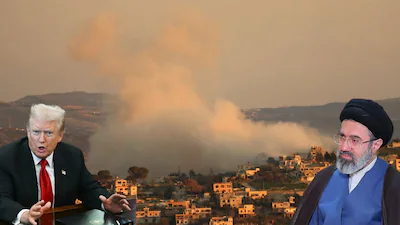
Even if the assessment is that defeat will inevitably occur in the end, the Iran war itself lends itself to documenting the conclusion that a regime, if it survives in the end, can emerge strengthened. On each front, the data are different, as are the calculations, while the possibility of miscalculation cannot be ruled out, something which is of course judged by the overall military and political outcome.
Making the decision to start the war
The overly optimistic way in which the Israelis presented the data in Washington helped shape the Sinocentric narrative with which – whether one agrees or disagrees – a rational decision-making process is supported, compatible with the American national interest. This is crucial in the attempt to refute the -simplistic- claim of many, that “Trump was playing into Netanyahu’s hands”.
The above concerns the “nuclear leg” of the interpretation of why an agreement was not reached, which the signatory considers central. As for the status of the Strait of Hormuz the next day, it is both a matter of substance and a matter of prestige. Trump even went so far as to threaten to… blow up one of the moderate monarchies of the Gulf and an ally of the Americans, that of Oman!
It is the second “key country” of the Straits from the southern side. He threatened it bluntly, because it allegedly does not object to Iran’s desire to impose transit fees. Obviously, Oman would have won! Such a development would be economically profitable, therefore compatible and beneficial to its own national interests. What is the reason, besides Trump’s well-known temperament, for threatening publicly, when he could theoretically do so behind closed doors? Or simply, that the mission was undertaken by the diplomatically… correct Secretary of State Marco Rubio?
Who is pressed by Time……..
This report leads us to the third factor that undermines the prospect of an agreement to definitively end the war. And since the Israelis have also expressed objections, the paranoid tactical conjuncture of the interests of Tehran and Jerusalem is presented!
But why does Iran have reasons not to be eager to reach an immediate agreement? Obviously, this is the case provided that the theocratic regime is not threatened with collapse and is sufficiently stable. This also brings the greatest possibilities, always in the opinion of the Liberal Globe. The reason is that the Iranians have enough reasons to believe that time is running out against the Americans and in favor of their own interests. They believe that they will soon be able to negotiate from an even more favorable position.
These reasons have been analyzed and reported in The Liberal Globe in previous analyses. The global deregulation that has resulted from the war significantly affects the interior of the United States. The American citizen pays very high prices – by the standards he was used to – for fuel, while his country has become the leading supplier worldwide.
At the same time, President Trump’s MAGA (Make America Great Again) movement is deeply divided, with opposition to the war growing ever larger. This is unprecedented for Republicans, as is opposition to US support for Israel. This is a “game-changing” development in many ways…
Since this problem is growing for Trump with each passing day, with the midterm elections that will determine the scope for exercising power as freely (see: uncontrolled) as possible just around the corner, by what logic is this not satisfying in Tehran? By what logic does this Iranian regime not want to… give the phenomenon time to develop?
At the same time, the world sees an Iran that does not even deal with Israel and gives the impression that it is negotiating hard, as an equal with the US. And when Washington chooses to launch a military strike, Tehran immediately retaliates. It doesn’t matter that one side blames the other.
Consequently, there is a third reason beyond Tehran’s nuclear program and the status of the Strait of Hormuz in the aftermath of war, which undermines this prospect, essentially constituting a disincentive for Tehran. The time factor that favors some and harms others… Always under the condition that the theocratic regime is stable.
Who would have expected Washington to be led into such a near impasse? The question is rhetorical. We at The Liberal Globe had warned.


