
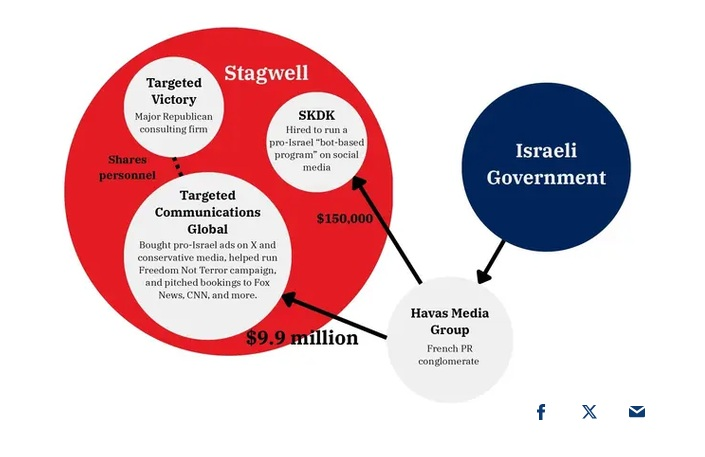
According to official filings filed with the U.S. Department of Justice under the Foreign Agents Registration Act (FARA), the Israeli government paid $9.9 million to the public relations firm Targeted Communications Global to organize a massive campaign to promote pro-Israel narratives in the media and social media platforms.
The case reveals a multi-layered network of communications efforts that spans from paid advertisements to television appearances, partnerships with political consultants, and efforts to shape public discourse in the United States.
Millions of dollars in advertising
The financial figures show the scale of the campaign. About $2 million was spent on advertising on Platform X, while additional amounts were allocated to American conservative media outlets such as Breitbart and the Daily Caller.
The contract is considered one of the largest active agreements between a foreign government and a lobbying and public relations firm in the United States. The goal was not just to purchase advertising space, but to systematically promote pro-Israel positions to hundreds of millions of Internet users.
The “Freedom Not Terror” Campaign
The central tool of the campaign was the Freedom Not Terror campaign, which was launched in October 2025. Its content was distributed via YouTube, TikTok, Instagram, Facebook and X, presenting Israel as a force for peace and democracy in the face of terrorism.
On YouTube, the campaign has garnered more than 224 million views, demonstrating the massive reach of the effort. One of the most popular videos, titled “Religious Freedom,” has garnered over 23 million views and featured an interview with former Israeli ambassador to the United States Michael Oren, who made particularly harsh allegations about Iran and Islamic terrorism.
A picture that conflicts with the complaints of human rights organizations
At the same time that the videos presented Israel as a force for peace, human rights organizations were recording a completely different picture.
In a video published on X, the narrative claimed that Israel, the United States and Arab countries were working for peace, while Hamas and “radicalized Palestinians” sought to continue the violence.
However, at the same time, the organization Euro-Med Human Rights Monitor was denouncing that the Israeli army was systematically violating the ceasefire in Gaza through daily bombings, shootings and the destruction of homes.
The contrast between the communication narrative and the reports of human rights organizations reinforces the debate about the extent to which advertising campaigns attempt to influence the international public’s perception of developments in the Middle East.
Infiltrating major US media outlets
Targeted Communications’ activities were not limited to paid advertising. According to FARA filings, the company made dozens of contacts with major US and international media outlets, including CNN, Fox News, NewsNation, Newsmax, BBC, and others.
The services included:
- arranging television appearances,
- promoting issues,
- managing public relations,
- suggesting pro-Israeli guests for television shows.
Fox News was the most frequent recipient of contacts, followed by CNN, NewsNation, and Newsmax. This practice highlights how a foreign government can attempt to influence not only advertising but also the news agenda.
Journalists and commentators with dual roles
Of particular concern is the involvement of executives who appear both as analysts in the American media and as registered representatives of a foreign government.
Matthew Gorman, the head of communications for Targeted Victory, participated as a commentator on NBC while also working for the Israeli government.
According to the investigation, the show Meet the Press did not disclose this relationship to the public. At the same time, Stagwell’s vice president, David Sable, published articles in the Times of Israel without disclosing that he was a registered foreign agent under the FARA law.
These cases have reignited the debate about transparency, the independence of commentators and the need for full public disclosure of potential conflicts of interest.
The “secret” $750,000 contract
One of the most controversial points of the revelations concerns payments totaling $750,000 to an American consulting firm, whose identity was not disclosed. This omission is causing strong reactions, as the FARA law requires full transparency about companies that work on behalf of foreign governments.
Ben Freeman, director of the Quincy Institute’s Democratizing Foreign Policy program, described the concealment of the name as extremely problematic. As he stated, when hundreds of thousands of dollars are being transferred on behalf of a foreign government, the public has a right to know who is behind these services.
The case, as he noted, raises reasonable questions about what exactly is being attempted to be hidden.
Bots, artificial intelligence and digital influence
The revelations do not stop there. The parent company Stagwell had already collaborated with Israel through its subsidiary SKDK, which had undertaken a program to amplify pro-Israeli narratives on social media.
According to journalistic investigations, part of the contract even included the use of automated accounts (bots) to amplify specific messages. After the revelations, the company announced the termination of the cooperation, claiming that its services were limited to public relations.
At the same time, other collaborations allegedly even included websites that aimed to influence the responses of artificial intelligence applications through optimized content.
The battle for public opinion
The huge investments in communication coincide with a period in which Israel’s image in the United States appears to be deteriorating.
A Gallup poll found that for the first time, more Americans express sympathy for the Palestinians (41%) than for the Israelis (36%).
Stagwell CEO Mark Penn attributed this shift to “misinformation,” arguing that younger generations in particular are not sufficiently aware of the Israeli reality.
At the same time, he appeared optimistic that public opinion can be shifted through more effective communications campaigns.
Parallel War
The revelations also fuel the debate about how governments attempt to shape public opinion far beyond their borders, using modern tools of political communication, digital advertising and media influence.
In an era where information is transmitted through algorithms, social networks and artificial intelligence, this case is a reminder that the battle for the narrative of war is now being fought not only on the battlefields, but also on the screens of hundreds of millions of people around the world.