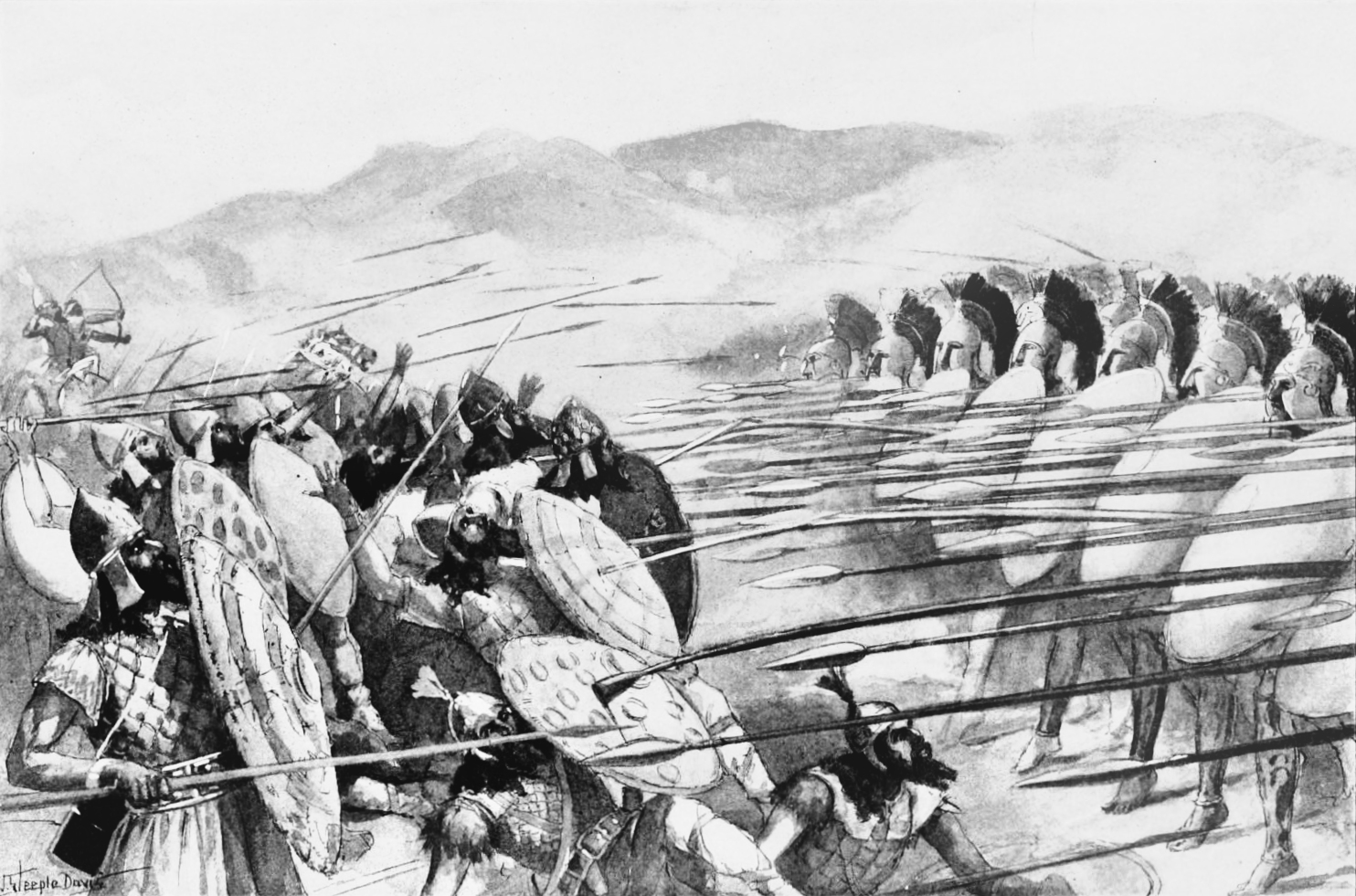
Based on one version after the victorious end of the Battle of Plataea, the Spartan Chief of the Greeks Pausanias was asked to impale the dead Mardonius, in order to avenge Leonidas whose head had been nailed to a stake by Xerxes and Mardonius. Pausanias, however, refused, responding that “these acts are done by the barbarians and not by the Greeks” ….
Initially, the word “barbarian” referred to the foreign language. However, the gradual realization of the characteristic elements of Hellenism, especially after the conflict with the Barbarian Persians in the 5th century BC, clearly attributed cultural content to the words “Hellin” (Greek) and “Barbarian”. Good and Goodness, Virtue, Word, Wisdom, Freedom, Beauty, Harmony, Measure, Law, against servility, arrogance, domination, uncultivated spirit, immoderacy, lawlessness, arbitrariness.
The earliest confirmed form of the word Barbarian , is the Mycenaean pa-pa-ro written in the syllabic script “Linear B”, the earliest known Greek script.

Herodotus describes in his wonderful work “Histories”, book 8, 144, 14-16, the national characteristics of the Greeks: «αύτις δε το Ελληνικόν, εόν όμαιμόν τε και ομόγλωσσον, και θεών ιδρύματά τε κοινά και θυσίαι ήθεά τε ομότροπα». With the adjective “barbarian” it is associated with Herodotus (Book 7, 35, 2) and the important adjective “unruly” (=evil, vicious, abusive) “were commanded, but by rapping we call ourselves barbaric and unruly”.
A characteristic example is the incident when, during Themistocles, not even this tradition of hospitality and the sanctity of the ambassador’s person rescued the envoy ambassador of the Persian king, whose death was decided on the grounds that «φωνήν Ελληνίδα βαρβάροις προστάγμασιν ετόλμησε χρήσαι» – “he dared to use the Greek language in barbaric commands” !
The Persian wars made the opposition of the Greek ethos to the barbarian more pronounced and much more evident. The interpreter of the mood and attitude of the Greeks towards the Barbarians is initially the marathon fighter tragic Aeschylus, (brother of the late Kyneigeros), the great Aeschylus, who opposes the Greek “measure”, the Greek “harmony” and the Greek “freedom” to the “immetry”, the “chlid” and the “slavery” of the barbarians and praises the internal opposition of the Greek nature to the barbaric, the opposition of the character of the Greek people to the people of the Barbarians. At the same time, the consciousness of the moral downfall of the Barbarians began to be formed.
Classical historians and philologists have long been interested in the question of the undeniable and timeless multi-layered differentiation of Greeks and Barbarians: His first in-depth scholar appeared the theologian and professor of philosophy in Tübingen, Johann Ulrich Steinhofer (1709-1757) with his work “Dissertatio critika de voce barbarian” (“Critical thesis of the barbarian voice”), Tübingen, 1732.
The German-Swiss historian Carl Jacob Christoph Burckhardt (1818-1897) in his work ‘Greek cultural history’ – ‘Griechische Kulturgeschichte’ presents the Barbarian as the great opposite pole through which the Greek spirit reached full self-awareness. It begins by removing later exaggerated distortions. Greek poets and orators due to the “Middle Wars” had loaded the word with accusations of cruelty, betrayal and perjury, while unfortunately over time the Greek behavior itself often moved in the same direction. Burkhardt also puts aside the influence of slavery, since at a later time the Barbarian stood before many Greeks mainly as a slave, even in huge numbers, a fact that had deeply coloured their judgment.
It also refuses to base the entire distinction on the partly plausible post-war hatred of Greeks and Barbarians, since mutual contempt flourished among many peoples, castes and ancient nations who considered themselves pure and sacred. The Egyptians considered the Greeks …. unclean, but used them as mercenaries worthy warriors.
The deepest distinction of Greeks is based on Culture and not on “Blood”
The Greeks reciprocated the demeaning feeling with their own form of contempt, and each side found signs of its ethno-racial superiority in everyday habits. Burkhardt, however, transcends insults and prejudices in search of a deeper essential distinction.
This deeper distinction lies in culture rather than in blood alone. A line between Greeks and Barbarians began in the Greek world itself ! The peoples of Pelasgian descent could be called barbarians, as well as the backward Greek groups whose lives remained far from the bourgeois model that determined the majesticly evolving Hellenism. Where there was little urban life, little public gatherings, little free exercise, little participation in struggles, little shaped individuality and a continuous life of raids, there the Greeks saw barbarism survive in its oldest form.
Thucydides supported this view when he described early Greek life as similar to barbarian life. Epirus could be called “barbaric”, although it contained the sacred Dodoni, one of the oldest and most sacred centers of the Greek religion. The mountainous Eurytanes seemed so rough to the rest of the Greeks that they said they ate raw meat and their speech sounded vague although it came from Greek roots. (They participated in the Trojan War and are mentioned by Homer). Even the Trojans, who in Homer are close to the Achaeans in religion and customs, gradually began to dress, be considered and judged as Asian barbarians. According to Burkhardt, this shows how the Greeks’ idea of themselves was limited, sharpened, and elevated above the earlier common world of the Greeks with the other neighboring Indo-Europeans.
As soon as the Greeks stepped out, they saw themselves placed between two broad species of Barbarians: Aristotle drew the famous picture:
- On the one hand stood the northern peoples of Europe, brave and free in spirit, but poor in thought, art, politics and government.
- On the other hand stood the peoples of Asia, rich in mind, knowledge and old culture, but weak in courage and therefore subject to the rule of the master.
Burkhardt uses this Aristotelian scheme as a way of organizing the Greek sense of the surrounding world. The Greeks appear between raw power and refined slavery. They do not belong either to the immense racial energy of the North or to the heavy cultural apparatus of the East. Through this contradiction, they acquire their clear definition. Greece becomes a “middle kingdom”, in which courage unites with intelligence, freedom unites with form, and the city becomes the school of a distinct type of man, distinct from both extremes.
The Scythians (The Northern Barbarians)
In Burkhardt’s account, Herodotus gives the richest picture of the northern barbarian, primarily in his portrait of the Scythians. These peoples had great fortitude, pride and warlike grace. A steppe rider could feel enormous personal freedom, but the life of the whole people followed a single common will. Burkhardt sees in them a racial collectivity, almost like the instinctive class of animal societies, where everything moves to a level of customs, religion and action, a level which is at times restrained there by force. A people of this kind draws its strength from similarity and from collective strength. Any strong movement toward diversity threatens the entire body. Hence the cruel fate of Anacharsis, a Scythian nobleman and philosopher, and Skylis, a Scythian king, both of whom were killed because of their great attraction to Greek worship and to Greek ways.
Burkhardt finds in this world a very limited space for the free struggle that the Greek individual has brought out. Northern games showed the strength of the tribe as a mass. Their feasts could be turned into armed events. Their memory of the past and the future remained dim, while the “power of the hour” overtook them with all its weight. War was their highest mood, often pursued by an internal impulse rather than a clear goal. Kingship, burial, sacrifice, oath and religion all bore the same stamp of collective energy and magical religious solidarity.
The Civilized Asia Barbarians
Against this northern type, Burkhardt poses the civilized barbarians of Asia: Old in culture, strong in technique, rich in accumulated knowledge, but “historically bound” in another way. Here the chain came from the caste, from despotism and from a life ruled by an imposed form. Egypt offers its strongest argument: She recognizes her immense gifts to world culture and her immense national pride, yet she sees the Egyptian individual morally broken by submission. Ancient fears, ceremonial burdens, symbols and inherited restrictions turned his life into a cruel service to the Pharaoh. Productive work and public life were in dire need.
In the narratives preserved by Herodotus, Burkhardt perceives what he interprets as the mentality of an inherently subjugated population: He is resourceful, suspicious, and prone to indirect revenge through slander and defamation. He even considers legal customs, such as the use of corpses as collateral for debts, as signs of a society shaped by multi-layered constraints and long-term coercion. The Egyptian emerges as persistent, resistant, even to torture, but internally bent by a depressing system that leaves him little room for free personal development. For Burkhardt, this contrasts sharply with the wondrous unique Greek course.
The Persian Barbarians
It then turns to Lydia and Persia, where the Greek relationship with Asia assumed a more direct historical form. Lydia appears relatively closer and at times even sympathetic, either through the old Aryan affinity of the two nations or through her partial participation in Greek religion and life. Persia inspired a different feeling: Fear, aversion and then an increased awareness of the Greek particularity, through open warfare. The Persian Empire appears to Burkhardt as a huge power that was later founded and ruled too many countries, having relatively weak rulers after Cyrus and Darius, but also spending a lot of energy on repeated reconquests.
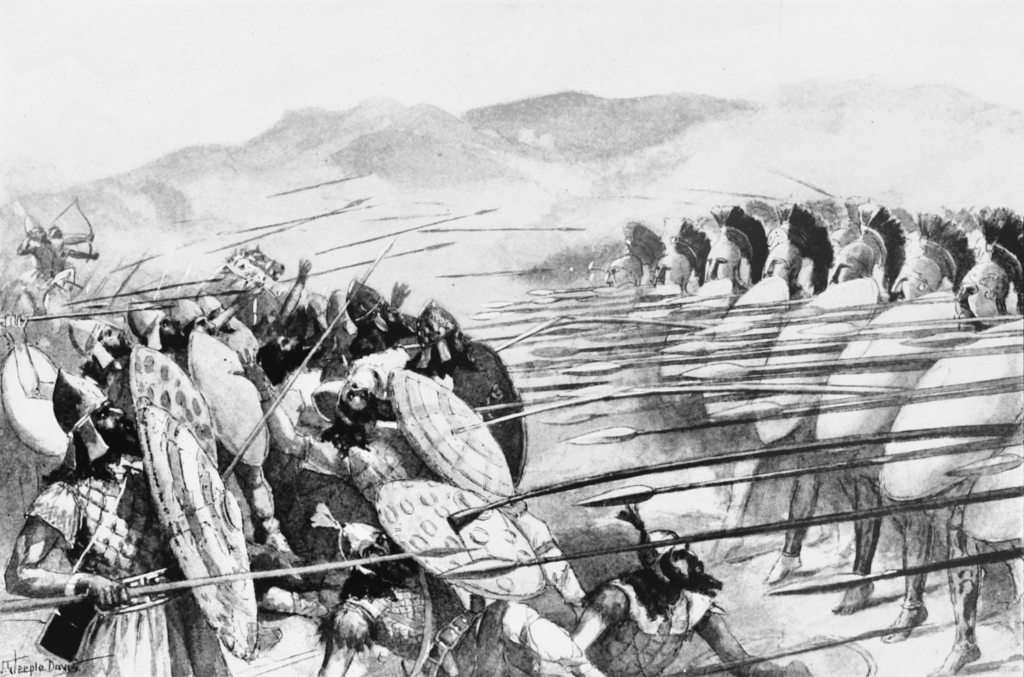
During the Persian Wars, the Greeks felt their difference more strongly than before, while later the Persian intervention in Greek affairs brought a deep sense of shame. However, Greek observers, such as Xenophon, also went so far as to see the enormous weakness hidden in the Persian imperial display. The court ceremonies, the royal splendor and the holy kingdom covered an empire that had already been vacated.
The Positive Image of Greeks
By the time of Alexander the Great, the Greek mercenaries were the only truly effective soldiers in the Persian army, while the leadership and central powers of the empire had become weak and unreliable. When Alexander advanced eastward, the Persian state disintegrated with unexpected and impressive speed. Only beyond this , among the most cruel peoples of the most remote regions, the Macedonian undefeated commander met once again the power of the true “natural barbarians”.
Here Burkhardt reaches the positive image of the Greeks: The Greeks stand free from the constant natural action of the race and the historical action of the caste. They live “equally among equals”, in constant competition, in major sports competitions, in the city, in the market and in the gallery, in speech, in singing, in art and in political ambition. The “Race” is at the centre of their existence: The unquenchable momentum towards constant competition, through which the Greeks define themselves in sports competitions (the competitions were not just a sporting event, but a way for man to reach a higher, almost divine state), in politics, art and speech. Even in the spirit of everyday life, mockery and criticism carry this spirit of “competition” into everyday life. The Greek mind enjoys the contrast between what it is and what it should be. Laughter, debate, competition, public crisis and the urge to discriminate shape citizens.
Burkhardt contrasts this with the East, which he considers serious and hierarchical, but bound by caste textures and poor in some open rivalry. Barbarians can drink a lot, obey, fear and endure, but Greeks talk, joke, compete and seek persuasion. He says that one could cooperate with the Greeks through logical causes, while violence suited dealings with the barbarians. This formulation reveals how deeply Burkhardt connects Greek freedom with the individuality of the mind.
Religion further deepens opposition between Greeks and Barbarians
The Greek religion, in Burkhardt’s view, bears the same stigma as Greek life: Multiplicity, intensity, living personality and a divine world shaped as a higher human form. The Olympian gods argue, take a stand and reflect the divisions of Greek existence, while Greek life on earth is also interpreted from many angles and influenced by competing claims.
Oriental religions seem to be governed by fixed rules and rigid heavy ritual, shaped by priestly authority and expressed through rigid symbolic forms: Gods with animal characteristics, multiple limbs and standardized, repetitive gestures often appear. The Greek gods look much more beautiful and wiser, as more capable and superior relatives and friends.
Greek divination also seems richer. Foreign peoples came to Delphi, Dodoni and other Greek sanctuaries for divine guidance. Croesus, the wealthy king of Lydia, offered abundant gifts to Greek temples, while Mardonius, the famous Persian general, consulted Greek divination before important decisions were made. The offerings came from distant peoples, from reverence but also from necessity. Some foreign rulers even founded Greek cults in their own countries. Through all this, the Greeks acquired an additional strong sense of religious superiority. They considered themselves especially pious, especially skillful in their dealings with the Gods, almost priestly in relation to other peoples.
The union of physical beauty and psychic power gave the Greeks a special power of attraction
Burkhardt also emphasizes the influence of the Greek human type on the barbarians. He accepts the Greek testimony here with relative confidence. The union of physical beauty and psychic power gave the Greeks a special power of attraction. Burkhardt emphasizes the legend in which the daughter of a Celto-Ligurian leader chooses the Greek Euxenus as her husband, an act that leads to the founding of Marseille, a Greek colony on the shores of the Mediterranean, known today by the same name, while seeing in it a symbol of a wider historical pattern of Greek colonization.
In the founding myth of Marseille, the leader of the Phocaeans is often referred to as Protis, but in some sources (such as Aristotle) his name appears as Euxenus. Euxenos arrived on the shores of present-day France in search of trading posts and married Gyptis (or Petta), daughter of the local king of Sigovrigian Celtic Ligurians, who chose him by offering him a cup of wine during a symposium.
Beyond the shores of the Mediterranean and the Black Sea, the Greek colonies attracted neighboring peoples to trade, imitation and admiration. In Egypt, as soon as the country opened up to the Greeks, its economic life flourished, wealth and population increased, and an entire older order of things and structures began to recede.
The warrior caste retreated to Ethiopia, while the mass of the population in Lower Egypt adapted to the new conditions and gradually formed a peculiar mixed population through contact with the Greeks. Burkhardt sees in this process a sign of the incorruptible Greek vitality but also of the disintegrating effect that constant Greek mobility could have on old, rigid cultures.
Then he turns again to Persia, this time from the point of view of the Greek influence in the court and the strange attraction of the empire to individual Greeks. Greek men rose to prominent positions in the Achaemenid Empire, serving as physicians, court exiles, advisers to kings, and even as rulers or political agents. The women of the royal house wanted Greek slaves.
The kings listened to Greek athletes. Personalities – such as Dr. Dimokides the Crotonian, the political-military adviser of Darius of ΄ Istiaeus of Miletus, the adviser of the Persian court exiled Spartan king Demaratos of Ariston, the warrior queen Artemisia of ΄ of Doric Caria, daughter of Lygdamidas, and the Salaminonite great Athenian politician and general Themistocles Neocleous of Frearios – gained access to the Persian court and came to influence decisions at the highest level.
Themistocles – the Great Athenian Politician and General
Burkhardt insists on Themistocles, the great Athenian politician and general, as the very image of Greek superiority in intelligence, crisis, improvisation, foresight, speech and ethos. [Tradition says that when Egypt rebelled, Artaxerxes asked Themistocles for his help in suppressing the revolution, but Themistocles refused to turn against Greek interests and on the other hand did not want to show ingratitude to the king of Persia. So he preferred to drink poison and put an end to his life. When Artaxerxes learned of his death, he admired his insurmountable patriotism. In honor of Themistocles, a glorious tomb was erected outside the walls of Magnesia and his statue in the market. His body was secretly transported to Piraeus, where the Athenians built him a grave out of gratitude for the great services he had offered in Greece and especially in Athens.
However, Themistocleous’ example also shows that Greeks rarely felt at home in the Persian world. The vast interiors, the endless journeys and the great distance from the sea weighed on them like a “weight of the soul”. Even wealth, favor and royal intimacy failed to cure their nostalgia. The epitaph stones of the displaced Eretrians near Susa reveal an immense sorrow for the homeland and the sea, which Burkhardt presents with moving force. The Greeks, both before and after their victories against the Persians, could influence Persia, impress it, and even serve it, but their deepest instinct was to turn back to the birthplace and the seashore.
The “Fall”
Burkhardt identifies the weakening and then the reversal of the old opposition. During the late classical era, the contrast between the Greeks and the Barbarians was at full intensity, although Herodotus already gave a more balanced and insightful narrative than later rhetorical writers, such as Euripides, whose “theatrical abuse” of the Barbarians is treated by Burkhardt with overt dislike.
A city was afraid to “become barbaric”, either through conquest or through gradual penetration. However, the fourth century brought about a change. The suffering of the Greeks at the hands of their fellow Greeks broke their old pride. Philosophers such as Antisthenes and Plato began to use the barbarians, or eastern civilizations, as examples of power, wisdom, or ancient domination.
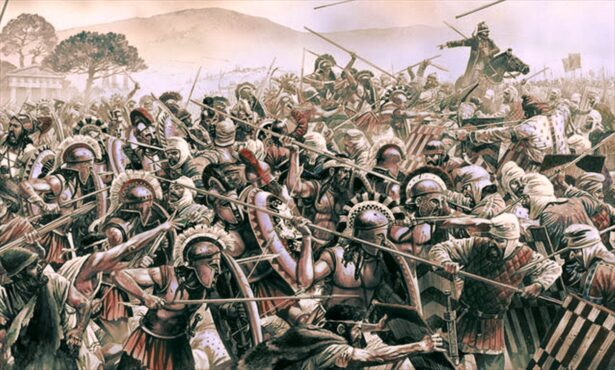
After Alexander, vast eastern countries entered the trajectory of Greek discourse and culture. Stoicism proclaimed the Greeks and Barbarians “children of God.” Eratosthenes, the leading intellectual of the Hellenistic world and head of the Library of Alexandria, rejected the old division between Greeks and barbarians and replaced it with a moral distinction based on excellence and dishonesty. From there, the road led to the admiration of the barbarians, the idealization of distant peoples, the charm of eastern wisdom and the praise of barbarian piety and political order.
In this late world, Burkhardt says, the Greeks came to feel that where the barbarians had been corrupted, Greek influence itself had played a crucial role. Thus, the old opposition that once complemented Greek self-consciousness, slowly gave way to a wider, mixed world in which the relative barbarian blood, the high intelligence of many “Barbarian” thinkers, sacred cults and extra-Greek thought entered Greek life itself.