



US President Donald Trump and his Iranian counterpart Masoud Pezeshkian have signed a “preliminary peace agreement”.
The document was reportedly ratified remotely via video call, with the American leader in Versailles and the Iranian side in Tehran.
Pakistani Prime Minister Shahbaz Sharif also participated in the process as a third party, who ratified the text. In fact, to be precise, the parties involved only signed a declaration of intent.
In other words, the United States and Iran have agreed to proceed with negotiations, without yet reaching a final agreement. The document includes some positive provisions. For example,
- the US has pledged to unfreeze some of the previously frozen Iranian accounts and lift restrictions on the Islamic Republic’s oil trade.
- For its part, Iran has reportedly agreed to open the Strait of Hormuz.
However, beyond these, most issues remain at a general level and form a framework for future negotiations.
Iran’s spiritual leader, Mojtaba Khamenei, has not yet signed the declaration of intent. Since the Islamic Republic is a theocratic state, the document could theoretically be revoked at any time.
Similarly, the United States maintains its own mechanisms that allow it to withdraw from the agreement if it deems it necessary.
At the same time, according to available information, the White House has only temporarily suspended sanctions against Iran, while only $3 billion of the frozen assets are expected to be returned to Tehran.
The situation in the Middle East
Let’s examine how the situation in the Middle East is shaping up from a military perspective.
Washington has for now withdrawn both Marine Expeditionary Units (MEUs) from the region. Along with the Marines, the landing craft have also left. At the same time, the “Makin Island” is preparing to sail from San Diego.
It is a general-purpose amphibious ship, equipped with an air group, a detachment of landing craft and amphibious armored personnel carriers. However, the “Makin Island” is not carrying landing craft or Marines on its mission in the Middle East.
Its deck has been configured exclusively to accommodate F-35B vertical take-off and landing fighter aircraft. In effect, the ship has been transformed into a light aircraft carrier, capable of carrying about two dozen of the most modern stealth attack aircraft.
In May, all of the US Arleigh Burke-class destroyers operating in the Mediterranean transited Gibraltar and returned to Rota, Spain, on the Atlantic coast. There, they underwent limited maintenance checks and were re-equipped. The Tomahawk cruise missiles were stored, and in their place the ships were likely equipped with SM-3 and SM-6 interceptor missiles.
All of the destroyers then returned to the Mediterranean. At least two Arleigh Burke-class units have already been deployed off the coast of Israel, in the same areas from which they had intercepted Iranian ballistic missiles during the 12-day war.
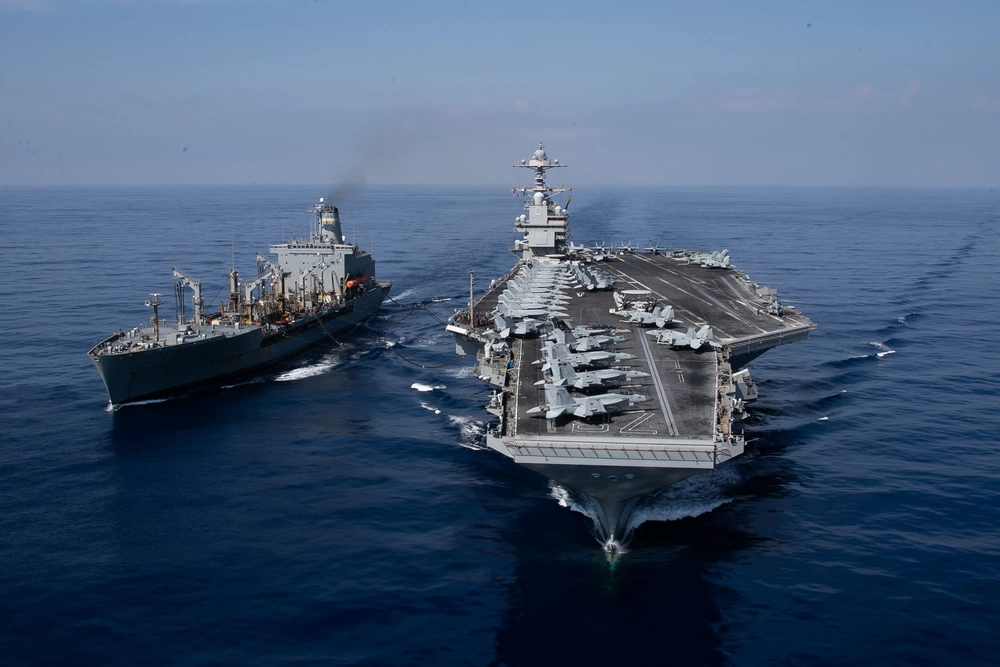
At the same time, two US Navy aircraft carriers, the Abraham Lincoln and George Bush, remain in the Gulf of Oman.
The Theodore Roosevelt is also preparing to sail. It is not yet officially destined for the Middle East, as it is to participate in multinational exercises near Hawaii.
However, the timing of the exercises coincides with the operational training schedule of the ship and its naval group. After the training is completed, the Roosevelt will be declared fully operational.
So far, there are no indications that the US Air Force is withdrawing forces from the Middle East. This concerns not only fighter aircraft, but also support assets, such as flying tankers, transport aircraft, airborne early warning and control systems, as well as electronic warfare systems.
At the same time, there is no redeployment of missile and air defense systems. The Patriot and THAAD systems remain in combat positions, although the level of readiness of their crews has decreased.
Their gradual return to permanent bases is likely to follow soon, as complex electronic and automated systems require maintenance and repair.
The picture of ground forces also remains unclear. Although the Marines have withdrawn from the Middle East, there is still no indication of the return to the United States of units such as the 82nd Airborne Division and the 10th Mountain Division.
The Pentagon continues to maintain a full operational presence of Army Aviation units in the Persian Gulf region, including AH-64 Apache attack helicopters and CH-47 Chinook transports.
At the same time, it has been revealed that paratroopers from the 82nd Airborne Division have been in Israel since April. According to the information, this is the 1st Brigade of the unit.
Exercises were held there related to a possible plan to occupy Kharg Island. More details have not been released. The plan reportedly included a combined airborne and helicopter operation.
Anger is building up
In fact, it is clear that Washington has taken a two- or possibly three-month pause on the Iranian front. The Pentagon needs this time to assemble a fully developed combat force.
The problem with the “Epic Fury” was that the United States was constantly trying to make up for lost ground. It could not impose its own initiative on Iran. Therefore, it was forced to react to the actions of the adversary, which led to a chaotic redistribution of forces and resources.
Whatever was available was immediately put to use. One need only recall the movements of the aircraft carrier “Gerald Ford” between the Mediterranean, the Red Sea and the Gulf of Oman, as well as the impressive passage of the aircraft carrier “George Bush” through southern Africa.
For now, the Pentagon is acting methodically and without haste.
The Roosevelt and Makin Island will sail according to the planned schedule and complete their operational training. Then, they will head to the Middle East at a correspondingly steady pace.
The air and ground forces will remain in the region, but their staffs will have more time to plan operations, train personnel and conduct exercises.
Iran, for its part, is fully aware of the US intentions and is feverishly preparing for a possible resumption of the conflict.
It can be assumed that around August or September, Washington will again begin to claim that the Islamic Republic is not complying with the terms of the agreement.
Then, tensions will escalate again, possibly culminating in a series of US strikes. August can bring blood and tears.

