



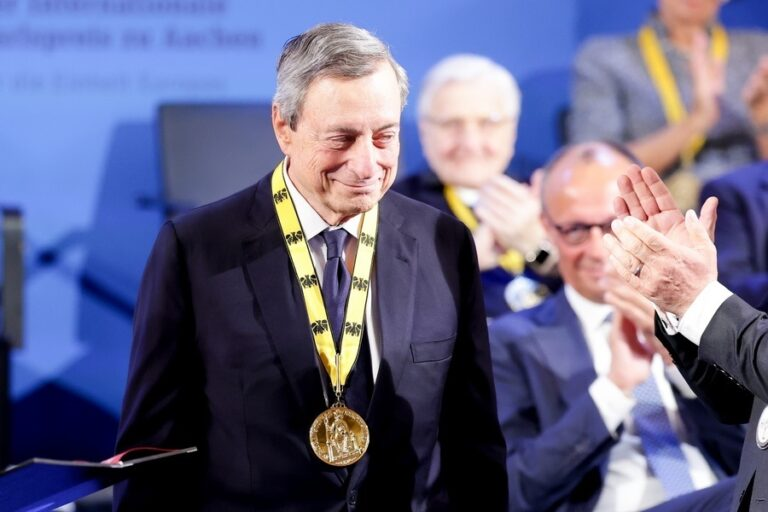
Mario Draghi has said in speeches that the decisions that Europe must make “can no longer be confined within the institutional framework we have inherited.” It would not work. For him, the answer lies in a strong change, in courage and in what he calls “pragmatic federalism.”
Draghi came to say this, in a speech that is perhaps his clearest and most concise yet, in Aachen, Germany, in a country that was deeply suspicious of him, almost to the point of making him a public enemy (“How can an Italian defend the stability of the currency?”, German politicians would ask, and newspapers sometimes described him as Count Dracula)…
In contrast, this morning Draghi received the Karlspreis, the Charlemagne Prize, Germany’s highest award, for his “life’s work.” In the chapel where around thirty German emperors have been crowned since Charlemagne, “Dr. Professor Mario Draghi” was awarded the medal, the certificate and the 1 million euro prize (for supporting European projects).
In the front row is Chancellor Friedrich Merz, who introduces him and thanks him. Draghi begins by improvising in English: “I have never had so many people to thank,” and as if at an Oscar ceremony he names many, but “thanks above all to my wife.”
Mrs. Serena seems surprised, reacts almost as if Draghi was making fun of her and resists (she “scolds” him a little, like wives who don’t want to follow their husbands in public), before standing up and accepting the applause. Then Draghi begins his lesson. A wordy speech, not given to criticism (not even hinting) towards the status quo.
America and China
Draghi says the context has completely changed. He is categorical about America, which has been his main orientation throughout his life. Decisions with profound consequences for European economies are being taken increasingly unilaterally, without respect for the rules that the United States once defended.
He calls for a more decisive stance against Trump, without naming him. But he is also very critical of Beijing. “China does not offer an alternative anchor either. It creates industrial surpluses on a scale that the world cannot absorb without emptying our own production base. And it directly supports our adversary, Russia.”
How did we get here?
If Europe is in this situation, it is no accident. The fact is that it was designed that way. “The European project was built, deliberately and wisely,” Draghi says, “to prevent the concentration of power. After the disasters of the first half of the twentieth century, Europeans decided that no member state would dominate the others.”
Independent authorities, processes bound by rules and markets, agreements between governments were wrapped “in layers of procedures that eliminated their political character.” Deliberately. The results of that system, Draghi says, were impressive: peace; the single market; the euro; freedom of movement. “It allowed us to achieve something historically rare: integration without subordination.” Until it stopped working.
Why isn’t it working?
Draghi says the European system was based on two assumptions.
The first: “That Europe had built a truly open economy, in which the state did not need to direct development.”
The second: “That Europe would never again have to face the toughest questions of power and security, because others would answer for us.”
But the fact is that “both of these assumptions have now been proven to be empty.” Then the more political Draghi emerges: “There is an irony in all this. Europe relied on markets to perform a task that the common political authority was not authorized to perform. But we deprived those markets of the continental scale they needed to succeed.”
Draghi believes that many of today’s solutions, such as the conclusion of international economic agreements, are a band-aid: they help but do not solve the real problem — a message that the Germans and Merz must give substance to.
Three vulnerabilities & Five ideas
Draghi identifies three major vulnerabilities of Europe:
- Dependence on external demand. “European companies have sought growth outside Europe because the internal market was not sufficiently integrated and dynamic.”
- Strategic dependencies (including US LNG).
- Technological lag, especially in AI. “This is perhaps the vulnerability he considers most serious,” says Draghi. Europe is losing ground to the US and China in the critical technologies of the next decade.”
He then moved on to proposals: completing the single market, an industrial policy (“If European member states attempt a large-scale industrial policy within the existing structure of the single market, they will fail. They will spend inefficiently, fragment investments along national lines and impose costs on each other”).
He then made an extensive reference to the need for European defense and strategic autonomy. And here there is a message to the sovereignists/Eurosceptics: “Even the parties that built their identity on national sovereignty now recognize that no European country can defend itself alone.”
Pragmatic federalism
Finally, Draghi spoke about two ideas that are particularly important.
His “pragmatic federalism”: for Draghi, the Europe of “27” often fails to decide, because everything fails through procedures and compromises.
The solutions differ: among them “allowing countries that want to move forward to do so,” but also “creating specific partnerships,” which give visible results, building consensus in society.

