



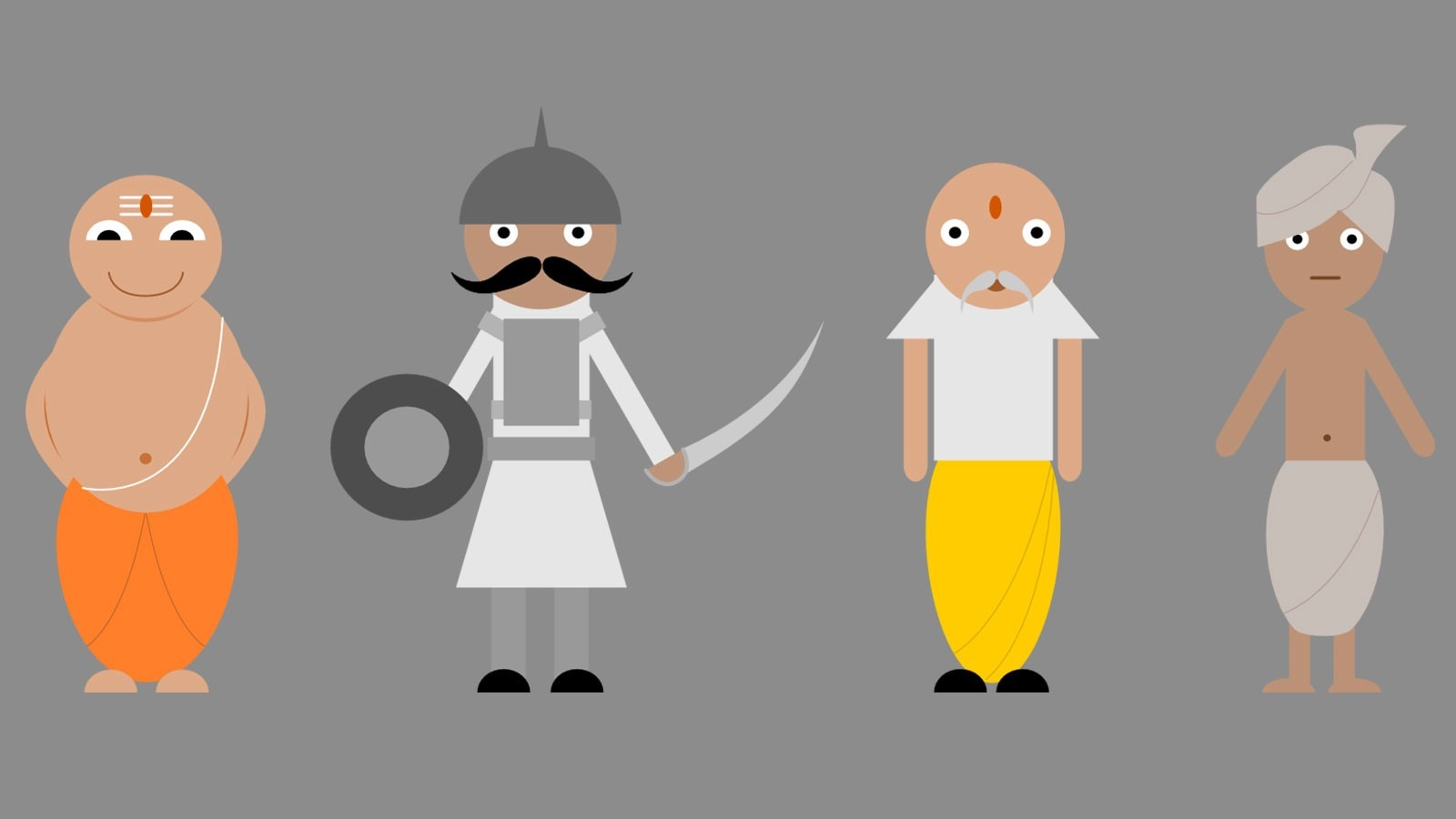
The caste system in India is a characteristically important example of social hierarchical stratification. It has its roots in ancient India after the Aryan invasion, and has undergone successive transformations by the various ruling elites in medieval, early modern and modern India, (especially in the Mughal Empire of India (from 1526 to 1857, the last 100 years essentially under British tutelage) and in British India (1858 -1947). To this day it is the basis of the system of educational and professional positions in India.
The system in its fullest development is found in Hinduism, although similar forms exist in Islam, Sikhism and other religious groups in South Asia. It is an ancient core institution of Hindu society for two millennia and has developed not only complex systems and practices, but also a complex theory that interprets and justifies them. The theoretical background has lost its original meaning and power, but many of its practices are still valid today.
The word caste in Hindi is rendered as “varna” (color) or “jati” (birth). The word “varna” indicates an ideal model, a way of planning society, while the word “jati” refers to the real social groups with which people identify and on the basis of which they interact.
There are only four varnas from ancient times:
- brahmins (priests),
- kshatriyas or rajas (warriors-lords),
- vaishyas (merchants-landowners) and
- shudras (farmers-servants).
- Outside the varna system is the fifth sub-stratum, the “refuse”, the dalits (“untouchables” or “forbidden”) who are crushed with “miserable” occupations and the “antivasi” (ancient inhabitants. Apparently in memory of the pre-Indo-European populations).
- The jatis are very numerous in number (thousands) and often internally divided. Although they differ from religion to religion and have changed their constituent identity several times, they continue to exert a particularly strong influence on Indians.
The jatis are very numerous in number (thousands) and often internally divided. Although they differ from religion to religion and have changed their constituent identity several times, they continue to exert a particularly strong influence on Indians.
Caste comes from the Spanish and Portuguese word casta, which, according to the Spanish dictionary (1599) of the English linguist and lexicographer John Minsheu (or Minshew) (1560–1627), means “race, lineage, clan, or fara”.
The Portuguese and Spanish word “casta” comes from the Gothic “kasts” – “group of animals”. With the Visigothic movement the word entered the languages of the Iberian Peninsula with the meaning “kind of animal” and soon evolved into “race of people” and later into “class, state of people”.
When the Spanish colonized the New World, they used the word to mean a “race or lineage”. However, it was the Portuguese, the first Europeans to reach India by sea in 1498, who first used the word casta in the main modern sense of the internationalized English word “caste” when they applied it to the thousands of endogamous, hereditary Indian social groups they encountered.
The use of the Latinized spelling caste, in the latter sense, is first attested in English in 1613. In the Latin American context, the term is sometimes used to describe the system of racial classification, based on whether a person was of pure European, indigenous, or African descent, or some mixture of these, with the different groups being placed in a racial hierarchy. However, despite the etymological connection between the Latin American casta system and the South Asian caste systems, it is debatable to what extent the two phenomena are truly comparable in scope and depth.
The great mystic René Guénon viewed aristocracy as the social domination of a “chosen” group, a few distinguished individuals with superior intellectual and spiritual authority, individuals whose functioning is incompatible with modern democracy, which is based on quantity and amorphous homogenized masses.
He saw true aristocracy as a hierarchical system where leaders, like kings, are guided by Tradition and higher principles, a concept that contrasts with plutocracy (rule by wealth) and the “soulless” “leadership” he observed in modern societies. This traditional aristocracy, in his view, was necessary for the maintenance of the intellectual and social order, which was being eroded by morbid modernity.
1. Aristocracy as Spiritual Sovereignty: Guénon defined aristocracy by its etymology, “government by the best” or “the elect.” These “elect” hold superior intellectual and spiritual authority, which is not based on popular vote or numerical strength.
2. Incompatibility with democracy: Guénon argued that true aristocracy is fundamentally incompatible with democracy, because democracy prioritizes the will of the majority over the quality or power of the minority.
3. A decline from traditional sovereignty: Guénon believed that modern “state leaders” (presidents, prime ministers) have lost their sense of duty to authorities higher than themselves. He saw them as subject to the whims of a plutocracy and as lacking the dignity of traditional leaders.
4. A hierarchy of purpose: Guénon saw the traditional social hierarchy, from kings to manual laborers, as having a sense of purpose and clear dignity associated with their specific roles within a divinely organized structure.
5. The chaos of modernity: He argued that modernity dissolves this hierarchy of cosmic interconnectedness, replacing it with “uniformity” or a nonexistent and fraudulent form of universal equality that strips away individual dignity and any higher human purpose.
6. Plutocracy as the true modern power: Guénon saw modern society as a formation governed by a plutocracy and a “mass suffrage,” ultimately serving the interests of this ruling class of the wealthy, rather than a true aristocracy.
Aristocracy means rule by the best
Therefore, anyone interested in re-establishing an elite must first understand what the best way of life is. Here we can start with some of Guenon’s ideas to see how they clarify and extend Aristotle’s ideas on how to achieve “Euzoia” (Wellness). For Guenon, there are two options for this:
- To realize all the potentialities of the human being
- To realize all the potentialities of transcendental states
For Aristotle, the pursuit of “Euzoia” (Wellness) was not an option for everyone. Much depends on good fortune, such as having good health, intelligence, financial resources, a good family background, and so on. There must also be an excess beyond the simple animal need for survival. Guenon described it in terms of one’s capabilities, which are derived from one’s caste. Christians, on the other hand, attribute such “luck” to “destiny” or “predestination.”
For the rest of our approach, we will leave aside the question of the capabilities of those who are not “blessed” with the necessary resources described by Aristotle. The devotee of the Native National Religion was in any case indifferent to them, since everything is in the hands of fate or the whims of the gods. In Hinduism, for example, the Brahmins are not interested in the condition of the Dalits. Even in Buddhism, which introduced the idea of “compassion,” the aim is not to alleviate the external causes of suffering, but rather to teach the elimination of desire as the root cause of suffering*.
- The first false form of well-being is to live solely for pleasure. It is not worth discussing here in the general approach to the structure and functioning of the aristocracy.
- The other false form of well-being is to live to gain esteem in the community. This is a powerful incentive for those who are able to do so, and sometimes it may achieve some good. Notice on a visit to a hospital all the branches, the wards, that bear the names of prominent or wealthy people in the local community. Their need for public esteem has been met with special centers … for the treatment of cancer and other diseases.
However, in a disturbed society, those who are esteemed may be much less deserving, such as the attention given in our day to various entertainers of dubious moral standing. Now we even have those who are “famous because … they are famous,” whose fame comes from so-called “reality shows” rather than from any notable achievement.
Appreciation can also be expressed on a scale disproportionate to reality, where the so-called “big fish in a small pond” is presented. Thus, there are … a myriad of small groups of people who promote various political and religious causes. Their leaders are overly publicized, boast, publish books, and are invited to speak at conferences. There will always be supporters for such people for some reason. However, the inferior cannot judge the superior, so the quantity of supporters is by no means a good guide to determining the true value of these leaders.
“Euzoia” (Wellness) consists in the realization of all one’s potentialities. Since the distinguishing feature of man is the rational or “intellectual soul,” this can only mean that one realizes one’s life based on this basis. Such a superior, complete man is capable of dominating the lower irrational elements of his soul and lives with the best use of his high intelligence. His intelligence is guided by the Universal Laws, by the harmonious cosmic Reason, that is, the order of things established by the Creator.
The true aristocrats, therefore, are those who are truly willing but also capable of following this path. If such people can unite in a true companionship, then the possibility of a genuine elite can arise.
There are two essential elements to this,
1. A proper education and
2. A code of honor.
1. The aristocrat should have knowledge of the liberal arts, specifically the trivium (the three-part group of knowledge of grammar, logic, rhetoric, which constituted the basic level of medieval education) and the quadrivium. (the basic elements of music, mathematics, language and cosmology), which form the basis for advanced studies. As potential leaders, they do not necessarily need to delve into philosophy and theology. Practical arts such as medicine, law, engineering are usually more suitable for the productive class.
The main issue is that the aristocrat be able to think logically, so that he can consistently follow an argument and be immune to false teachings. Through rhetoric, he learns the techniques of persuasion. Although leaders must be willing to use force when necessary, persuasion is the best approach. Furthermore, with this training they will be able to recognize the rhetorical tricks of false teachers and will not be influenced by them.
2. It would be premature to formulate a code of honor by comparing various ancient and medieval codes. The most important point for now is how it will be enforced. Since the aristocrat is the “best,” he cannot be judged by his inferiors. Therefore, he must be self-controlled, untroubled, “Olympian.”
Here the moral will comes into play because of the tendency to protect or advance his friends, or even his own property. Nevertheless, this aristocratic elite must be willing to exclude with cruelty and without hesitation those who violate this code.
In the novel “The Four Wings” by Alfred Edward Woodley Mason (English writer and Liberal MP, 1865 –1948), a man disgraces himself by deserting the army in time of war. Three of his friends, as well as his fiancée, each give him a wing – a symbol of cowardice – to mark this. This is the model of behavior that should be followed by groups with lofty political ambitions, at least those that do not rely on popular popularity. They must establish an unwavering code of honor and have the will to enforce it. Those who follow an immoral lifestyle, those who are egotistical and vulgar in their rhetoric, those who are irrational, etc., must be excluded from leadership positions by group consensus. Otherwise, the efforts of a group that condones such excesses will be fruitless. Those who have an aristocratic mind and corresponding faith would reject any participation in or support from such pseudo-movements.
The Wise One
The philosopher is the lover of wisdom and seeks it. For some, this search is a way of life. Therefore, they participate in discussions, disputes, disagreements, dialogues, conferences, etc., which simply prolong the search without getting closer to the goal. The Wise One, on the other hand, is the one who has achieved wisdom. Beyond the aristocrat, these are the initiates, the saints, etc., who have realized possibilities beyond the human condition. Their education is done privately, as it cannot be fully condensed in the written word.
Aristotle, being himself the Great Sage, did not have a methodical awareness of this level and did not provide his own opinion on it, but he was the teacher of the invincible cosmocrator Alexander. Therefore, his general approaches to individual and collective life must serve as spiritual and intellectual guides for the aristocrats. Through rituals, moral codes and external religion, the Aristos can connect with the people, providing a common spirit to the community in order to give it cohesion and continuity. Only they will have the power to anoint the Leaders and give them the legitimacy to lead effectively.
In the contemporary global gloom, the Aristocracy returns as an alternative ideological-political proposal, as a timeless historical social necessity and as a new political solution, capable of leading to the improvement of the governance of the people and their liberation-therapy from the existing regimes or systems. The aristocratic regime is not related to the economic autocracies of the super-rich tycoons of wealth, that is, to the provocative plutocratic pseudo-nobles. It is a political system of highlighting the best through institutions and tests that come from the ancient Greek political models, from the Roman preservation and imposition of civilization, from European history and the timeless Indo-European institutions adapted to today.
Let no one naively hope that the wretched rulers will peacefully hand over power to the Elites, the people must fight for this!
Notes
*In our time a curious frivolous superstition has arisen, known as the “Law of Attraction.” It is a form of primitive theurgy which seeks to compel the universe to deliver its goods through the “attractive positive thought” or visions of individuals. However, this is defective, as it seeks to obtain only the material conditions for well-being, without undergoing the moral transformation required to achieve it in reality. All day long the self creates its image in consciousness through numerous thoughts and fantasies. Spending only five or ten minutes in a supposedly “active meditation” trying to consciously concentrate one’s thoughts and visions in a positive direction is obviously not enough to compensate for the random disturbances that arise in consciousness during the rest of the day.


