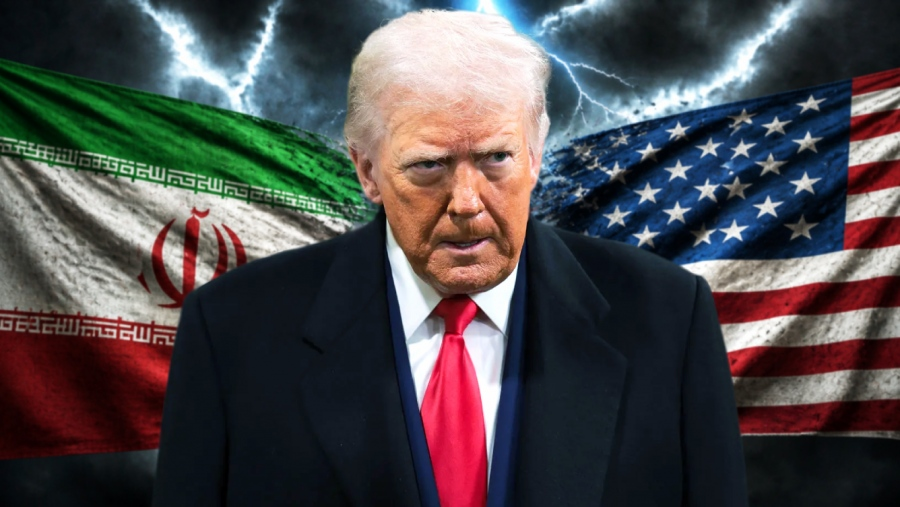
Iran has scored a strategic victory of unprecedented historical significance against the US and Israel, with the Islamic Republic successfully testing the strength of Trump’s fragile ceasefire, launching multiple ballistic missiles and drones at energy facilities in the United Arab Emirates early in the morning of May 5.
Surprisingly, the US is stating that it does not perceive the relevant attacks as a breach of the ceasefire, as confirmed by both Secretary of War Pete Hegseth and President Trump himself.
The United States believes that the ceasefire with Iran is being observed despite the American military operation in the Strait of Hormuz, the head of the Pentagon stressed earlier.
“No, the ceasefire is not over,” he clarified.
However, Tehran declares its determination to end the US blockade of Hormuz by force, even if it has to target US Navy frigates, as it did on 4/5.
In fact, the speaker of the Iranian parliament, Mohammad Baqer Qalibaf, warned that the ongoing situation in the Strait of Hormuz is becoming “unbearable” for the United States, while Tehran “has not even started yet”… It is worth noting that on the morning of May 5, a USAF KC-135R tanker aircraft transmitted the emergency signal “7700” and has been missing since then…
Iran mercilessly strikes the UAE, while the US… speaks of a ceasefire
The IRGC Aerospace Force is currently carrying out multiple drone and ballistic missile attacks against the United Arab Emirates, in response to the Emirati airstrikes against military and civilian sites in Bandar Abbas and Qeshm Island early in the morning of May 5.
The war between the Islamic Republic of Iran and the United Arab Emirates is ongoing, with both sides attempting to silence many aspects and developments of the conflict.
US KC-135R Stratotanker sends distress signal in Persian Gulf
Meanwhile, a USAF KC-135R tanker aircraft sent a distress signal “7700” at noon on May 5 while flying over the Persian Gulf and has been missing since. 7700 is an emergency for an urgent incident, such as an attack or a serious malfunction.
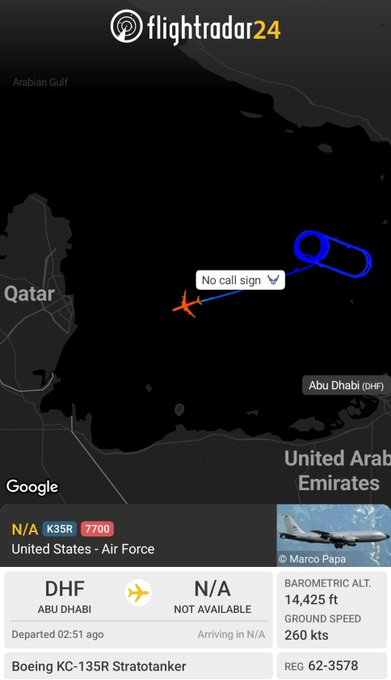
The plane’s transponders were lost before it reached Qatar.
There is a possibility that the plane crashed into the water before reaching Qatar. More information has not yet been released.
Trump: Iran knows what to do to avoid “breaking” the ceasefire
For his part, US President Donald Trump said that Iran knows what actions to avoid in order not to violate the ceasefire. “They know what to do and what not to do,” the US president said.
In this way he responded to a question about what actions by Iran would be considered by the US as a violation of the ceasefire. According to the White House, Iranian military forces are using high-speed boats armed with small-caliber weapons, which he called “pea shooters”, in the Strait of Hormuz. Trump added that Iran no longer has ships and its fleet now consists only of these small boats.
Hegseth: Iran has not violated ceasefire
The United States believes that the ceasefire with Iran is being respected despite the US military operation in the Strait of Hormuz, US Secretary of Defense Pete Hegseth stressed in a briefing with reporters.
“No, the ceasefire is not over,” he said. “This is, ultimately, a separate, different project,” Hegseth claimed, referring to the operation in the Strait of Hormuz. Ultimately, the president [of the United States, Donald Trump] will make the decision if there is an escalation to the point of violating the ceasefire, and Iran knows that. “However, we would of course urge Iran to be cautious with its actions, to keep them below the threshold [of violating the ceasefire],” the Pentagon chief noted.
“At the moment, the ceasefire is certainly being observed. But we will be monitoring developments very closely,” Hegseth stressed.
Trump announced on May 3 that the United States would launch the naval blockade operation “Project Freedom” in the Strait of Hormuz.
According to the president, this will focus on ensuring the safe passage of ships through the strait. The American leader threatened to respond with force “if this humanitarian process is subjected to any interference.”
Meanwhile, Ebrahim Azizi, head of the National Security Committee of the Iranian parliament (Majlis), warned that Tehran would consider any US interference in navigation in the Strait of Hormuz as a violation of the ceasefire.
Hormuz ‘dead’ after Iran attacks Fujairah – 135 tankers stuck in the strait
In total, hundreds of ships are now gathering near Dubai to avoid the expansion of Iran’s zone of control around the Strait of Hormuz.
Daily transits through the strait have almost completely dropped, from around 135 ships a day before the conflict began.
The new Iranian zone of control extends south along the coast of the United Arab Emirates to Umm al-Quwain, with Dubai temporarily remaining outside it.
As part of the escalation, an ADNOC supertanker was attacked by drones in the strait, while for the first time a South Korean-flagged ship was also targeted.
Oil shipping markets are in complete chaos, with no cargo moving and no one knows when normality will be restored to the transits.
The situation highlights the tension and uncertainty prevailing in this critical sea route, testing the international shipping community and energy markets.
Project Freedom Failed – Iran’s Total Control of Hormuz
According to confirmed data from international maritime analysis centers, the Strait of Hormuz remains fully under Iranian control, while the US Project “Freedom” (a euphemism for Trump’s naval blockade) has failed.
Despite the US Navy’s announcement yesterday of the creation of a new safe passage for ships crossing the Strait, satellite tracking data shows that no ships have used this route. The information about the alleged passage of the Maersk ship has not yet been officially confirmed.
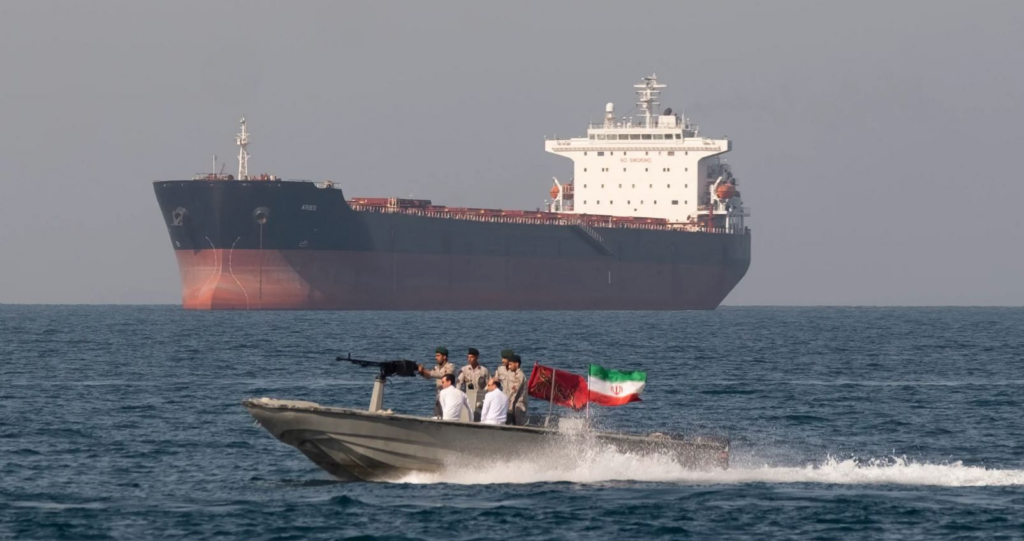
The HFI Research Institute, which analyzes oil and gas markets, said that no ship is even attempting to consider the possibility of passing through the Strait of Hormuz, in response to the US moves.
Furthermore, according to shipping monitoring data, in the last 24 hours, when according to US statements the operation to “open” the strait began, at least three ships associated with Iran – the “Darya”, “NOOH GAS” and “XAVIA” – successfully passed through the Strait of Hormuz.
The situation demonstrates the failure of the US effort to ensure freedom of navigation in this critical sea route, while the Iranian presence remains crucial for the security and control of the region.