The debate should now be opened in the EU and beyond, on the limits and identity of European integration. The situation in the Middle East is further testing the limits of endurance of governments and citizens in the EU, amid US threats to withdraw from NATO, the simultaneous wear and tear from the ongoing war in Ukraine and the increasing fears in Europe about the Russian threat from the East.
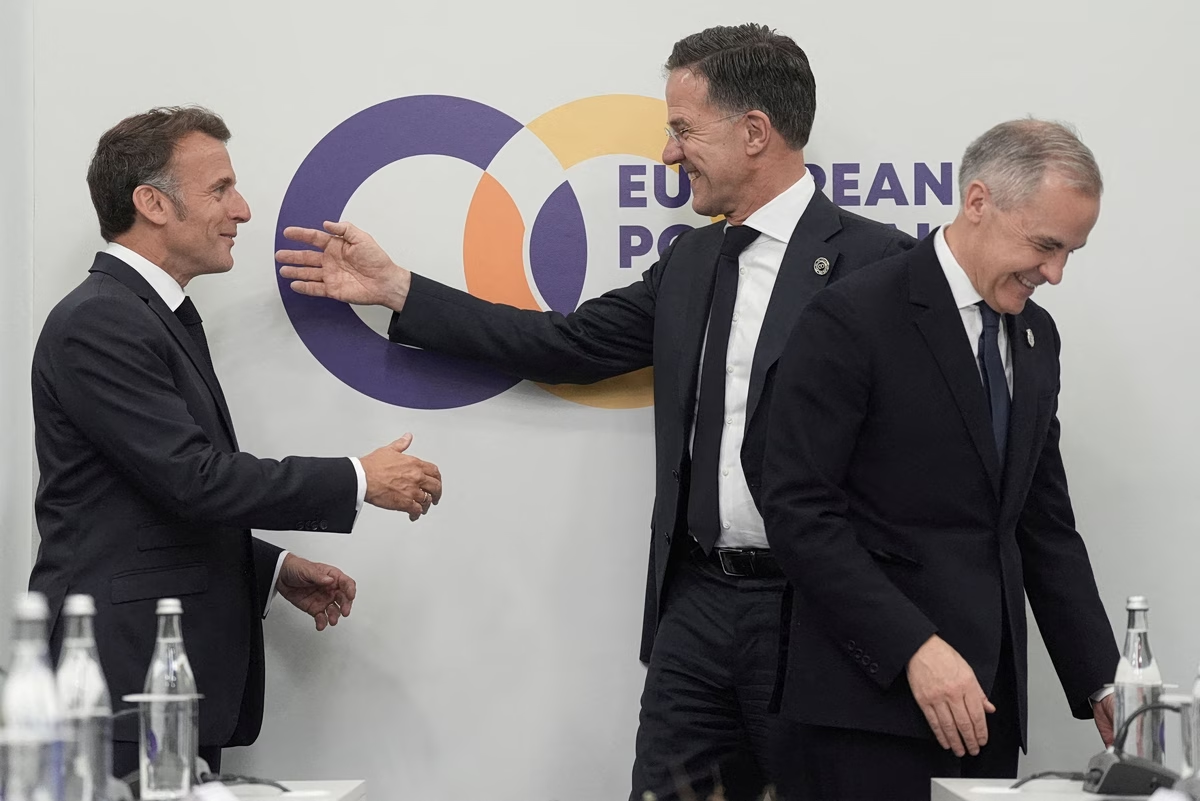
“We do not believe that we are doomed to submit to a more transactional, isolated and brutal world,” Canadian Prime Minister Mark Carney said on Monday at the 8th summit of the European Political Community, in Yerevan, Armenia.
As the first non-European leader invited to the forum – which was created in 2022 with the aim of bringing the EU closer to other European states – he implied that the era of American hegemony was coming to an end, expressing an “unwavering” belief: “The international order will be rebuilt, but by Europe.”
At the same session, with German Chancellor Friedrich Merz conspicuously absent, Ukraine insisted on its rapid accession to the EU and Brexit-stricken Britain on strengthening relations with Brussels.
Canada, “the most European of non-European countries”
In a break with Trump, with rising and falling tensions, the Canadian prime minister has already made history with his speech this year in Davos, calling on “middle powers” to act together in a world torn apart by the post-war world order (for more analysis on this issue please read the article titled “PM Mark Carney: Excellent “standing ovation” in Davos about what is happening in the world“).
Marking his unprecedented presence at the summit of the European Political Community, with the central slogan “Building the Future: Unity and Stability in Europe”, Mark Carney described Canada – one of the 12 founding members of NATO – as the “most European of non-European countries”. He stressed that his goal is to deepen his North American country’s relationship with Europe.
It is already the first and only country outside the European Union to fully participate in the European defense “superfund” SAFE, amounting to 150 billion euros.
And the majority of its residents consider the EU to be Canada’s most important partner over the next 3-5 years.
In the same poll by the leading Canadian polling company Abacus Data a year ago, 46% even expressed “strong or moderate support” for Canada’s accession to the EU, compared to 29% who were “strongly or somewhat opposed”. 25% were not sure about such an option, which remains theoretical.
According to Article 49 of the EU Treaty on enlargement, an application for membership can be submitted by “any European country that respects the principles of liberty, democracy, respect for human rights and fundamental freedoms, and the rule of law”.
However, the concept of a “European state” is not strictly defined legally and the final decision is political, as it lies with the EU institutions, namely the European Council.
The discussion on extending qualified majority voting to sensitive areas such as foreign and security policy has already been opened, at the initiative of the President of the European Commission, Ursula von der Leyen.
Expansion to the North?
While Canada’s accession to the EU remains a distant theoretical scenario, geopolitical uncertainty and the US’s ally hostility seem to be pushing more and more European countries towards the European project. Iceland is a tangible example.
A founding member of NATO, without its own standing army and relying mainly on a bilateral defense agreement with the United States for its security, the island country in Northern Europe, in the icy North Atlantic, has reconsidered its position amid Trump’s threats and is moving forward with a referendum next August to restart accession negotiations with the EU.
Having submitted a request for membership in 2009, following its economic crisis, Iceland suspended the process in 2015, maintaining access to the EU’s single market through the European Economic Area (EEA).
Now, the reasons for the attempted return are not economic, but geopolitical. Just last March, it signed a historic security and defense agreement with the EU.
“Iceland has been a valued partner of the European Union for a long time, as well as a trusted ally in the North Atlantic. Also, what is important these days is that it is a really strong supporter of the rules-based international order,” European Union foreign policy chief Kaja Kallas pointedly emphasized at the signing.
The referendum in Iceland is meanwhile being closely watched by Norway, a member of NATO, the EEA and the Schengen area, but not the EU.
It has twice rejected its membership in referenda. However, Trump’s reckless foreign policy and the war in Ukraine have brought the issue back into the public debate.
According to Norwegian Foreign Minister Espen Barth Aida, “we are fully aware that the difference between EU membership and EEA participation is growing,” as “we are increasingly outside everything we would like to be inside.”
Europe between ambitions and dilemmas
With 27 member states today, after the United Kingdom’s exit with Brexit, the history of the EU (and previously the EEC) already counts seven consecutive enlargements, with the largest occurring in 2004, with ten new members.
Candidate member states must meet political, economic, and legal conditions (the EU acquis).
Today, there are officially nine, mainly from the Western Balkans – which have been waiting for years – while also including Turkey (although negotiations with the latter are frozen) and war-torn Ukraine, with its president, Volodymyr Zelensky, declaring at the 8th session of the European Political Community that his country is “technically fully ready”.
Corruption remains one of the major “thorns” for Kiev, however, and Brussels has ruled out any “preferential treatment.”
With enlargement now seen as a tool for promoting peace, democracy, and security, the question of balance between adding new members and internal reform of the EU, within which disagreements already abound, is increasingly being raised.